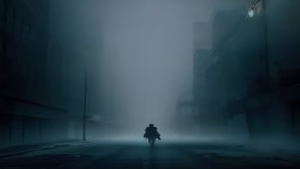
Shinjuku's torrential rain lashed the asphalt with relentless fury, transforming Tokyo's nocturnal arteries into a liquid mirror where neon signs bled crimson and cyan hues upon the passersby. Aiko held her breath, clutching her digital recorder as she slipped between the concrete pillars of an abandoned harbor warehouse. Her journalistic instinct—that mental scalpel which had so often allowed her to dissect the darkest lies of Japanese high society—was whispering an urgent warning this time: she had to flee. But morbid fascination won the day.
I. The Underground Auction in the Shadows
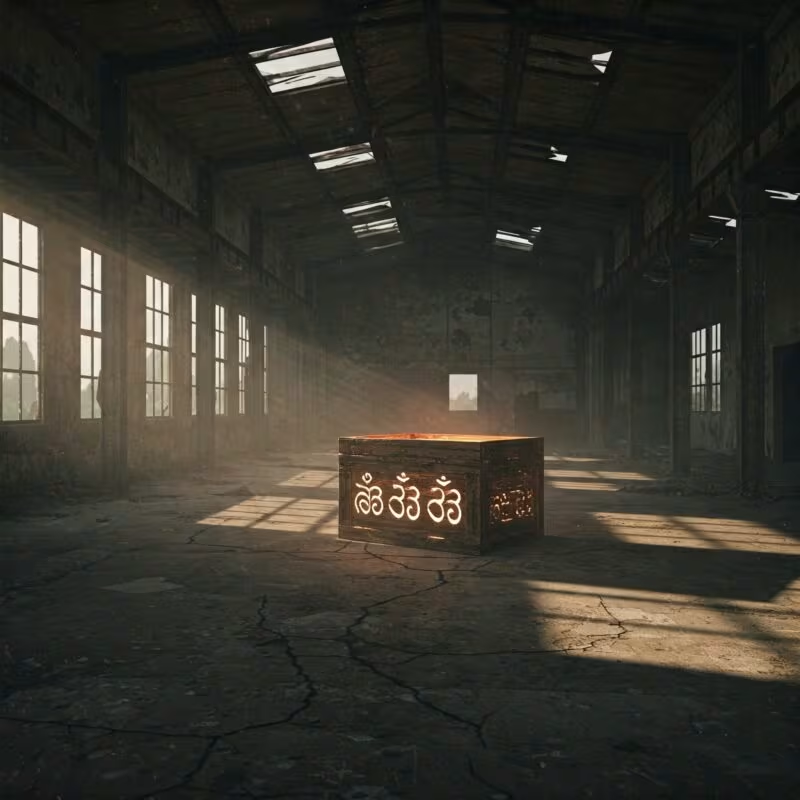
At the center of the industrial hangar, a circle of figures wrapped in heavy black coats kept a sepulchral silence, broken only by the monotonous tapping of leaks filtering through the collapsed roof. Without warning, the overhead spotlight flickered, revealing the figure of Mr. Kuroda. With a haggard face and a gaze that seemed to absorb the venue's meager light, Kuroda raised a small box carved from sakura wood with trembling hands. The wood grain mimicked an organic, almost vascular pattern that pulsed imperceptibly beneath the rust's reflection. "This box is not sold… it is surrendered," Kuroda uttered, his voice scraping like gravel across glass. "Only those willing to pay the ultimate price may possess what it holds."
True horror does not lie in what lurks in the dark, but in the guilt we carry that ultimately decides to devour us from within.
Aiko felt a biting cold descend her spine, an ancient ice that temporarily paralyzed her motor functions. There were no security cameras, no live streams; this was a rite of pure pain transfer. When Kuroda lifted the lid barely a centimeter, a stench of damp earth and ash flooded the room, accompanied by the murmur of hundreds of overlapping voices speaking in an archaic dialect. Aiko pressed her camera's shutter, capturing the fateful instant without knowing she had just opened a dimensional door to her own ghosts.

II. The Violated Refuge and the Voice of the Past
With her heart hammering against her ribs like a hydraulic piston, Aiko managed to escape the docks and take refuge in the concrete sanctuary of her apartment in the Minato district. She slid the three security deadbolts, exhaling a sigh of relief that was abruptly snuffed out when she switched on the living room light. Resting upon the coffee table was the sakura-wood box. The same texture, the same perfume of dead cherry blossoms and rot. No one had entered; the windows were sealed. "You know your brother died because of you…" whispered a cavernous, three-dimensional voice that seemed to originate directly from the walls of her skull.
Aiko's knees buckled under the weight of the revelation. The highway accident, the fire, the impossible choice she made that winter night in Hokkaido to save herself while leaving her younger brother behind: all the buried pain of a decade emerged with unprecedented violence. Over the following nights, insomnia became her executioner. The box did not need to be opened to torture her; its mere presence in the room warped her perception of reality, blurring the line between wakefulness and hallucinatory dementia. The walls of her home seemed to sweat a blackish damp that smelled of chloroform and buried memories.
III. The Macabre Resolution in the Mirror
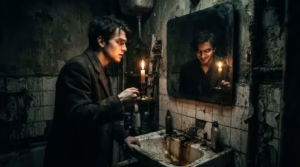
At the apex of her mental exhaustion, driven by a hypnotic summons that utterly annulled her will, Aiko reached her fingers toward the latch of the cursed box. As she lifted the lid completely, there were no magical flashes nor monsters mythological spectacles; instead, threads of a viscous, filamentous blackness welled from within, rising like blind serpents. Those tentacles coiled with surgical precision around her throat, choking off any attempt at a scream. Aiko rushed toward the glassed-in balcony seeking aid, but upon catching her reflection in the rain-lashed windowpane, she understood the true nature of the trap. Her human face had vanished, replaced by a grimace of sadistic, unnatural glee, while her actual body hung limp, strangled by the materialization of her own guilt. Outside, the Tokyo night pursued its indifferent course, swallowing the final, choked whisper of a journalist who should never have peered beyond the veil.
📜Investigation • Frequently Asked Questions
Documentary Archive and Analysis of the Occult • Relatando.com
What elements of traditional Japanese folklore and contemporary urban horror converge in the symbolism of the sakura wood box described in the narrative?
The sakura wood box fuses the ephemeral, melancholic aesthetic of cherry blossoms with Japanese folklore archetypes concerning enchanted objects, or 'Tsukumogami'. In modern Tokyo urban fiction, these artifacts function as psychological gateways that exploit guilt and repressed trauma, reflecting the dread atavistic dread of karmic retribution and buried family secrets.
In what manner does the character of Aiko, an investigative journalist, embody the duality between Western rationalism and the inevitability of Eastern mysticism?
Aiko embodies the tragic transition from the rational, scientific observer to the adept consumed by the occult. Infiltrating an underground auction driven by professional skepticism, she underestimates the liminal forces of Tokyo. Her descent into madness underscores how investigative journalism in these narratives turns into an involuntary ritual of spiritual exposure.
What are the signs or anomalies that precede the manifestation of such cursed artifacts within urban environments?
Testimonies and urban legends suggest that the apparition of Cursed Objects is typically preceded by drastic shifts in the local climate, heavy scents of decaying organic matter (such as aged wood and damp earth), and the perception of familiar voices echoing secrets the individual believed they had entirely forgotten.
Is there any documented psychological or anthropological explanation behind the guilt mirrored in this type of tales of terror?
From the perspective of depth psychology and Japanese cultural anthropology, unprocessed guilt acts as an ego-disintegrating agent. Tales of objects that devour the psyche symbolize the imperative need to confront repressed traumas before the mind constructs a delusional, self-destructive reality of its own.
Do not extinguish the light yet...
If you have had the courage to make it this far, we have other dossiers that will test the limits of your sanity.

Terms and Figures of this Tale
To delve deeper into the legends, creatures, and dark concepts that inspire this account, consult their entries in our dictionary of the uncanny:

Tu correo no se publica ni se comparte con terceros: solo sirve para notificar la respuesta.