The left rubber boot sank into the moss with a wet squelch, like bone creaking under a drunkard's heel. Kaito halted mid-step. The weight of the pack — loaded with dry rations, spare batteries, and the roll of perimeter tape — bowed his vertebrae. For four hours he had been swallowing the thick air of the Jukai, air that stank of rotting resin, graveyard soil, and the black mold that grows in corners where sunlight has never touched a leaf. To his left, a strip of yellow plastic — filthy, shredded by brambles, tied in double knots to the gnarled bark of a lava pine — hung limp. It did not move. There was no wind in the sea of trees. The silence here was not an absence of sound; it was a physical presence, a dense substance that plugged the ears and forced him to hear his own heartbeat like a mallet striking the skull.
I. The Labyrinth of Black Roots
The ground of Mount Fuji is not soft earth. It is a labyrinth of volcanic basalt, a terrain of jagged rocks cloaked in green fuzz that hides treacherous fissures capable of fracturing an ankle in a second. Kaito adjusted the strap of the headlamp on his forehead and looked at the yellow plastic. The tape was the umbilical cord the rangers strung so as not to lose themselves in the green vastness, but it was also the trail of the doomed. Those who came seeking the end of the path left their mark on the polyethylene before venturing into the thicket where compasses go mad.
He pulled the device from his jacket pocket. The copper needle did not point to magnetic north; it spun in spasmodic circles, like a dying insect trapped at the bottom of a glass. The iron hidden in Fuji's volcanic rock devoured human orientation. Kaito tasted bile at the back of his tongue. His instructor, a weathered veteran named Tanaka, had warned him the night before as they drank lukewarm tea in the watch station:

If the tape begins to tremble on its own and the pines seem to shift position when you blink, do not look down. Retrace your steps. If you look, they have already found you.
Kaito let out a dry laugh, a pathetic sound that immediately drowned among the titanic trunks. He kept walking. The yellow tape snaked around the firs with deliberate purpose, tracing impossible curves that defied any logic of rescue. At times it descended into dark hollows where the leaf litter smelled of decomposing flesh; at others it climbed over mounds of black volcanic stone that resembled scabs of dried blood. Every hundred meters, the plastic showed tighter knots, as if whoever had placed it had fingers numb or pressurized by panic.
II. The Shop in the Basalt
At nightfall, the ashen light outside faded, swallowed by the dense foliage. The darkness in the Jukai does not descend from the sky; it sprouts from the ground, climbing the trunks like an invisible vine. Kaito switched on the white beam of his flashlight. The cone of light cut through the blackness, revealing wisps of moisture suspended in the air that seemed like deformed faces vanishing just before they could be brought into focus.
The yellow tape ended abruptly. There were no more knots in the trees. Before him, in the middle of a circular clearing ringed by gnarled roots that called to mind clenched human fingers, stood a blue canvas tent. It was torn from top to bottom, as though a dull blade had sliced the fabric from within. An empty backpack lay overturned at the entrance, its contents—sodden notebooks, a rusted thermos, a pair of sneakers furred with mold—strewn across the basalt.
Kaito held his breath. His fingers trembled so violently that his thumb struck the body of the flashlight with a metallic rattle. No one answered his shouts. He had called over the radio three times and gotten only shrieking static, the sound of grease frying in a pan. He took a step toward the tent. The smell shifted all at once. It was no longer dampness or resin; it was the cloying, heavy stench of burnt hair mingled with rancid animal fat.
III. The Deception of the Forest
He blinked. When he opened his eyes, the pine that had stood less than a meter away was no longer there. It had shifted a few centimeters to the left, partially blocking the way back. Kaito felt an icy chill at the nape of his neck, a thick sweat crawling down his spine without asking permission. He blinked hard again, rubbing his eyelids. The surrounding trees seemed to breathe; their bark contracted and expanded with a slow, synchronous rhythm, like the ribcage of some gigantic animal hibernating beneath the stone.
He looked down at the floor of the tent. The compass he had let fall onto the rock was spinning with a demented velocity, whistling a sharp, metallic hum. At the center of the tent, half-buried beneath a heap of black leaves, a bundle of yellow ribbons tied one to another formed a knotted figure, a blind knot the thickness of a human torso that pulsed with an imperceptible vibration.
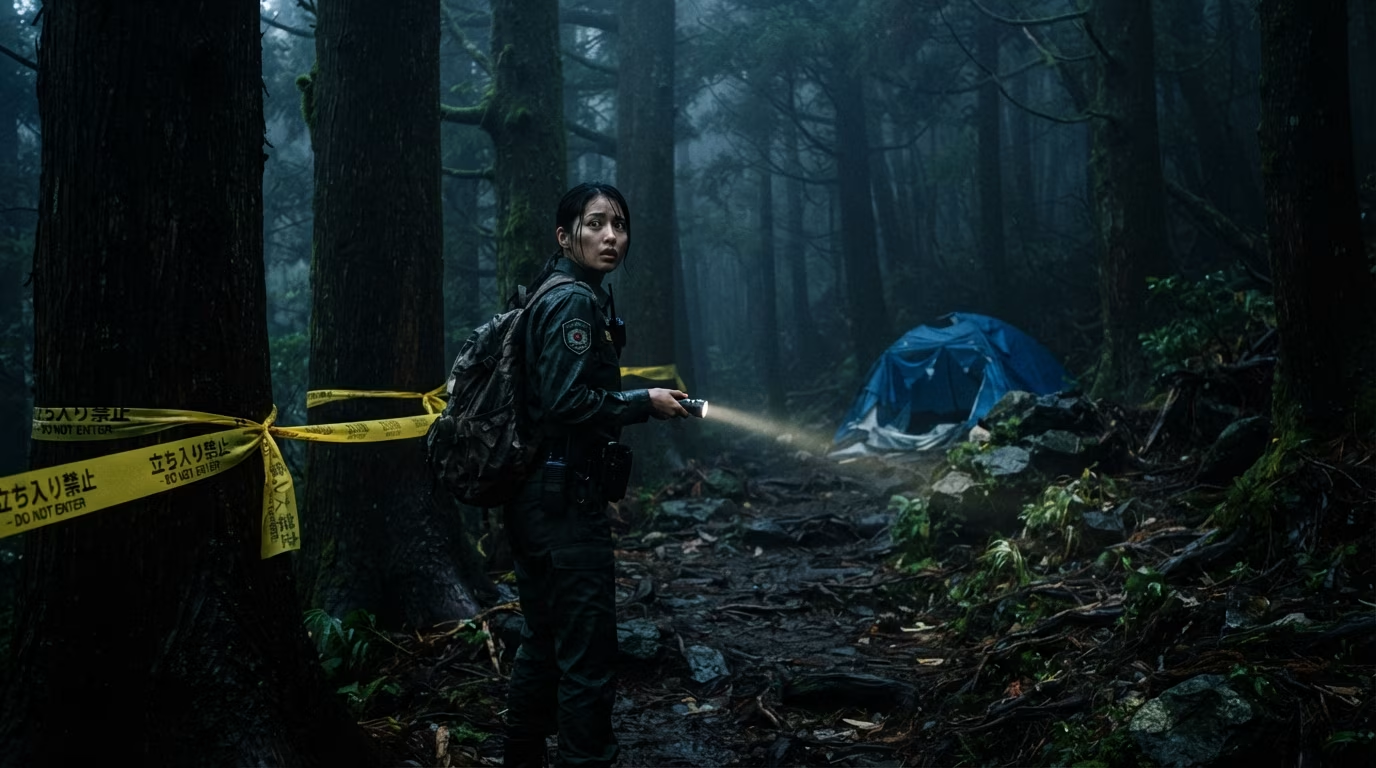
Kaito wanted to run, but his boots had fused with the moss. His legs weighed tons. When he turned his head toward the path he had come by, he discovered that the row of trees no longer bore yellow marks. All the ribbons had vanished. In their place, thousands of strands of long, matted black human hair hung from the branches like funeral garlands, swayed by a nonexistent wind that blew directly into his ears, whispering his name in the exact voice of his own mother.
📜Investigation • Frequently Asked Questions
Documentary Archive and Analysis of the Occult • Relatando.com
On what myth or dread reality is this tale based?
It draws inspiration from the Aokigahara forest in Japan, notorious for its dense canopy, the magnetic pull of its volcanic soil, and the lingering human tragedy that haunts it.
Are there documented real cases similar to this story?
Rangers use plastic ribbons to mark rescue routes and keep from being lost forever in the intricate topography of the sea of trees.
What does the ending of the story mean?
It represents the protagonist's mental collapse, trapped in a psychological loop where the forest absorbs his identity and his own fears.
Do not extinguish the light yet...
If you have had the courage to make it this far, we have other dossiers that will test the limits of your sanity.

Terms and Figures of this Tale
To delve deeper into the legends, creatures, and dark concepts that inspire this account, consult their entries in our dictionary of the uncanny:

Tu correo no se publica ni se comparte con terceros: solo sirve para notificar la respuesta.