The mud clung to his soles with the insistence of a corpse that refuses to stay buried. Mateo spat into the gravel, trying to rid himself of the metallic taste the fog left on his palate—dense, cloying, cold as a hospital sheet. The path linking the two valleys appeared on no modern map; it was little more than a scar of rubble and slate cut between centuries-old oaks, closed to traffic for decades by landslides no one ever bothered to clear. His flashlight flickered twice. A high-pitched hum, almost imperceptible, rose from the filament before it died with a dry click. He hung suspended in a total darkness so compact it ached behind the eyes.
I. The Woolen Compass
The silence that followed the death of the lightbulb was no peaceful silence; it pressed down on his shoulders like lead. Mateo tucked the useless metal cylinder into the pocket of his sheepskin jacket and drew a deep breath, trying to steady the involuntary tremor in his jaw. The night reeked of rotting leaf litter, of vermin urine, and of that penetrating damp that seeps into the bones long before the rain truly begins to fall. He took a blind step. Then another.
It was on the fourth step that he heard the twin footfall.

To his left, among the bramble thickets lining the ditch, something advanced at the same pace. It was not the erratic crackle of a fox nor the clumsy stampede of a wild boar. It was a measured cadence, slow and heavy. Four points of contact. Clack, clack, clack on the loose limestone. Mateo stopped dead, holding his breath. The sound ceased at the exact same instant, without dragging a single dry leaf more than it should.
"It's an abandoned herding dog. Nothing more than that. A stray mastiff from some farmstead up above."
The reasoning sounded ridiculous even inside his own skull, but Mateo clung to it tooth and nail. Human reason is a cowardly animal that prefers a pious lie to admitting the abyss. He turned his neck slowly. In the milky half-light the moon let filter through the storm cloud, he made out a monumental bulk. It was no ordinary beast. It had the bearing of a young calf, covered in a thick, dense, utterly white pelt, almost phosphorescent amid the vegetal blackness. Its eyes were two wells of still water, devoid of hostility.
The animal did not growl. On the contrary: when Mateo resumed his march with stiffened legs, the white bulk positioned itself barely two spans from his side. It emanated an anomalous heat, a dense vapor that smelled of warm milk, clean wool, and incense burned in a closed chapel. That thermal blanket mitigated the stinging cold on the back of Mateo's neck. For a full kilometer, the traveler allowed himself to be lulled by this spectral escort. He felt safe, absurdly protected, as if the creature were weaving an invisible bell around him against the wild elements of the mountain range.
II. The Fracture of the Thermometer
The illusion of shelter shattered upon reaching the Fraile pass, where the trees twisted like arthritic hands over the living rock. It happened in a fraction of a second: the temperature plummeted. It was no gradual descent; it was as if someone had flung open the door of an industrial cold room. Mateo's breath turned thick, almost solid, and the hairs on his forearms bristled with an electric current that ran down his spinal cord.
The white dog stopped. Its forelegs dug into the mud and a sharp whine, pitiful and human in its desperation, rose from its throat. The animal's back bristled into a rigid ridge. It was no longer looking at the path: it was looking backward, toward the shadowy gorge they had just crossed.
Then came the stench.
It was not the vegetable rot of the forest. It smelled of burnt horn, of carrion reheated under the sun inside a blind well, and of an unmistakable chemical trail: sulfur and damp ash. The air turned unbreathable, thick as black pitch. Mateo felt a violent nausea seizing the mouth of his stomach. He tried to swallow saliva, but his throat had become a dry rasp.
"Let's get out of here. For all you hold dear, run."
But his legs would not respond. They were welded to the earth by a primal dread that annihilates any flicker of reason. From the bend in the path, wrapped in tatters of mist that dissolved at his approach as if the very dampness fled his presence, the second measure appeared. This time there was no stealth at all. One could hear the dragging of enormous claws striking sparks from the slate and a dull, rhythmic clinking, like rusted iron links beating against stone.
III. The Tarred Claw
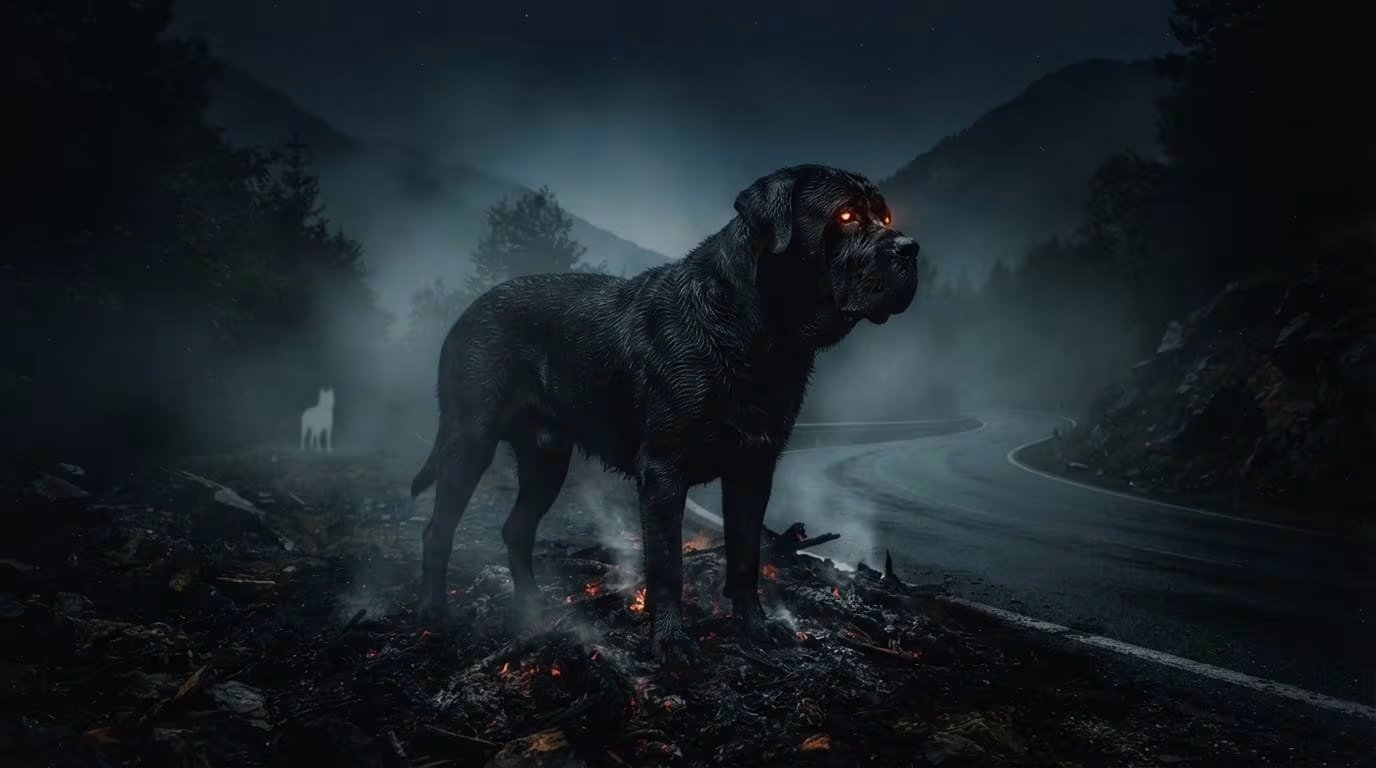
It emerged from the mist like a nightmare sculpted in soot. If the first dog had been large, this one doubled its bone structure in a deformed frame, broad-chested, with gnarled muscles trembling beneath a dry, mangy hide. It had no coat, strictly speaking, but a blackened crust that seemed to smolder with an inner fire. And in its face, where the eyes should have been, burned two coals of lit charcoal, two purulent embers that never blinked and that scrutinized Mateo's chest directly, stripping bare his ribcage until they fixed on the chaotic beat of his heart.
The black mastiff drooled a dense, dark liquid that hissed as it fell on the dead leaves, burning them instantly. It let out a cavernous wheeze, a guttural sound that vibrated in the traveler's dental fillings. Mateo understood with an atrocious lucidity that the thing sought neither his flesh nor his blood: it coveted the spark that kept him conscious, the intangible marrow of his being.
The white mastiff interposed itself with a silent leap. It did not bark; it hurled itself at the shadow with fiery eyes with suicidal ferocity. The clash of both masses rang like the collapse of a masonry wall. Mateo fell backward onto the frozen mud, dragging himself along with his heels while the whirlwind of jaws and claws unfolded less than two meters from his body.
The fight was an abominable paradox. The white dog fought without a sound, distilling a pale luminescence that waned with every bite it took. The black beast, on the other hand, howled with a thousand human voices trapped in an oven; every snap it delivered tore not only its rival's skin, but the very fabric of the night, leaving gusts of suffocating heat that scorched Mateo's cheeks. A swipe from the monster black one grazed the traveler's shoulder; it did not tear the fabric of his jacket, but Mateo felt a searing polar cold deep inside his bone, as though an irreplaceable fragment of his memory had been excised.
«It's eating him... and then it will come for me.»
The white dog fell on its side onto the stony ground, drenched in a clear fluid that evaporated on contact with the earth. Its breathing was a broken bellows. The pitch-black mass placed a massive paw on the neck of the vanquished and slowly turned its skull toward Mateo. The embers in its eye sockets dilated. It took a step toward the prostrate man. The smell of sulfur clouded Mateo's senses; the air escaped his lungs in an agonized rattle as the steaming jaw opened wide, revealing rows of blackened fangs dripping ice.
Mateo closed his eyes and clenched his jaws, awaiting the final blow that would shatter his soul.
A distant bell toll. The brazen peal of the neighboring village church, slicing through the fog at five in the morning with its call to dawn.
The sound was like a whip crack. There was a thunderous hiss, similar to that of a bonfire smothered by a bucket of stagnant water. When Mateo dared to open his eyelids, the black mastiff was gone. Only a circle of scorched earth remained, steaming and sterile, where the mud had petrified into a vitreous crust.
IV. The Hollow Basin
Beside him, the white dog lay motionless. Its coat no longer gleamed; it was ashen, grayish, losing substance by the moment like dirty snow under rain. Mateo, dragging himself on elbows and knees, reached out a trembling hand and touched the animal's back. He felt neither flesh nor fur: he felt the icy texture of a salt statue on the verge of crumbling. The animal opened one milky eyelid, gave him a last look of infinite exhaustion, and came apart between the man's fingers into a fine grit that the dawn wind scattered down the ravine.
Mateo reached the village at midmorning. He spoke to no one. He did not wipe the caked mud from his boots, nor did he go to the doctor to have his numb shoulder examined. He shut himself away completely in the inn's room, with the blinds drawn and the stove turned up full blast.
He has not set foot on the roads since. When night falls and silence takes possession of the house, Mateo sits in the gloom before the mirror and studies his own chest. He knows his body is still whole, but he also knows that the black dog it departed chewing on something of his. There is a frozen hollow behind his ribs that the hearth fire cannot warm, and he fears that one of these nights, leaning toward the sealed window, he will not see the fog, but two red embers waiting patiently at the end of the street.
📜Investigation • Frequently Asked Questions
Documentary Archive and Analysis of the Occult • Relatando.com
What does the chromatic and sensory duality introduced by the apparition of the canid symbolize within the oral tradition of the mountain paths?
In Iberian and Latin American folklore, the apparition of a phantasmagoric quadruped typically embodies the liminal figure of the psychopomp or guardian of travelers. The initial transition of the stark white, warm coat—associated with protection, warm milk, and incense—operates as a psychological and supernatural ruse. This false sense of security prepares the traveler for the imminent fracture of sanity, subverting the traditional motif of the benevolent protector to plunge into the dark realms of the myth warning.
How does the sensory atmosphere—the mud, the fog, and the scent of rotting leaves—function in building the psychological suspense of the tale?
Carlos Nieto employs a rigorous tactile and olfactory mimesis to disorient the reader from the very first paragraph. The 'metallic taste' on the palate and the suffocating darkness are not mere decorative devices, but mechanisms that annul sight to sharpen auditory perception. The 'clac, clac, clac' against the limestone acts as an implacable metronome marking the countdown toward an encounter with the numinous, reflecting the protagonist's absolute isolation on a route erased from modern maps.
In what way does the text converse with the cryptozoology files and legends popular accounts regarding the Black and White Cadejo?
Although the title anticipates the presence of the dreaded Black Cadejo—usually linked to ruin, vice, and sudden death—the fragment first introduces an imposing albino manifestation that emanates heat and mystical protection. This inversion or luminous prologue enriches the corpus of Relatando.com stories, suggesting that both creatures are part of a single dual entity that weighs the morality, the dread and the destiny ultimate end of the stray traveler before the inevitable fracture announced at the close of the text.
What role does the geographical setting of the abandoned path play as a silent actant within the narrative structure?
The 'scar of rubble and open slate between centuries-old oaks' transcends its role as mere setting to become a timeless, liminal space, severed from civilization and contemporary cartography. This geographic isolation acts as a metaphysical catalyst that suspends natural law, allowing the protagonist to cross the border between the everyday and the inexplicable. The impassable terrain ultimately mirrors Mateo's state of psychological vulnerability before his imminent fate.
Do not extinguish the light yet...
If you have had the courage to make it this far, we have other dossiers that will test the limits of your sanity.

Terms and Figures of this Tale
To delve deeper into the legends, creatures, and dark concepts that inspire this account, consult their entries in our dictionary of the uncanny:

Tu correo no se publica ni se comparte con terceros: solo sirve para notificar la respuesta.