Chapter I: The Cathedral of Cold and Shadows
There is a peculiar silence that belongs only to the high Aragonese peaks when winter decides to bury the world. It is not an empty silence; it is a dense, abrasive presence, heavy with memories drowned out by the bitter cierzo wind. There, erected among the mountains like the skeleton of another century’s splendor, the Canfranc International Railway Station rose like a colossal monument to oblivion. Its iron and glass vaults, once bathed in the pride of two nations, now gathered nothing but snow and woodworm.
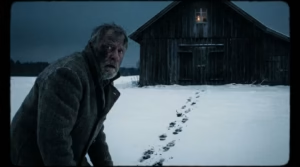
Esteban knew this well. For over forty years, his family had guarded the secrets of that catatonic giant. At sixty-seven, his joints ravaged by the Pyrenean damp and his skin tanned like the hide of ancient leather trunks, Esteban refused to abandon his post in the crossing-keeper’s hut. The central administration had long since forgotten to pay his wages, but the old man did not look after the facilities for money. He tended the station because of a promise made to his father in 1943—the year train number 404 passed through the Somport tunnel, never to return to the sunlight.
That December night, the blizzard howled with an almost human fury. The outdoor mercury thermometer had frozen, hovering at fourteen degrees below zero. Inside the hut, the cast-iron stove emitted a copper-colored glow, insufficient to dissipate the vapor rising from Esteban’s breath. The crystal radio let out a muffled crackle before dying out completely. The old man sighed, adjusted the thick wool blanket over his shoulders, and lifted the brass oil lamp.

It was then that he felt it. Not a sound, but a primal tremor born from the bowels of the earth, ascending through the stone floor to the soles of his boots. The dead tracks—those needles of steel devoured by rust and entombed under half a meter of virgin snow—were vibrating.
Chapter II: The Resonance of Burnt Snow
Esteban pressed his face against the fogged windowpane. Outside, the blackness was absolute, violated only by the white dart of the blizzard. And yet, in the distance of the Somport tunnel—that stone throat connecting Spain to France through the mountain’s dark interior—a light not born of electricity began to flicker. It was a jaundiced, withered luminescence, akin to the glow of a candle lit inside a dried-out skull.
“Impossible”, Esteban murmured, feeling a knot of ice tighten in his stomach. That section of the line had been dismantled decades ago. The rails were shattered, twisted by landslides and choked by rotten ties.
Yet, the sound became unmistakable. A rhythmic, heavy, overwhelming chug-chug. The purulent shriek of metal against metal scraped at the frequencies of madness. A thick, purple vapor, reeking abominably of sulfur, burnt grease, and sea rot, billowed from the tunnel's maw. The snow did not merely melt upon contact with the haze; it boiled and bubbled, transmuting into a black sludge that stank of decomposition.
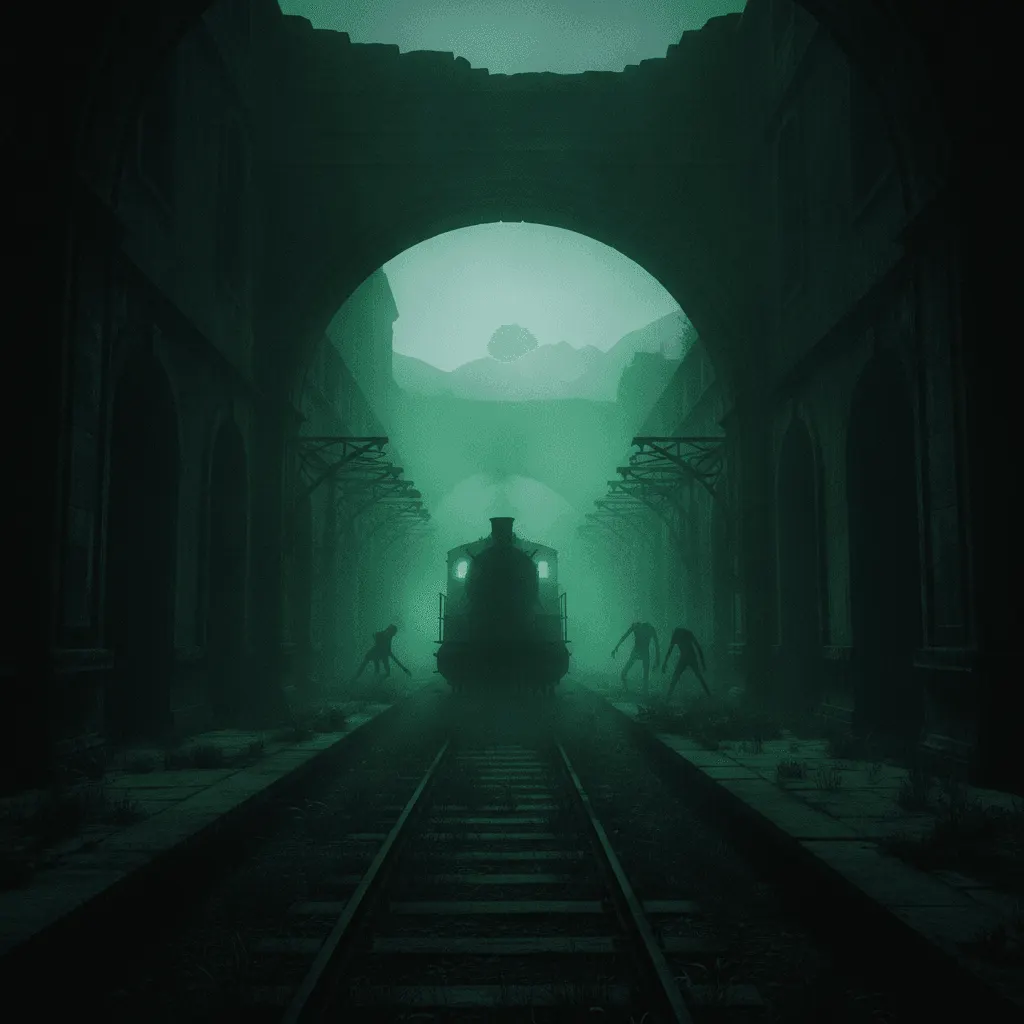
With the oil lamp trembling in his right hand, the old man stepped onto the exterior platform. The frozen wind sliced his face like a razor blade, but panic froze his lungs faster than the gale. Cutting through the purple fog, a colossal silhouette slid along the abandoned track. The steam locomotive—a monolith of black iron and blackened Prussian-made rivets—advanced, exhaling not living steam from its valves, but a dense mist that seemed to drink the light.
And behind it, coupled in a macabre convoy, came the wooden carriages.
Chapter III: The Faceless Passengers
They were freight and passenger cars from the last century, built of teak and dark oak. The wood was fissured, weeping a viscous resin that resembled putrefied blood. Through the guillotine windows, their panes veiled in a layer of frost that had crystallized into the shapes of agonized faces, Esteban could make out the figures.
There was no life in that convoy, yet neither was there the peace of the grave. Hundreds of shadows stood upright, pressed tight against one another within the carriages. They wore period attire: World War II military uniforms with insignia erased by mildew, fur coats eaten away by moths, silk dresses reduced to tattered ribbons. None of them moved. None of them breathed. But all of them had their eyes open.
The travelers' eyes lacked pupils or irises. They were sockets filled with a phosphorescent substance that pulsed to the rhythm of the locomotive's labored gasps. As the convoy passed the main platform at Canfranc, the friction of the wheels against the rotting rails emitted a shriek so piercing that Esteban was forced to drop his lantern and clutch his ears in a fury. The glass of the kerosene lamp shattered upon impact with the ground, leaving the man at the sole mercy of the spectral gloom.
The train began to brake. The brake shoes did not screech like ordinary metal; they sounded like the unbroken weeping of a thousand children buried underground. The massive machine halted directly in front of the station’s central building, exhaling one final cloud of purple soot that coated the ground in a fine layer of warm ash.
Esteban, paralyzed by a sickly fascination that dulled the Horror, watched as the door of the second wooden carriage slid slowly along its rusted rails. A guttural groan echoed through the deserted expanse of the station canopy.
Chapter IV: The Ticket to Immensity
From the darkness of the carriage descended a man. He wore the impeccable uniform of a 1940s Canfranc-Paris Express conductor, yet the fabric was stained with broad, black rings, as if the sweat of his body had been squid ink. His face was a smooth surface of taut, grayish skin, where only the mouth—a jagged slit devoid of lips or teeth—stood out like an open wound.
In his left hand he carried a ticket puncher made of rusted bronze; in his right, an oil lantern whose flame glowed with a violet-blue hue.
—You're late, Esteban… —a voice echoed within the old man’s mind. It was no acoustic sound, but a frozen intrusion that scraped the inside of his skull—. Your father paid the fare in forty-three. But the convoy never leaves luggage behind. We were missing the signalman.
The old man tried to retreat, but his boots were fused to the ground. The black ash spewed by the locomotive had solidified around his ankles like a hook of ice. He peered into the open carriage. There, in the damp-choked gloom, he saw wooden crates marked with imperial eagle seals and ingots of a reddish metal that seemed to seep like liquid, and packed between the gold, hundreds of bodies frozen in postures of supplication.
He recognized a face amidst the carriage shadows. An aged face, identical to the one he recalled from his father’s casket decades prior. The corpse smiled at him with the same phosphorescent vacuity as the others.
The Canfranc convoy transported no merchandise between nations. It was a cursed artery binding reality to the forgotten abysses of the mountain, a collector of souls trapped on the threshold of life and extinction, doomed to traverse the infinite tunnel beneath the Pyrenees for all eternity.
The train conductor raised his blue lantern and took two steps toward him. The air around him grew so bitingly cold that the skin on Esteban’s hands began to blacken with instantaneous frostbite. Yet, the physical agony no longer mattered. A horrific peace, sedative as opium, began to seep into the old man’s arteries.
—Board —the voiceless sound whispered—. The night's final service is about to depart. And the tunnel has no end.
The locomotive's whistle tore through the Pyrenean night with a howl of ultimate agony. The snow fell denser, burying Esteban's tracks as he moved with an automaton's gait toward the rotted wooden step. The sliding door latched shut with a dull, hollow thud.
The following day, when the maintenance crews for the new tourist site reached the station after the storm, they found only the empty trackman’s cabin, a stove long cold, and upon the immaculate snow of the abandoned rails, two parallel lines of black ash stretching deep into the inert darkness of the Somport.
📜Investigation • Frequently Asked Questions
Documentary Archive and Analysis of the Occult • Relatando.com
What historical and symbolic weight does the year 1943 hold within the railway folklore of Canfranc?
The year 1943, invoked in the protagonist Esteban's oath, coincides with the height of the Second World War. During this period, the Canfranc International Station operated as a contradictory nexus of espionage, Nazi gold smuggling, and refugee transit. The disappearance of trains and convoys within the Somport tunnel during those tumultuous years feeds the Legend belief that certain cargoes never reached their destiny official destination, remaining trapped within a suspended temporal dimension.
In what ways does the geography of the Aragonese Pyrenees nourish the myth of the 'convoy Phantom'?
The high peaks of the Pyrenees and, in particular, the winter isolation dominated by the bitter *cierzo* wind, have historically functioned as catalysts for legends tales of wandering souls and mechanical apparitions. Geographic isolation not only hindered administrative oversight, but it also bred a psychological microclimate where the silence of iron-and-glass vaults compelled locals to project their grief and the geopolitical secrets of the border onto inexplicable acoustic phenomena, such as the phantom vibration of dead-end tracks.
What does Esteban's figure as a track watchman archetypally represent in the region's folklore?
Esteban embodies the archetype of the 'custodian of the threshold,' a classic figure in Mythology comparative mythology and Pyrenean folklore. At sixty-seven years of age, his body worn down by the damp, his stubborn refusal to abandon the station without pay symbolizes an unyielding loyalty to a blood pact forged with the dead. He is no conventional railway employee, but rather a terrestrial psychopomp guarding the permeable frontier between institutional oblivion and the spectral persistence of historical memory.
Is there a real documentary background behind the literary image of train number 404?
Although Carlos Nieto's narrative introduces elements of fantastic horror, the history of Canfranc is documented with countless logistical anomalies, delayed convoys, and records lost during border crossings in mid-20th-century Europe. The fiction employs the nomenclature of train number 404 as a metaphor for the 'ghost expresses' that transported both precious metals and anonymous exiles, whose documentary traces vanished into the bureaucratic and subterranean labyrinths of the international tunnel.
Do not extinguish the light yet...
If you have had the courage to make it this far, we have other dossiers that will test the limits of your sanity.

Terms and Figures of this Tale
To delve deeper into the legends, creatures, and dark concepts that inspire this account, consult their entries in our dictionary of the uncanny:


Tu correo no se publica ni se comparte con terceros: solo sirve para notificar la respuesta.