Chapter I: The Return of the Voyager
The rain on the Cantabrian coast does not fall; it settles with the tenacity of a wet shroud. Mateo Valdés adjusted the collar of his trench coat as he watched the silhouette of La Casona de los Tres Arcos, perched upon a jagged cliff near Luarca. The building was a monstrous marvel of late 19th-century Indian architecture: mismatched towers, tiles of a cadaverous blue imported from Portugal, and glazed bay windows staring out at the sea like lidless, hollow eyes. Don Melquiades de la Torre had amassed an unnamable fortune in the sugar plantations of Cienfuegos before returning to his native Asturias to erect that monument to hubris.
As a preservation architect, Mateo had been commissioned by the heritage board to evaluate the structure before the estate went to public auction. The heirs had either died under tragic circumstances or dissolved into the distant madness of sanitariums. The house had remained sealed for four decades, breathing in the mold and the salt gale of the northern squalls.
The old groundskeeper, a bent man named Braulio whose hands resembled the roots of dry oak, handed him a heavy ring of wrought-iron keys. His breath smelled of harsh liquor and aged, festering fear.

—Don't linger when the mist sets in, Señor Valdés —the old man murmured, reluctant to cross the threshold of the porch—. This house is not empty. It harbors things made of neither stone nor wood. Don Melquiades brought back something more than sacks of gold and stuffed parrots from overseas. He brought home a debt.
Mateo, a man of science, rule, and square, smiled with professional condescension. He stepped into the foyer. The thick, damp stench, mingled with a rancid reek reminiscent of spoiled animal fat and stale wax, enveloped him at once. The chestnut floorboards groaned beneath his boots like worn bones.
Chapter II: Blind Geometry
For the first three days, Mateo devoted himself to drafting the blueprints of the ground floor and the upper level. He used the plumb line, the measuring tape, and the steel rule. Yet on the afternoon of the fourth day, while cross-referencing the dimensions of the west wing—where the library and the private chapel were situated—a mathematical anomaly began to consume him.
The outer hallway measured twenty-four meters in length. The library occupied twelve meters; the chapel, eight. Theoretically, only two meters of dividing wall remained. Yet upon measuring the depth of both rooms from their respective interiors, Mateo uncovered an incomprehensible discrepancy: a volume nearly four meters wide by six long was missing. A perfect cube of shadow wedged between the colonial adventurer's faith and his erudition.
—A blind space —Mateo muttered aloud, listening to his own voice rebound off the ceiling rafters like a smothered echo. There were neither doors, windows, nor access hatches on the original 1888 blueprints.
Armed with a steel chisel and a heavy bronze mallet he had found in the carriage house, the architect returned to the far end of the west wing's corridor. There, behind a faded tapestry depicting the binding of Isaac, the wall was coated in a thick layer of plaster and baroque stucco. When he struck it with the mallet, the sound lacked the dull thud of brick or Asturian masonry, yielding instead a hollow, almost yielding snap.
Mateo delivered a second blow. The stucco splintered into large flakes, releasing a gust of pressurized air from within. It did not smell of construction dust. It smelled of a dead sea, rusted iron, and the damp parchment of an archive forgotten for centuries.
Chapter III: What the Stone Conceals
Behind the broken plasterwork, there was no ashlar masonry. Instead, a wrought-iron door appeared, studded with brass rivets and sealed with three independent locks whose keyholes had been filled with molten lead. Around the frame, someone had carved an inscription into the lintel in erratic, trembling Latin: «Ne me aperias, nam cutis clamat» (Do not open me, for the skin cries out).
Instinctive panic urged him to turn back, return to the villa, and forget the commission. But academic pride and a morbid fascination with the mystery overrode common sense. Mateo spent nearly three hours drilling out the lead plugs using hand drills and iron pries. The metal finally gave way with a sharp groan that seemed to reverberate through the entire structure of the mansion down to the cliff's foundations.
The door ajarred a couple of centimeters. A tepid air, inexplicably denser than that of the house, seeped from the gap. Mateo's flashlight cast a beam of stark white light into the absolute darkness within.
Crossing the threshold, the beam of light illuminated a circular enclosure, devoid of furniture, windows, or lamps. There were no wooden beams nor visible bricks. Every wall, from the baseboard to the conical dome of the ceiling, was upholstered in a yellowish, textured substance, stitched together with heavy gut thread in vertical strips. Mateo drew near to the nearest surface and reached out a hand, his heart hammering against his ribs.
It was not paper. It was not woven cloth. To the touch, the material was soft yet firm, vaguely elastic, peppered with tiny aligned bumps and pale scars. It was human parchment. Dozens of square meters of treated dermis, cured with alum and saltpeter, stretched over hazelwood frames to line the living stone of the room.
Chapter IV: The Calligraphy of Pain
Absolute horror paralyzed Mateo, but the beam of his flashlight revealed something even more aberrant. The parchment blanketing the chamber was not clean: every square centimeter was covered in minuscule, cramped handwriting, traced in a blackish ink that exuded a coppery sheen beneath the light. These were neither prayers nor sacred texts.
Mateo stepped closer to read one of the strips at eye level. The penmanship belonged to several different hands. Some syllables were elegant and baroque; others were agonized strokes, clawed into the skin as if with a white-hot nail.
May 14, 1876. Don Melquiades promised me my son's freedom if I signed this parchment. He lied. The iron was hot when they cut my back in the Cienfuegos factory. My voice dies, but my flesh will speak when the Indian attempts to pray…
Another strip, inscribed with trembling strokes in archaic Spanish, read:
“He sold us the land and the bread. He promised to bring us the progress of the Indies, but brought only pestilence and the foreclosure of our homesteads. Here we remain, the seventeen of the parish of San Martín, flayed and bound. The house he has built upon our grief will not rest on plaster, but upon our final breath.”
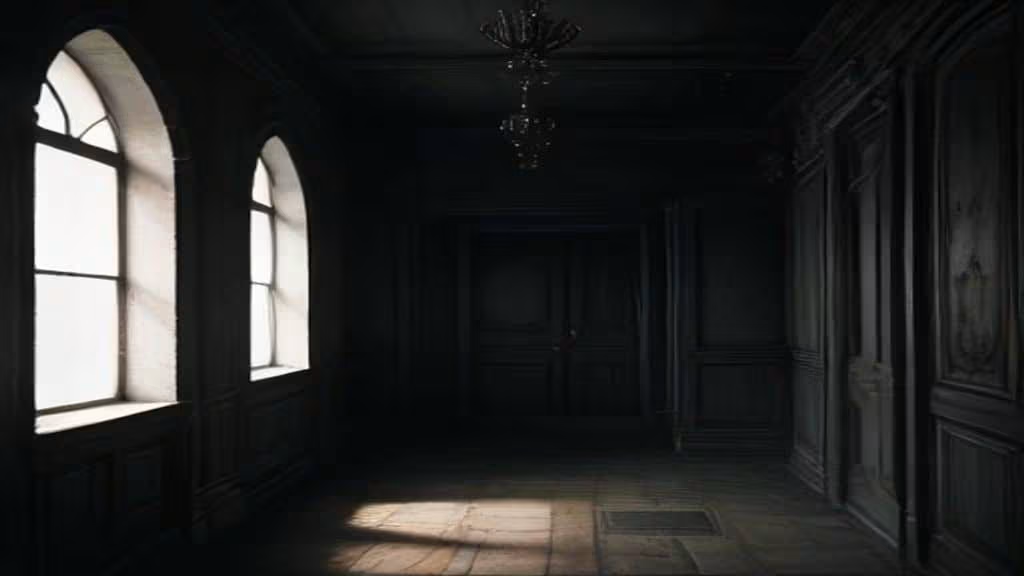
Mateo grasped the monstrous truth of the Great House of the Three Arches. The returned colonial, Melquiades de la Torre, had not built his sanctuary merely with the wealth of sugar and slave flesh. He had brought back the very hides of those who perished beneath his yoke, turning his private refuge into a monument of satanic penance or a sorcerous prison to stifle the ghosts of his victims. Every wall was an accounting ledger of agony, written upon the flayed remains of the wretched.
Suddenly, the atmosphere within the room shifted. The lukewarm air grew heavy, suffocating. Mateo noticed the yellowish surface of the walls beginning to sweat. Tiny beads of a viscous, brackish liquid welled up from the microscopic pores of the parchment.
Chapter V: The Echo of the Walls
A low sound began to articulate from the corners. It did not come from without; it emerged from the very fabric of the walls. A murmur of a thousand overlapping voices, a harsh hiss, dry as autumn leaves, repeating names, dates, curses, and imprecations in distant tongues and the deepest Asturian dialect.
The stretched parchment seemed to pulse. The gut-seams swelled. Terrified, Mateo watched as lumps took shape beneath the taut hide—the outlines of fingers and faces pressing desperately from the stone inward into the room, striving to burst through the dry leather that kept them entombed.
—Señor Valdés! —a distant voice echoed from beyond the room. It was Braulio, though his cry sounded muffled, as if filtered through miles of dirt.
Mateo tried to retreat toward the iron door, but his heels caught against the threshold. As he fell backward, his left hand struck squarely against the lower paneled wainscoting. A suffocating, almost feverish heat seared his palm. The parchment was not dead; it drank the moisture from his skin, clinging to his fingers with the leech-like suction of an embrace.
With a scream of pure Horror, Mateo yanked his arm with all his strength, leaving a torn shard of his own flesh clinging to the parchment wall. He stumbled into the corridor, dragging himself over the dust of broken plaster as the iron door began to close on its own with a heavy clank of its forged hinges.
Before the iron slab sealed completely in the dark, Mateo saw—beneath the final sliver of light from his abandoned flashlight on the floor—how the smear of his own blood spread across the blank parchment in the bottom right corner. And there, with a neat, fresh handwriting tracing itself before his horrified eyes, the hide began to write his name:
“Mateo Valdés, Architect. He entered to measure the house. He will remain to finish it.”
Mateo sprinted down the hallway, plunged blindly the stairs, and shattered the glass of the main bay window, hurling himself into the night under the relentless rain of the Asturian coast. The villagers would later say that the architect was found three days later upon the cliff rocks, shivering with fever, soaked in blood, and muttering incomprehensible words about a house built not of stone walls, but of a paper heart that demanded to be written with the lives of those who dared measure its guilt.
📜Investigation • Frequently Asked Questions
Documentary Archive and Analysis of the Occult • Relatando.com
What does the Three-Arch House symbolize architecturally within the phenomenon How does the 'orvallo' and the geographic setting of Luarca function as atmospheric and psychological elements in the narrative?
The Casona of the Three Arches embodies the monumental materialization of fortunes amassed in the Antilles during the late nineteenth century, frequently forged through dark colonial dynamics. Far from simple homes, these buildings functioned as mausoleums of hubris and trauma, where the return of the 'indiano'—here represented by Don Melquiades de la Torre—demanded a defiance of the Cantabrian landscape with exotic elements alien to local tradition, foreshadowing the eventual isolation and madness of his heirs.
What is the hidden meaning behind the geometric anomaly and the blind space discovered in the west wing of the mansion?
The coastal climate in the tale transcends mere background to become an active agent of physical and mental decay. The fine, persistent drizzle, described with the tenacity of a shroud, saturates both the stone and the characters' psyches, choking the positivist rationality of the architect Mateo Valdés. The dampness and salt air act as catalysts for an unresolved colonial past that refuses to fade beneath the mists of the Cantabrian Sea.
What narrative and folkloric function does the old guard Braulio play at the threshold of the tale?
The dimensional discrepancy between the exterior walls and the interior chambers is no mere nineteenth-century architectural blunder, but a topological transgression reflecting the utter impossibility of containing Don Melquiades's secrets. That cube of shadow, hidden between the library and the private chapel, embodies the overseas debt and the amorality of an ill-gotten fortune that warps the very structure of constructed reality, mocking the measuring tools of the man of science.
| September 2, 2026 |
Braulio embodies the classic archetype of the threshold guardian or the 'witness to the curse', serving as a nexus between earthbound folklore and the technocratic arrogance of the urban visitor. His warnings regarding what Don Melquiades brought back from across the sea—not mere material treasures, but heavy metaphysical burdens—establish that primordial tone of foreboding necessary for any fine tale of mystery to dismantle the protagonist's false sense of security.
Do not extinguish the light yet...
If you have had the courage to make it this far, we have other dossiers that will test the limits of your sanity.

Terms and Figures of this Tale
To delve deeper into the legends, creatures, and dark concepts that inspire this account, consult their entries in our dictionary of the uncanny:


Tu correo no se publica ni se comparte con terceros: solo sirve para notificar la respuesta.