In the darkest and most labyrinthine corners of Jewish mysticism, where the veil between the world of the living and that of the dead is so thin it might almost be torn with a fingertip, there lurks the Dybbuk. As a mystery researcher and director of Relatando.com, I have delved into the abyss of the Kabbalah to understand this phenomenon terrifying: we are not dealing with a simple demon of the Mythology popular, but rather the wandering soul of a dead man who, unable to find peace or complete his cycle of atonement, returns by force to cling to the body of a living being. It is a possession born of pain, guilt, and an existential void so profound that it defies the very limits of death. Welcome to the definitive analysis of one of the most terrifying and fascinating manifestations of universal occultism.
Classified File
- Origin: Jewish mysticism and the Kabbalistic tradition (Eastern Europe, 16th–19th centuries).
- Nature: A discarnate soul (an Ibbur, or incomplete Nefesh) seeking temporary refuge within a living host.
- Hazard Level: Extreme. Capable of altering the host's personality, voice, and vital functions, driving them to psychological and physical collapse.
- Weaknesses: Strict rabbinic exorcisms, the use of the shofar (ram's horn), the secret names of God, and the intervention of a religious tribunal (Bet Din) for a posthumous trial.
Origin and Etymology
To comprehend the genesis of the Dybbuk, we must immerse ourselves in the texts of Lurianic Kabbalah, developed by the master Isaac Luria in sixteenth-century Safed. The word Dybbuk derives from classical Hebrew dybbuk (דִּבּוּק), which literally means "adhesion" or "attachment." It is not a primordial demonic creation, but an aberration within the cosmic order of the human soul. According to Kabbalistic theosophy, the human soul (composed of levels such as Nefesh, Ruaj, and Neshamah) has a mission to fulfill on Earth. If a person dies violently, prematurely, with grave sins unconfessed, or with such a strong earthly attachment that it prevents them from crossing the threshold into the next world, their soul remains drifting in limbo, known as a Nefesh wandering or incomplete.
This tormented soul, trapped between dimensions, endures unbearable suffering, unable to participate in the mitzvot (commandments) or experience the divine light. The only way it finds to interact fleetingly with the material world is through atypical transmigration. The concept evolved strongly in the Hasidic communities of Eastern Europe during the eighteenth and nineteenth centuries, where tales of rabbis confronting intrusive souls became moral and spiritual warnings deeply rooted in popular culture and Jewish folklore.

Anatomy and Appearance
Unlike the traditional demons of Christian demonology — which tend to possess monstrous forms, horns, or brimstone — the Dybbuk lacks any physical form of its own on the earthly plane. It is a purely incorporeal entity, a spiritual shadow that cannot be perceived by the common human eye. Yet its manifestation becomes profoundly tangible once it manages to penetrate the body of its victim, whom we call the «host» or meshugga in contexts of induced extreme delirium.
Once inside the body, the Dybbuk utterly rewrites the functional anatomy of the possessed. Visually, the host may undergo drastic changes in facial expression, adopting hardened features or a perpetual grimace of agony. Most disturbing is the vocal duality: the possessed begins to speak in a voice entirely alien to their own, often that of the deceased possessor—a hoarse old man's voice from a young woman's body, or idioms, languages, and dialects the host has never studied nor heard in their life. In many cases documented by Hasidic chroniclers, the host's body exhibits intermittent cadaveric rigidity or superhuman physical strength that contrasts violently with their actual constitution.
Modus Operandi and Powers
The Dybbuk does not strike at random; it seeks out cracks in the soul of the living. Its modus operandi begins at a subtle level. It seizes upon moments of extreme psychological vulnerability, deep depression, crises of faith, childhood traumas, or the deliberate transgression of moral and religious law. These apertures in the individual's aura or spiritual protection act as an involuntary invitation for the wandering soul.
Once the Dybbuk clings (hence its name, to cleave fast to the host's body), it seizes control of the higher mental faculties. The host suffers episodes of dissociative amnesia, drastic shifts in mood, compulsive blasphemies —especially if the deceased bore a grudge against religious precepts— and an absolute dominion over the vocal cords. The entity uses the living body as a vehicle to sate unfinished earthly frustrations: it may demand food, forbidden love, vengeance against those who wronged it in life, or simply confess crimes it committed before dying that no one else ever knew.
Among its most terrifying powers is xenoglossy (the ability to speak dead or foreign tongues with perfect fluency) and access to the intimate secrets of the host's family, information that the Dybbuk uses to sow chaos, discord, and the psychological terror in the immediate surroundings of the victim.
Weaknesses and Protective Rituals
To combat a Dybbuk requires profound esoteric knowledge and unshakable spiritual authority; never is it a task for a layman. The primary defense rests upon the shoulders of a Baal Shem (a master of the divine name) or a rabbi versed in the mysteries of practical Kabbalah and the hidden names of God.
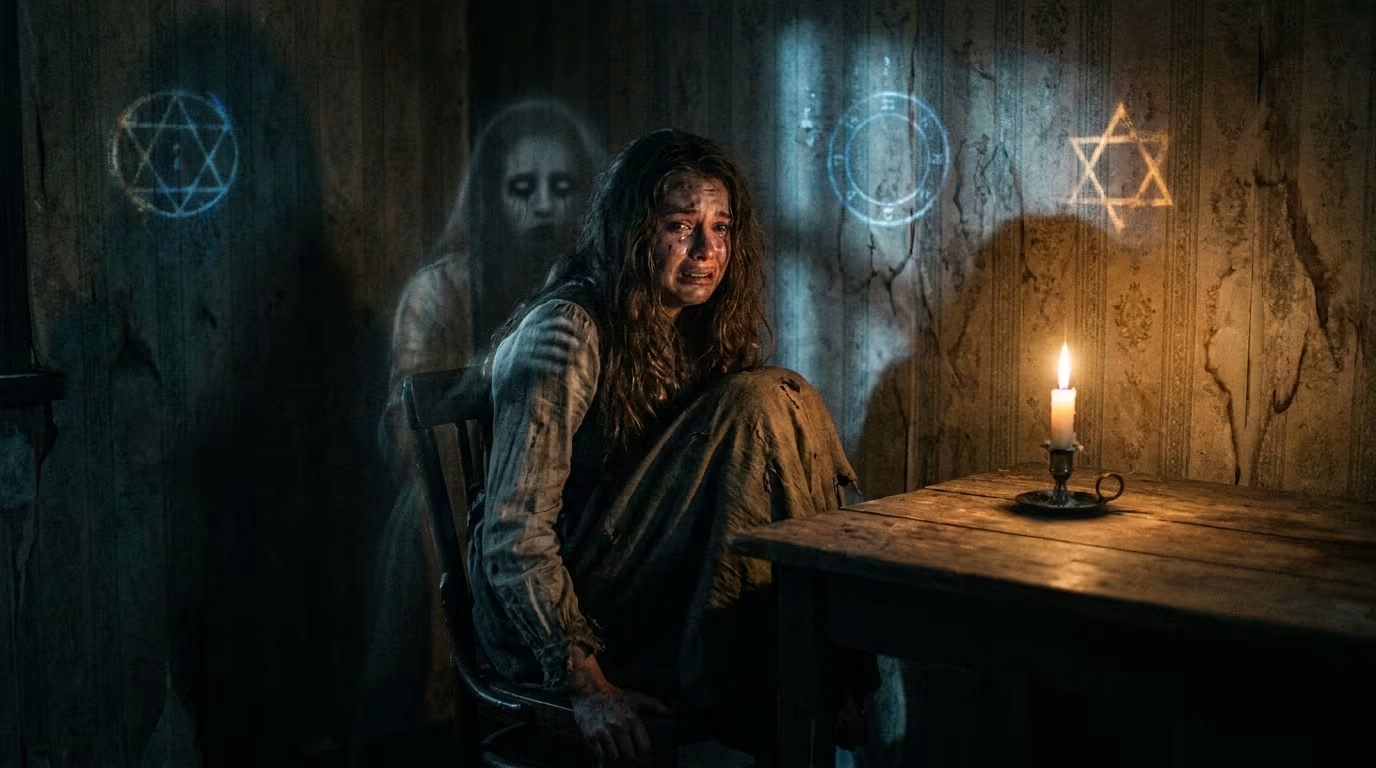
The expulsion process, known as the exorcism of the Dybbuk, is a highly structured ritual. Traditionally, it is performed inside a synagogue, at midnight, surrounded by a minyan (a quorum of ten adult men). The rabbi begins by establishing a dialogue with the entity, interrogating it to uncover its true identity, the motives behind its possession, and the sin that binds it. Once identified, it is commanded to abandon the body through strict mandates rooted in the Torah.
The ritual calls for black candles, the burning of specific incenses, and above all, the piercing sound of the shofar (the ram's horn), whose mystic vibrations possess the power to shake the spiritual foundations of the entity and sever its tether to the physical body. In complex cases, an earthly rabbinical tribunal (Bet Din) hands down a posthumous verdict, forcing the soul to accept a sentence of purification—at last releasing the host and allowing the wandering soul to be guided toward its tikkun (spiritual reparation).
Documented Cases and Famous Legends
Hasidic literature and the archives of Jewish communities in Poland and Ukraine are replete with documented cases of possession by Dybbuk. One of the most celebrated accounts occurred in the Polish city of Lublin in the early seventeenth century, recorded by chroniclers of the time. A young woman from a respectable family began to behave erratically, emitting grunts and speaking in the coarse voice of a recently deceased man. The renowned Rabbi Joel Sirkes intervened, discovering that the entity was the soul of a peddler murdered on the outskirts of the town, whose body had never received a proper Christian or Jewish burial. Through a rigorous exorcism with shofars and psalms, the soul departed the young woman through her little finger, leaving a black mark as physical proof of the entity's passage.
In contemporary culture, the myth has transcended to film and modern literature, highlighted by the famous theatrical work The Dybbuk (1916) by S. Ansky, who collected the folklore of the shtetls. Likewise, the Horror modern was shaken by the Legend urban legend of the “Dybbuk Box” (Dybbuk Box), a wine crate supposedly possessed by such an entity that unleashed a wave of strange events and nightmares across the United States in the early twenty‑first century.
Comparative Analysis
When analyzing the Dybbuk from an anthropological and comparative perspective, it proves fascinating to observe how it differs from other figures of spiritual possession across the world. Unlike Western demonic possession, as described in traditional Christian demonology, where the invading entity is a fallen angel or a demon that has never worn human form, the Dybbuk shares a profoundly human essence. At its core, it is a tragic soul, a victim of its own unfinished past.
Whereas Christian exorcism seeks to expel an agent of pure evil, wholly alien to divine Creation, the exorcism of a Dybbuk carries undertones of redemption and restorative justice. The rabbi does not merely do battle with the entity; in many respects, he engages it in dialogue, takes pity on it, and seeks to help it find the peace it so desperately craves, fulfilling an act of chesed (mercy). It is this ambiguity—the blurry line between the monster and the victim, caught between human anguish and supernatural intervention—what turns the Dybbuk as one of the most complex, psychological, and terrifying myths in all of universal mysticism.
Do not extinguish the light yet...
If you have had the courage to make it this far, we have other dossiers that will test the limits of your sanity.

Terms and Figures of this Tale
To delve deeper into the legends, creatures, and dark concepts that inspire this account, consult their entries in our dictionary of the uncanny:

Tu correo no se publica ni se comparte con terceros: solo sirve para notificar la respuesta.