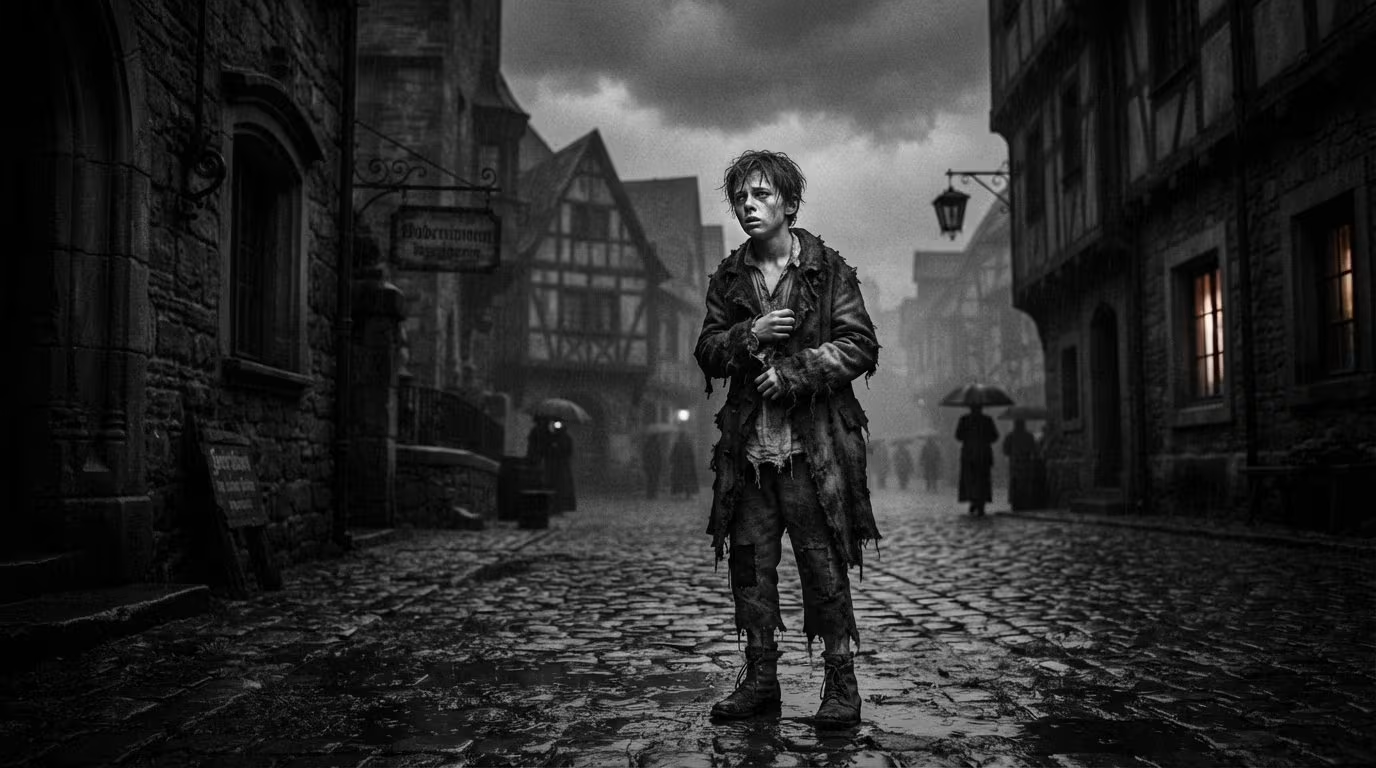
The mud of Nuremberg stank of rotting cabbage and horse urine when the boy crossed the cobblestones of Unschlittplatz. He had the hands of an infant and the twisted body of an old animal that had never once stretched its legs. He did not walk; he dragged his limbs with the clumsiness of one who knew only the friction of damp straw against bare skin. He clutched a yellowed envelope with spasmodic rigidity, gripping the paper as if the outside air might dissolve it. His mouth emitted a thick babble, a gurgle of saliva that recalled water stagnant in a broken pipe. He was sixteen years old, yet his eyes regarded the world with the dull fury of a fetus ripped by force from its mother's womb.
I. The Smell of Rotten Wood
For months, Dr. Daumer attempted to peel the scabs from that blank slate of a mind. The scholar's house filled with an acrid stench—a blend of rancid sweat, dried excrement, and the fungus that breeds in cellars where the sun is a Legend distant memory. Kaspar could not tolerate white bread; his throat contracted with convulsive violence at any nourishment other than the foul water and black rye bread a faceless man slid to him in the dark through a slit in the door. Whenever the midday light pierced the room's drapes, the boy would writhe on the floor, clawing at his eye sockets with black, brittle nails, incapable of processing the violent explosion of color. There were no words in his skull, only textures. The cold of stone. The dampness of silt. The dull ache of the shackles that had deformed his ankles before he ever learned to stand on his own soles.
The man who brought me food never spoke. He would only set down the bowl and prod my shoulder with a cold iron to see if I was still breathing in the stench.
Daumer would jot in his notebook with a trembling hand. He watched how Kaspar's pupils dilated until they consumed the entire iris at the slightest hint of gloom. The boy could not tell a real horse from a carved wooden toy; to him, both possessed the same menacing density, the same hostile volume that threatened to crush him. The subterranean cell where his childhood unfolded measured no more than two meters long by one wide. In that nameless hole, time did not pass by clock hands, but through the nauseating rhythm of decay and hunger. The jailer, a voiceless silhouette operating in perpetual gloom, had sculpted the boy the way one sculpts a gargoyle: out of privation, isolation, and a silence so thick it weighed on the shoulders like a slab of lead.

II. The Shadow in the Gardens of Ansbach
The relocation to Ansbach brought no clemency, but rather the logical culmination of an existence scarred by cruelty. The snowy December streets crunched beneath the boots of the curious who came to see the monster prodigy. But Kaspar was no longer a scientific curiosity; he had become a living threat to the secrets of the high German aristocracy. One winter afternoon, as twilight stained the rooftops the bruised purple of a fresh contusion, a stranger summoned him to the public gardens. The boy came with the pathological docility of a prisoner who recognizes his master. There were no screams. The assailant had no need to force him. A Toledo-steel blade pierced his floating ribs with the surgical precision of an abattoir slaughtering a swine, seeking out the diaphragm with methodical calm.
Kaspar returned home dragging his intestines across the snow, leaving a dark, steaming trail that froze on contact with the ground. His breathing was a whistle of broken bellows, a wet death rattle that filled the entrance hall with an atrocious irony: the open air, that very air for which he had begged so desperately in his pit, now refused to enter his ruined lungs. When the doctors examined the corpse hours later, they discovered that the pocket of his coat held another note, neatly folded. Written in mirror script, the final sentence declared with cold elegance that the boy came from the Bavarian border and that his name was a lie. No one wept for the dead man. On the autopsy table, the smell of formaldehyde and opened flesh dissipated the last vestiges of a mystery that Nuremberg preferred to bury under three meters of dry earth and quicklime.
📜Investigation • Frequently Asked Questions
Documentary Archive and Analysis of the Occult • Relatando.com
Are there documented real cases similar to this story?
Yes, there are tragic historical records of feral children and victims of extreme confinement, clinically known as severe isolation syndrome.
What does the ending of the story mean?
It represents the impossibility of escaping the original trauma; the outside world proves as hostile and lethal as the dark cell that saw him born.
Do not extinguish the light yet...
If you have had the courage to make it this far, we have other dossiers that will test the limits of your sanity.

Terms and Figures of this Tale
To delve deeper into the legends, creatures, and dark concepts that inspire this account, consult their entries in our dictionary of the uncanny:




Tu correo no se publica ni se comparte con terceros: solo sirve para notificar la respuesta.