The fog from the Sil River did not rise toward the fortress like some vulgar vapor of cold water; rather, it crept with the slow, deliberate voracity of a blind, white-bellied reptile, scaling the ashlar masonry of Ponferrada Castle until it devoured the battlements. That October night, the full moon offered neither comfort nor clarity, but a pale, cadaverous fixity hanging over the Bierzo region. The air smelled of damp undergrowth, ancient rot, and an acrid, metallic tang—a scent that vaguely recalled dried blood kept in a sealed cellar.
Andrés drained the last swallow of bitter coffee from his steel thermos. At fifty-eight, with his left knee worn down by twenty winters patrolling for the Civil Guard and ten more as a night watchman for the heritage consortium, he knew every fissure in the stone, every turn of the parapet, and the precise groan old timber makes when expanding in the frost. The castle, erected by the Knights Templar in the thirteenth century upon foundations even more ancient and pagan, was by day a swarm of tourists armed with cameras and brochures. But when the clock struck twelve, the ruins reclaimed their sovereign state: they became an ossuary of shadow and memory, suspended outside of real time.
Chapter I: The Weight of the Wind on the Parapets
At half-past one in the morning, Andrés began his second round. A bone-deep cold seeped through the lapels of his dark wool coat, and the beam of his high-intensity flashlight carved into the darkness, opening a tunnel of white light where motes of dust and dried lichen powder danced. He paced the interior perimeter, adjusting his gait to spare his aching joint. The fortress’s double walls cast gargantuan shadows that writhed in time with his stride.

He adjusted the radio transmitter on his belt. The frequency remained in absolute silence, punctuated only by the static crackle caused by interference from the distant mountains. Everything unfolded within a predictable monotony. He paused beside the Old Keep, where the stones retain a dark patina that centuries of rain have failed to scour away. Among the village elders, it was whispered that there, in the subterranean chambers where sunlight never reached, the friars kept secrets that the Church of Rome preferred to burn rather than understand.
A sudden shudder prickled the hairs on the back of his neck. It was not a sound itself that alerted him, but a jarring shift in the density of the air. The temperature plummeted in an instant, to the point where his breath bloomed into a thick, grey plume that lingered in the stagnant chill. The whisper of the river Sil, which usually drifted up from below like the constant grinding of gravel in the current, seemed to vanish entirely, smothered by an unnatural and sudden deafness.
Chapter II: The Echo in the Parade Ground
Andrés stood motionless, his hand resting on the hilt of his rubber baton. The silence grew dense, almost solid, heavy with that oppressive weight that precedes catastrophes. Then, he heard it.
It was a dry snap. Not the crackle of a withered branch nor the strike of a loose stone, but the dull thud of heavy iron against the patio slab. Seconds later, the open space of the parade ground was shaken by an unmistakable cacophony: the violent, brittle clash of two steel blades colliding with murderous force.
Andrés's heart slammed violently against his ribs. The sound resonated within the enclosure like thunder trapped inside a stone vault. He pressed himself against the guardroom wall, desperate to merge with the masonry as cold sweat tracked down his spine. Hoodlums? Trespassers who had scaled the lists despite the razor wire and motion sensors? But the perimeter alarms had not emitted a single beep.
The clash repeated, this time followed by a frantic sequence of strikes: steel against steel, the rasping scrape of one blade sliding against another, and the heavy impact of hobnailed boots upon the earth and stone floor. There was also a human sound, or something grotesquely akin to a human chest: cavernous, guttural gasps that did not emanate from living throats, but resembled the broken bellows of a church organ blowing fetid air through rusted pipes.
Driven by an atavistic impulse where the duty of his trade warred against an ancestral dread, Andrés crawled along the parapet until he reached the rampart overlooking the courtyard. He clicked off his flashlight. He did not need it. The full moon, finally free of the low clouds, bathed the heart of the fortress in a sickly, silver luminescence.
Chapter III: The Knights of the Ungodly Night
What he saw below froze the very blood in his veins.
The parade ground was not empty. At the exact center of the enclosure, illuminated by the sepulchral disc of the moon, two warriors of gargantuan stature engaged in a duel to the death. They did not wear the props of armor displayed in the castle museum; they wore chainmail darkened by a thick rust that seemed to seep from the very links. Across their chests, their white Templar habits were frayed, worm-eaten, and stained with a black, viscous substance that resembled aged tar. The cross pattée, red as an open wound, stood out against the moldering fabric.
One of them wore a bulbous helm lacking a movable visor, a mass of hammer-forged iron with two simple horizontal slits through which no eyes were visible, but rather two pits of absolute darkness, heavy with prehistoric hatred. The other gladiator fought bareheaded: his face was nothing more than desiccated leather stretched over the skeletal structure of the skull, a visage mummified by the centuries, with the mouth permanently agape in a grimace of alien agony. In place of teeth, he bared rotting, blackened gums.
The swords they wielded were hulking two-handed sledgehammers, veritable bars of jagged iron that groaned as they cleaved through the mist. Each time the blades clashed, a spray of sulfurous sparks leaped into the air, fleetingly illuminating the scene with a sickly, violet light. The sparks fell to the ground and continued to burn for moments upon the stones, leaving behind a trail of dense smoke that reeked of scorched flesh.
Andrés wanted to scream, wanted to call for backup over the radio, but his fingers were rigid, numbed by the Horror pure terror. He understood with a devastating horror that he was witnessing neither a theatrical reenactment nor a hallucination: the blows possessed a tangible mass, a force capable of demolishing a wall. The impact of those specters' feet made the very stone upon which he leaned vibrate.
Chapter IV: The Liturgy of Flesh and Iron
The combat bore no resemblance to the nobility of chivalric chronicles; it was a savage settling of accounts, a mutual and infinite execution. The unhelmeted warrior launched a brutal thrust that pierced his adversary’s breastplate. Andrés heard the horrendous crunch of chainmail snapping and the wet snap of ribs yielding under the weight of the steel. The helmeted knight made no sound; he simply grasped the blade protruding through his body with his iron-gauntleted hands, immobilizing the attacker, and with his own sword delivered a downward slash that severed the mummified warrior's neck.
The head vaulted into the air, tracing a flawless arc through the gloom, and rolled across the pavement until it struck the stone curb of the courtyard well. Yet, the headless torso did not fall. It remained standing, shivering in rhythmic convulsions as from the severed throat flowed not red blood, but a torrent of greenish pus and shapeless mire that bubbled upon contact with the night.
The head by the well parted its withered eyelids. The eyes, rolled upward, revealed jaundiced sclerae stained with black filaments. And then, the head, severed from the trunk began to emit a shriek. It was no articulate cry; it was the voice of eternal damnation, a deep, shrill vibration that rattled the windowpanes of the tower and pierced Andrés's ears as if white-hot needles were being driven into his eardrums.
Andrés clutched his head, the flashlight slipping from his grip as agony surged. The device tumbled from the rampart, clattering against the stone steps with a metallic shriek that echoed across the courtyard like the tolling of a death knell.
Chapter V: The Eye of the Cross Potent
The scream from the severed head was silenced, sudden and absolute.
Silence returned to Ponferrada Castle, though this time it was a clutching silence, pooling upon the balcony where Andrés crawled on his knees. Below, the helmed knight wrenched his blade from the rival's body, which finally collapsed like a sack of bones and rotted rags. Slowly, with a grotesque and heavy lethargy, the phantasmal executioner turned his iron throat upward.
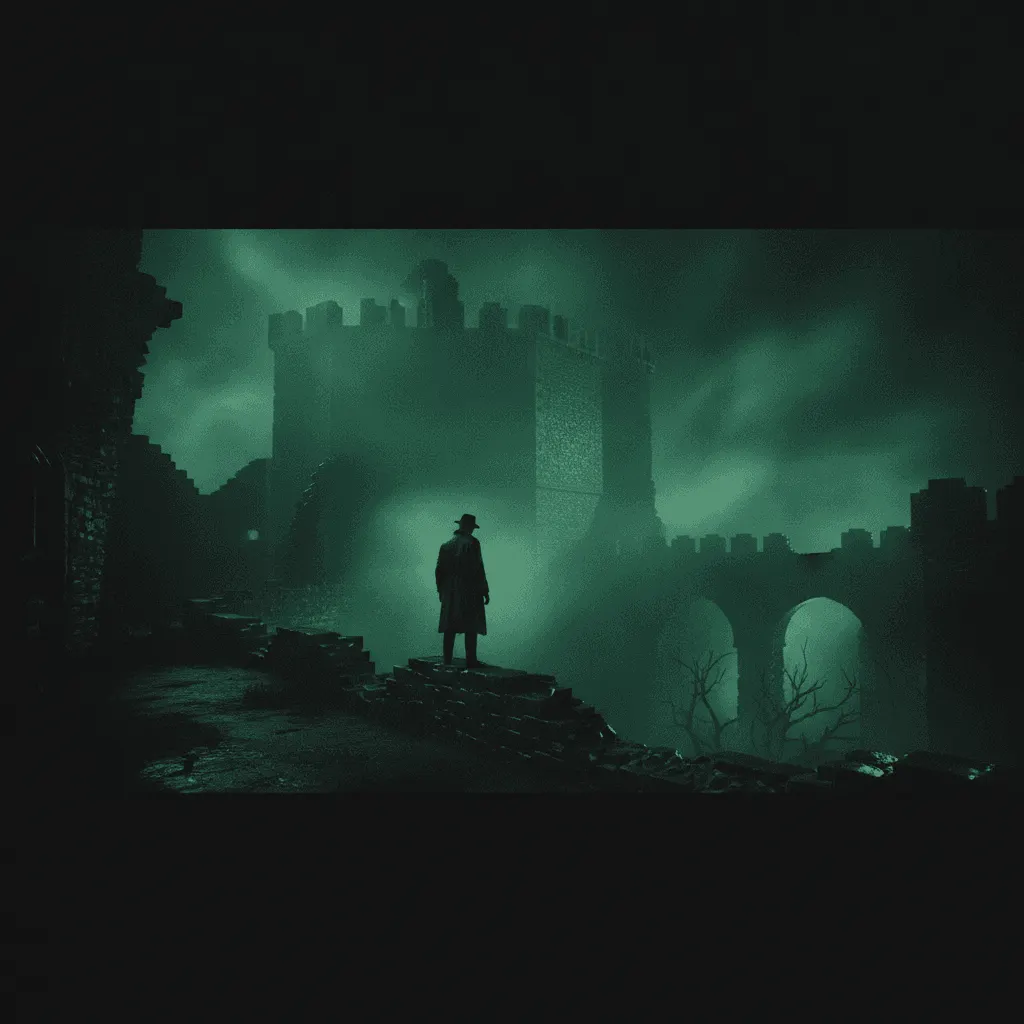
Two fissures of absolute blackness within the helm transfixed Andrés.
Despite the distance, the watchman caught the stench. It was not the chill of the night, but the miasma of a tomb violated after centuries of oblivion: the scent of rancid ash, of funeral candle wax, and corrupted blood. The knight raised a hand encased in notched iron and pointed directly at the parapet. Skeletal fingers protruded through the rents in his gauntlet.
Andrés tried to stand, but his legs were made of lead. The flashlight lying on the courtyard floor remained lit, illuminating from below the figure of the Phantom. The warrior did not begin to climb the stairway leading to the ramparts; he began to rise unnaturally into the air, floating in the mist without altering his rigid posture, ascending meter by meter toward the wall with the dull, rhythmic sound of a dying heart.
—N-no… for God's sake… —Andrés whispered, trying to form a prayer that caught in his parched throat. Childhood prayers had lost their power against the ancient horror that had inhabited those stones before the Leonese kings ever drew borders.
The specter rose above the parapet. His frayed habit drifted into the void, revealing that beneath the fabric there were no legs, only a pillar of somber vapor that bled into the bowels of the courtyard. The iron helmet stopped mere inches from Andrés’s face. The watchman could see the chisel-carved incisions upon the helm’s surface: inverted crosses, names in a corrupted Latin, and the charred marks of ritual fire.
The knight extended his sword, resting the tip of the notched blade directly against Andrés’s chest, over the embroidered crest of his security firm. The touch of the steel brought no biting pain, but an unholy cold that pierced through skin, flesh, and bone, freezing the very muscle of his heart.
—The watch does not end… —a voice rumbled inside Andrés's skull, not in the air, but in the depths of his thought—. The Temple does not surrender its strongholds. You shall guard the secret until stone returns to dust.
Epilogue: The Dawn Frost
At seven in the morning, when the first maintenance shift arrived at the Castle of Ponferrada to open the gates to the public, the fog had withdrawn toward the bed of the Sil. The morning sun tinted the battlements and the masonry of the enclosure in old gold.
They found Andrés sitting on the floor of the parapet walk, his back against the wall of the Keep. His hands were folded in his lap and his face serene, though his hair, which the previous afternoon had still held glints of chestnut, had turned white as the snow on the peaks of the Montes Aquilianos.
The ambulance doctor certified the death as a massive cardiac arrest, most likely brought on by a sudden freezing—something incomprehensible given that the night temperature had not dropped below four degrees above zero. Yet the corpse's skin was covered by an exceedingly thin layer of hard frost that would not melt at the sun's touch.
Strangest of all—something the employees preferred not to mention in the official report—was the mark discovered when the shirt was removed for the forensic examiner: upon the skin of the thorax, at the height of the heart, Andrés bore a clean and symmetrical scar, engraved in fire and ice, in the perfect shape of the cross pattée of the castle's knights. A mark that seemed as ancient as the stones upon which he had fallen.
📜Investigation • Frequently Asked Questions
Documentary Archive and Analysis of the Occult • Relatando.com
What do the mists of the Sil River symbolize, both literarily and documentally, at the beginning of Carlos Nieto's tale?
The fog is not a mere atmospheric device, but a living and predatory entity that erases the border between the present and the Templar past. Acting as a 'blind reptile,' it anticipates the invasion of historical memory upon the rationality of the watchman Andrés, immersing the reader in the climate of oppression and mystery characteristic of the Bercian castle.
How does the figure of the Civil Guard and Andrés's military past influence the construction of narrative tension?
Andrés's veteran status as a former civil guard provides an anchor of rigor and sobriety that contrasts sharply with the supernatural element. Far from being an impressionable civilian, his clinical knowledge of the terrain and his weather-beaten body legitimize the truth of the phenomenon, making the sudden alteration of the environment terrifying for both himself and the reader.
What historical and mythical weight do the underground chambers of the Old Keep possess in the tradition of Ponferrada?
The text alludes to the dark secrets the Order of the Temple harbored within its most hermetic foundations. In local folklore and mystery literature, these subterranean spaces function as the archive of the proscribed, those arcane matters that defied the orthodoxy of Rome and that persist latent beneath the stone, waiting for midnight to manifest.
In what way does the author use sudden silence and the drop in temperature as triggers for the supernatural?
The deliberate cancellation of the murmur of the Sil river and the drastic drop in temperature operate as a classic rupture of physical laws, a prelude to the ghostly irruption. This sensory isolation strands the protagonist in a timeless dimension, intensifying the suspense and preparing the ground for the encounter with the Templar specter.
Do not extinguish the light yet...
If you have had the courage to make it this far, we have other dossiers that will test the limits of your sanity.

Terms and Figures of this Tale
To delve deeper into the legends, creatures, and dark concepts that inspire this account, consult their entries in our dictionary of the uncanny:

Tu correo no se publica ni se comparte con terceros: solo sirve para notificar la respuesta.