Chapter I: The Quicksilver of the House of Chimeras
Don Julián de la Torre did not believe in the vulgar superstitions that frighten the ignorant, but he respected the weight of old objects. For over forty years, his antiquities shop in the darkest heart of Habsburg Madrid had been a sanctuary of time's shipwrecked remains: pendulum clocks whose ticking seemed to measure the agony of dead eras, manuscripts worm-eaten by moths, and oil portraits whose subjects stared into the void with stern gazes. Yet nothing in his lengthy career had prepared him for the arrival of the lot from the house of the Counts of Somoza.
Among the leaf litter of baroque furniture and nicked dinnerware, three Victorian mirrors stood out with a disturbing singularity. They were tall pieces, their dark mahogany frames carved with filigrees that mimicked twisted ivy and grotesque faces concealed within the foliage. The glass showed none of the typical pitting of worn quicksilver; the surface reflected reality with an almost painful clarity—metallic and cold. According to the auction inventory, they had been commissioned in 1888 by an English alienist who died confined in his own library.
That November afternoon, as rain struck the windowpanes with the cadence of impatient fingers, Julián decided to arrange the three pieces in the back room. He placed two of them at an obtuse angle and fitted the third at the center, forming a reflective triptych against the exposed brick wall. Opposite them, barely three meters away, stood his favorite reading chair: a wingback upholstered in crimson velvet, flanked by a side table crowded with his most prized incunabula and a brass oil lamp still smoking.

"A perfect alignment," murmured Julián, adjusting his silver spectacles as he contemplated the play of depth the three aligned lenses produced.
The mirror on the left showed the row of shelves laden with calfskin-bound tomes. The mirror on the right returned the image of the old iron stove and the coat rack where his wet overcoat hung. But when he set his gaze on the central mirror, Julián's blood seemed to freeze in his arteries with the swiftness of a fulminant poison.
Chapter II: The Deviated Geometry
In the reflection of the central moon, the space was not empty. Seated in the crimson velvet armchair —the same armchair that in the real world sat deserted a scant few steps from Julián— rested a human figure.
The antiquarian blinked hard, convinced that evening fatigue or the oil lamp's treacherous shadows were playing a cruel trick on him. He removed his glasses, polished the lenses with his handkerchief, and put them back on. The specter was still there. It was the silhouette of an extremely tall, gaunt man, dressed in a nineteenth-century cut suit of cloth so black it seemed to absorb the room's light. His hands, long and pale as the wax of a paschal candle, held an open volume.
The most dreadful thing was not the intruder's presence, but the perfect correspondence of the scene. The book the figure read with slow devotion was the very same copy of the Ars Magna by Ramon Llull, which Julián had left on the side table minutes before. In the physical world, the book lay closed upon the varnished wood. In the world of the central mirror, the figure turned the pages with a methodical and graceful motion.
"Who's there?" Julián cried out, his voice ringing with a tremor unbecoming of a man of his character. The echo of his words died against the wallpaper-clad walls.
He looked at the actual armchair: it was absolutely empty. The indentation in the velvet cushion showed no weight at all. He looked at the left mirror: it reflected the empty armchair. He looked at the right mirror: the armchair remained empty. Only the central mirror, the third silvered glass, harbored the intruder.
Julián reached a trembling hand into the air. In the central pane, the figure did not mimic his gesture. The guest did not even lift his gaze from the text. He kept leafing through the incunabulum, absorbed in a silent reading. And then, shattering the barrier of the impossible, a faint but unmistakable sound tore through the silence of the back room: the dry, rasping creak of a page of laid paper being turned.
Chapter III: The Whisper of Paper
That night, Julián did not sleep. Unable to abandon the back room, he dragged a wooden chair to the farthest corner and sat wakeful through the dark, armed with a candlestick and an old damascened dagger he used as a letter opener. The figure in the third mirror did not stir from its armchair for hours. It simply read.
As the night wore on and the city sank into a sepulchral silence, Julián began to notice the macabre details of his visitor. The man's face remained hidden by the shadow cast by the brim of a tall top hat, but his exposed skin—neck, wrists, fingertips—had a grayish hue, like the flesh of the drowned that the river police sometimes pulled from the Manzanares. Moreover, each time the guest turned a page in the reflection, the real book on the table vibrated imperceptibly, raising a speck of dust that floated in the golden candlelight.
Toward three in the morning, panic gave way to a sick fascination, an unhealthy curiosity worthy of scholars who have stared too long into the abysses of the forbidden. Julián rose and slowly approached the central mirror. The cold emanating from the glass was unbearable; it was not the cold of a winter night, but a mineral temperature, extinct, the absolute nothingness of interstellar spaces.
"What are you looking for in my books?" whispered the antiquarian, pressing his face almost against the glass pane.
For the first time since their apparition, the guest stopped the movement of his fingers. His hand froze over the top of the page. Slow, agonizingly slow, the figure began to tilt its head upward. Julián wanted to back away, to break eye contact, to bolt into the cobblestone street and scream for the night watchmen, but his legs refused to obey. He stood paralyzed, captive to the perverse geometry of the three mahogany frames.
Beneath the shadow of the hat, there was no human face. There were no eyes, no nose, no lips. In their place, the glass reflected a smooth, whitish surface, a mask of stretched skin where only two dark, deep cavities seemed to absorb the reality outside. The being had no mouth, yet in Julián's mind echoed a metallic creak, like the turning of a rusted gear in the depths of a well.
Chapter IV: The Invasion of Quicksilver
At dawn, the greyish light of the Madrid day, filtered through the lace curtains, did not dispel the nightmare. On the contrary, it made it more tangible. The guest was no longer reading the Ars Magna. He had left the book on the mirror table and now held Julián's personal diary, a leather-bound notebook in which the antiquarian recorded his memories and his debts.
Julián discovered with horror that the air in the back room had grown dense, reeking of ozone, of crypt damp and rancid wax. When he looked at the real table, he noticed something terrifying: the cover of his journal lay open to the very same page the specter was reading in the mirror dimension. As the entity's cadaverous finger traced a line across the paper of the reflection, an invisible mark crushed the ink in the actual notebook, leaving behind a damp and blackened imprint.
"Enough!" Julián shouted, losing his mind. He seized a heavy bronze candelabra from the shelf and brought it down with all his strength against the central mirror.
The impact should have shattered the three-millimeter glass. Yet the bronze rang out with the dull thud of a blow against indestructible rock. The mirror did not suffer a single scratch. There were no cracks, no splinters, no shards. The blow merely sent a series of ripples across the surface of the quicksilver, as if the liquid silver were the surface of a mercury lake.
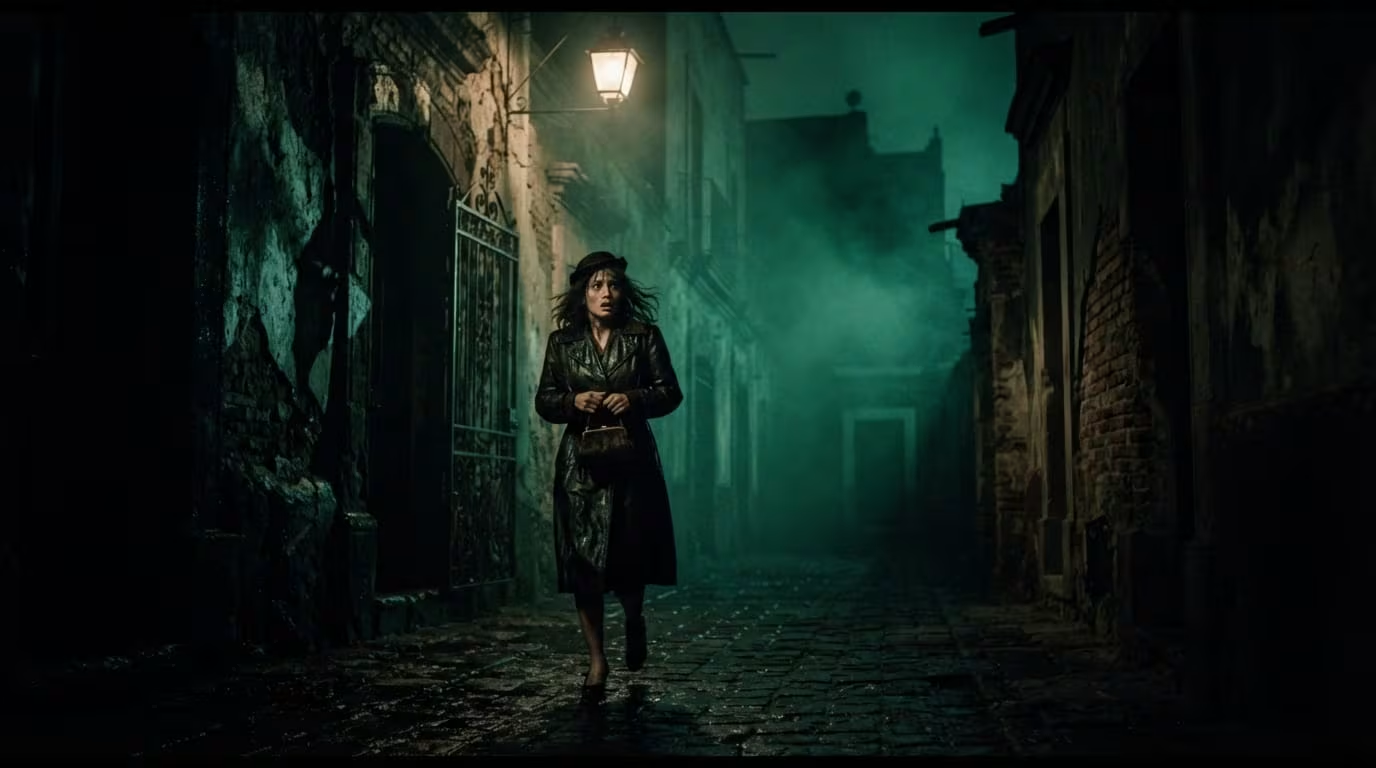
The guest slammed the journal shut. The snap echoed through the physical room with the blunt finality of a gunshot. The figure rose to its feet.
In the side mirrors, the armchairs remained empty, but the central glass reflected the creature standing tall, brushing the ceiling with its slender silhouette. It took a step forward. In the real world, the backroom carpet dipped under the weight of unseen footsteps. The stench of putrefaction grew unbearable.
Julián dropped to his knees, hands clamped over his head, feeling his sanity unraveling in his mind like a broken rosary of beads. He understood then the terrifying nature of the Victorian ensemble: the three mirrors were neither mere decoration nor traps to catch spirits. They were a three-eyed bridge, an optical funnel devised by that deranged alienist to permute realities. The first mirror captured form; the second, shadow; the third… the third was the receptacle housing the true master of the house.
Chapter V: The Velvet Exchange
The creature walked to the glass barrier. It extended one of its waxen hands and pressed it against the inner face of the central pane. The glass gave outward, bulging like a membrane of transparent rubber. The host's fingers pierced the boundary of quicksilver and entered the air of the Madrid of men.
The cold borne upon the specter's hand seared the skin of Julián's face from several meters away. The antiquarian tried to pray, but the prayers of his childhood were erased from his memory, displaced by the names of impossible geometries and dead stars that the entity dictated to him without uttering a single sound.
“Your time on this side of the silver has ended,” whispered the void in his brain.
The cadaverous hand seized Julián by the neck. The entity's force was not muscular but gravitational; it was the irrational pull of the abyss reclaiming what belongs to it. Julián was dragged across the wooden floor, clawing at the boards with his nails until they bled, leaving a trail of desperation as he was thrust toward the mahogany frame.
The transition was not painful, but horribly lukewarm. As he crossed the threshold of the quicksilver, Julián felt his body lose its weight, its flesh and breath, becoming a flat shadow, a mere refraction of light. The smell of ozone vanished, replaced by the absolute absence of scent and the paralysis of the void.
When the light returned to his eyes, Julián found himself seated. His body was now gaunt, his hands of a cadaverous pallor, and his face devoid of features. He stared ahead, through the glass of the central mirror.
In the real world, on the other side of the glass, the tall figure dressed in black was adjusting his shirt collar against the brick wall. The guest stretched his real fingers, lifted the wet overcoat from the rack, set the hat upon his head, and walked with a firm stride toward the backroom door. Julián heard the entrance bell ring with its cheerful tinkle as the man crossed the threshold and stepped out into the rain of Calle de la Pasa, vanishing among the crowd of passersby who would never suspect the origin of that wayfarer.
Now, in the grim stillness of the abandoned back room, Don Julián de la Torre waits in the velvet armchair of the reflection. Between his silver fingers he holds the Ars Magna and he turns the pages with infinite patience, waiting for the next buyer to cross the threshold and commit the fatal error of aligning the three mirrors.
📜Investigation • Frequently Asked Questions
Documentary Archive and Analysis of the Occult • Relatando.com
What historical and occult symbolism is veiled within the provenance of the Victorian mirrors from the House of the Counts of Somoza in Habsburg Madrid?
The provenance of the mirrors, commissioned in 1888 by an enigmatic English alienist who died under dark circumstances, is rooted in the nineteenth-century tradition of spiritualism and phrenology. By placing them in the Madrid of the Austrias—a district heavy with inquisitorial memory and subterranean stratifications—Carlos Nieto uses the antique object not as mere set dressing, but as a psychic threshold where aristocratic decay and a medical science obsessed with madness and the double converge.
In what manner does the triptych arrangement of the glass act as a geometric catalyst for the warping of reality within Julián's backroom?
The placement of two mirrors at an obtuse angle and a third at the center configures a liminal space of a specular nature, evoking the ancient mirrors of divination and catoptromancy. Far from being a mere symmetrical reflection, this skewed geometry fractures the antiquarian's temporal linearity. The triptych functions as an optical and metaphysical trap that withdraws the image of the immediate surroundings to project a bodiless otherness onto the furniture.
What does the figure of the antiquarian Don Julián de la Torre reveal to us when pitted against the late 19th-century positivist skepticism of the unfathomable?
Julián embodies the classical scholar who trusts blindly in material order and the mercantile dominion over the relics of the past. His reverence for old objects is purely aesthetic and historical, refusing to acknowledge the animic or accursed charge they bear. His collapse before the central mirror symbolizes the failure of bourgeois rationalism in the face of ancestral forces that escape the taxonomy of auction catalogues.
What narrative function does the sensory transition of rain and the smoking oil lamp fulfill in building the atmosphere of Carlos Nieto's tale?
The rainy November atmosphere and the precarious glow of the brass oil lamp create an impressionistic chiaroscuro that seals the back room off from the outside world, turning it into an airtight vessel. This dense, claustrophobic atmosphere numbs the senses of both the reader and the protagonist, easing the suspension of disbelief before the visual impact of the intruder in the mirror.
Do not extinguish the light yet...
If you have had the courage to make it this far, we have other dossiers that will test the limits of your sanity.

Terms and Figures of this Tale
To delve deeper into the legends, creatures, and dark concepts that inspire this account, consult their entries in our dictionary of the uncanny:





Tu correo no se publica ni se comparte con terceros: solo sirve para notificar la respuesta.