Chapter I: The Mist Over the Pazo of Sombragal
There is a corner in the interior regions of the province of Pontevedra where the mist never truly dissipates. It clings to the ashlar masonry like cold, greenish moss, staining the horizon a leaden gray that numbs the memory. It was late in October when I arrived at the Pazo de Sombragal, answering the urgent dispatch of Don Álvaro de Souto y Bolaño, the last scion of an aristocratic lineage whose very name smelled of damp decay and moth-eaten archives.
My task, as a restorer of sculpture and a bibliophile specializing in nineteenth-century sacred art, was to appraise everything. Debts were drowning the aging baron, and the estate was slated for public auction before the winter solstice. The rental car dropped me off at the wrought-iron gates, devoured by rust and choked in briars. The driver, a local peasant with a shifty gaze and a nervous habit of crossing himself, flatly refused to cross the threshold. "The pazo has witches in its stones, your lordship," he muttered before swinging his vehicle around and abandoning me to the mercy of a freezing mist that soaked straight to the bone.
I walked down the path of centuries-old beeches whose bare branches intertwined overhead like the ribs of a ruined cathedral. In the distance stood the manor: a hulking mass of dark granite with baroque balconies, crenellated towers, and a deserted sunroom overlooking a cloistered courtyard. It was as I crossed the threshold that I saw it for the first time. The central courtyard—a garden choked with ivy, wild lavender, and misshapen cypresses—sheltered a collection of seven Carrara white marble figures. They clashed brutally with the Galician granite. They depicted classical allegories: the Three Graces, three theological virtues, and a central figure, slightly elevated, which posed as a silent angel with an index finger pressed against its stone lips.

—Italian art brought over by my great-grandfather, Don Nuno de Souto, in 1888 —said a raspy voice behind my back.
I spun around, overcome by an unearthly dread. Don Álvaro was waiting beneath the archway. He was a lean man, consumed by a cadaverous pallor, draped in a frayed velvet dressing gown that smelled of camphor and stale tobacco. His eyes, sunken in purplish sockets, held the feverish gleam of those who suffer from chronic, incurable insomnia.
—They are magnificent —I remarked, trying to mask the shudder that raced down my spine. There was something profoundly wrong with the proportions of those statues; their arms were imperceptibly longer than normal, and their faces, though beautiful, displayed a rigidity in the cheekbones that hinted at a grimace of smothered agony.
—Do not look at them too closely, Don Gabriel —the old man murmured, coughing dryly—. And above all… keep the sheer curtains drawn when night falls. This manor has damps that warp the mind.
Chapter II: The Geometry of the Anomalous
The first day passed amidst inventories of manuscripts, moth-eaten tapestries, and time-darkened silverware. Yet my mind could not tear itself away from the courtyard. From the library window on the second floor, I could gaze out upon the sculptural ensemble with perfect clarity.
I took advantage of the fading twilight to descend into the garden with my tape measure and notebook. As I drew closer to the statues, a detail struck me with a sudden, chilling jolt. The central figure—the angel of silence—bore none of the familiar chisel-work of classicism. The stone seemed to have been hollowed out from within; the marble veins did not follow the natural drape of the tunic's folds, but instead swirled in concentric spirals, akin to the fingerprint of a giant. The facial surfaces lacked carved pupils, yet the tilt of the neck possessed a deeply unsettling expression.
I noted the exact positions in my ledger: the angel stared fixedly toward the south, pointing to the dry stone basin at the heart of the cloister. To its left, the allegory of Prudence extended a hand of impossible, elongated fingers toward the service pavilion. To its right, Faith kept her head bowed, gazing down at the leaf-strewn earth.
I dined alone in the grand dining hall, where a colossal fireplace barely managed to temper the glacial air seeping through the gaps in the tall windows. The maid, a mute old woman who refused to meet my eyes, served me a broth of collard greens and stewed meat before hurrying away toward the outer quarters. By ten o'clock, the manor was plunged into a crushing silence, broken only by the dying crackle of the embers and the relentless lash of rain against the panes.
I withdrew to my bedchamber on the northern face of the house, whose attic window looked directly down upon the courtyard of statues. Driven by a strange fixation, I lit a brass oil lamp and peered out. Below, the marble gleamed beneath the storm water with a pale, ghostly sheen. Everything remained utterly still. I smiled at my own edginess, chalking up the creeping dread to the owner's superstitions and the oppressive atmosphere of the place. I barred the wooden shutters, crawled into the four-poster bed, and let exhaustion drag me under.
Chapter III: The Creak of the Twelve
I was jolted awake by a dry, metallic, cavernous snap, akin to the sound of a grain mill crushing river stones. The grandfather clock in the hallway began to toll midnight. Its chimes fell slow and heavy, muffled by the dense, stagnant night air.
One, two, three…
In the interval between the fifth and sixth stroke of the bell, I heard another sound. It did not come from within the manor, but from outside, directly beneath my bedroom. It was a dull, heavy scraping, as though a mass of a ton and a half were being dragged across the damp granite. The groaning shriek of mineral substance subjected to unnatural stress.
Seven, eight, nine…
Clambering out of bed with my heart hammering against my ribs, I crept toward the window without turning on the light. I parted the lace curtain by barely a centimeter and pressed my forehead against the cold glass.
The full moon had torn a jagged seam through the black clouds, bathing the courtyard in a spectral glare. What I saw eroded my sanity in an instant, devastating fashion.
The statues were no longer in the positions where I had cataloged them that very afternoon. The figure of Faith no longer gazed at the ground; her marble neck had wrenched ninety degrees to the left, at an anatomically impossible angle, pointing directly toward the west tower. But that was not the most horrifying part. The central statue, the great angel of silence, had descended a step from its pedestal. Its limbs of stone, hitherto static, were now flexed in the posture of one crouching in the shadows.
And worst of all: its blind, smooth face, utterly devoid of pupils, tilted upward. It was staring fixedly at my window.
A whisper began to rise from the courtyard. It was not the wind sighing through the cypresses. It was a harsh hissing, a murmur of a thousand dry voices grating against stone as they articulated words in an archaic tongue, dead long before mankind ever raised its first cities. The statues did not speak with opening mouths—their lips remained sealed in immutable marble—rather, the stony matter itself vibrated, emitting a stifled chant that resonated within the very structure of my teeth.
«…venia… petra… sanguis… ad nos…»
I stumbled backward over the rug and crashed onto my back, gasping, hands pressed hard over my ears to block out that demonic whisper that seemed to seep straight up through the floorboards.
Chapter IV: The Mad Stonemason's Notebooks
I did not sleep another wink all night. I remained sitting upright against the headboard, clutching a heavy bronze candelabra as my sole, absurd defense. At the break of dawn, when the sickly first rays of a diseased sun stained the sky a bruised gold-gray, I mustered enough courage to look out once more.
The statues had returned to their pedestals. Or so it seemed at first glance. Yet, upon closer inspection, I noticed fresh friction scars on the stone bases, fine chips of raw marble scattered across the ground, and deep drag marks gouged into the courtyard moss. They no longer pointed toward the fountain. Every single one of the seven statues—without exception—had its face turned toward the northern façade. Toward my window.
Desperate for any rational explanation, I made my way to Don Nuno's private study, tucked away at the rear of the library—a room Don Álvaro had explicitly and strictly forbidden me to enter. I forced the brass lock using a scalpel from my restoration kit.
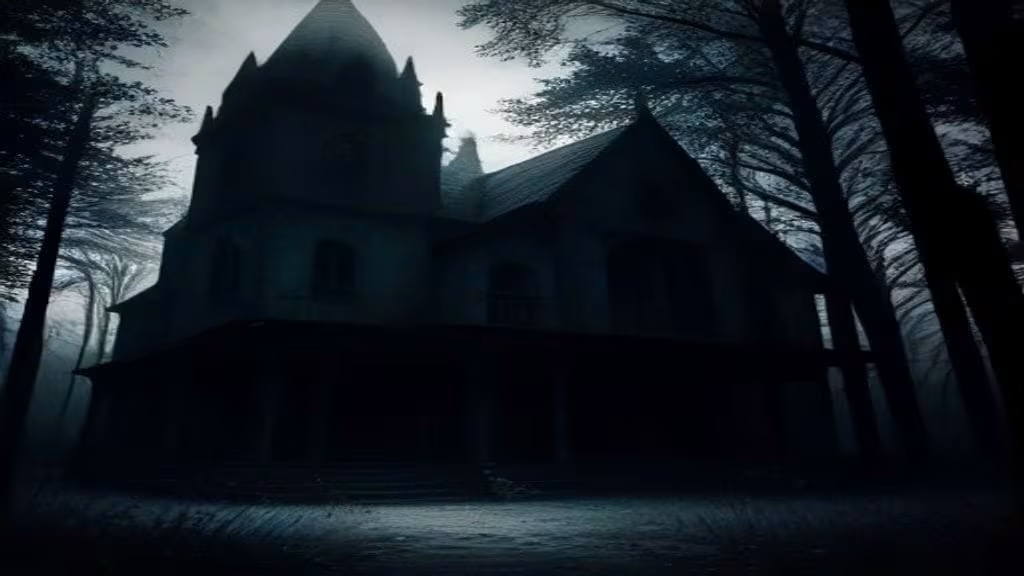
The study smelled of rancid wax, dampness, and something else… something sweet and putrid that reminded me of the scent of open crypts. Upon the mahogany desk I found my great-grandfather's working journals, wrapped in lambskin. I thumbed through the pages with trembling fingers. The final entries, dated in the winter of 1888 in Carrara, exuded a progressive and terrifying madness.
"It is not marble", read a note scrawled in erratic handwriting with red ink. «The quarry at Pietrasanta hid something older than the Alps. A vein sealed by the Romans with lead and salt. It is not inert stone; it is a slumbering entity that devours time and flesh. If sculpted, it takes the shape of the mason's desire, yet retains its hunger. It demands a fixed gaze. If you look upon it, it recognizes you. If you listen to it, it claims you. I have brought seven fragments to Sombragal. God forgive me, they require nourishment so they do not consume me first…»
Pages further on, I discovered a blueprint of the courtyard featuring astronomical diagrams and a list of names. Among the names of servants and visitors who had vanished in the late nineteenth century, I read with mounting horror more recent annotations written in Don Álvaro's shaky hand. There were dates: 1945, 1972, 1998… And beside each date, a note that read: “Accepted by the Garden”.
Then the terrible truth settled over me. Don Álvaro had not summoned me to appraise his estate. I was no restorer. I was an offering.
Chapter V: The Dance of the Marble
I ran toward my room to gather my belongings and flee on foot across the hills, regardless of the rain or the distance to the nearest village. But when I reached the main foyer, I found the massive oak door double-bolted and barred from the outside with heavy iron latches.
—Don Álvaro! —I screamed, beating against the wood with raw, bleeding fists—. Open the door, for the love of God! Let me out!
From the upper floor came a faint, dry laugh, choked off by a cavernous cough.
—It is useless, Don Gabriel —the old man's voice echoed from the upstairs balustrade—. The pact must be fulfilled. One soul every twenty-five years so that the stone remains at rest and does not devour the entire house. My great-grandfather promised it, and I have paid the tribute all my life. Today it falls to you. Be grateful that it will be quick… if you do not try to fight.
—You're mad! —I howled—. Open the door! Help!
The hallway clock began to chime noon. But the sunlight vanished all at once. An eclipse-like blackness seized the mansion's glass panes, and the courtyard seemed to plunge into the gloom of a perpetual midnight.
A deafening snap shattered the glass of the cloistered courtyard. The gallery windows burst into shards under the impact of tons of weight. Panic seized me, and I took refuge in the center of the courtyard, trapped, as I saw the interior corridors blocked by debris falling from the ceiling.
There, beneath the darkened sky, I watched the statues step down from their pedestals. They did not move like creatures of flesh and bone, but with a dread rigidity, in instantaneous jerks that defied the laws of physics. One second they were ten meters away; with a blink, they had advanced five more, leaving deep gouges in the granite paving stones in their wake.
Their necks twisted with dry cracks. The white marble of their faces had grown translucent, and within them, writhing dark shadows could be discerned—human shapes trapped in an eternal agony, petrified in the living rock. Their mouths, once sculpted and sealed, began to fracture. The stone split open, forming black orifices that exhaled a freezing breath smelling of graveyard earth.
The central angel loomed over me. Its two-meter-tall figure cast a deformed shadow that seemed to devour the remaining light. The marble hand, heavy as a tombstone, descended slowly toward my face. I tried to move, to scream, but my legs were paralyzed by a sepulchral cold rising from the ground, freezing my blood, stiffening my muscles.
I heard the final whisper, not in my ears, but deep within my own skull, echoing through the bony structure of my head:
«Join the stonework… be stone with us…»
I looked at my hands. Beneath the skin, my veins no longer pulsed with red blood; they were stained a chalky white, hardening into the texture of marble. My final breath dissolved into a puff of white dust as the angel's mouth closed over my sight, plunging me forever into the eternal, whispering silence of Pazo de Sombragal.
📜Investigation • Frequently Asked Questions
Documentary Archive and Analysis of the Occult • Relatando.com
What does the literary and atmospheric use of the 'orvallo' symbolize in the introduction of Pazo de Sombragal?
The orvallo is not merely a realistic meteorological device within Galician folklore, but a tactile metaphor for melancholy and the oppressive weight of time. This fine, persistent drizzle acts as a damp shroud isolating the Pazo from the outside world, creating a liminal atmosphere where the boundaries between historical reality and the Legend supernatural blur in an unsettling manner.
What historical-artistic backgrounds do the Carrara marble sculptures possess in nineteenth-century Galicia?
During the final third of the 19th century, the agrarian bourgeoisie and the decaying nobility sought to emulate European grandeur by importing Italian Carrara statuary. Yet in this tale, the classical purity of the marble collides violently with the grim Galician granite, hinting at a failed transculturation and the introduction of alien elements harboring dark familial secrets.
What role does the dread superstitious local chauffeur play against the rational mindset of the restorer Don Gabriel?
It embodies the classic epistemological conflict between vernacular superstition—rooted in an ancestral terror of witches—and the positivist arrogance of the urban expert. The chauffeur's abandonment marks the point of no return, stripping the protagonist of his modern safety net and casting him into a domain where artistic erudition is utterly useless.
What does Baron Don Álvaro's final warning about keeping the sheer curtains drawn at nightfall foreshadow?
It functions as the classic catalyst of the Horror chamber gothic, anticipating that the Pazo de Sombragal conceals a nocturnal vigil where the statues and remnants of the past take on an active role. Night is not merely the cessation of light, but the awakening of an aristocratic curse bound to guilt and silence.
Do not extinguish the light yet...
If you have had the courage to make it this far, we have other dossiers that will test the limits of your sanity.

Terms and Figures of this Tale
To delve deeper into the legends, creatures, and dark concepts that inspire this account, consult their entries in our dictionary of the uncanny:


Tu correo no se publica ni se comparte con terceros: solo sirve para notificar la respuesta.