Chapter I: The Inheritance of the High Moor
The fierce northern wind howled across the high moor with the muffled fury of a dying beast. As my aging vehicle labored up the winding road toward Sepúlveda de las Ánimas, the Castilian landscape stripped itself of any vestige of life, reducing itself to a mineral tableau of brown limestone, stunted holm oaks, and a sky the color of molten lead. There, atop a frost-battered promontory, stood the Caserón de los Olmo, the estate my grandfather, Baltasar Olmo, had bequeathed to me in his will after three decades of absolute mutism and self-imposed exile.
The locals from the nearest village, upon hearing my surname at the roadside inn where I stopped to refuel, had fallen into a silence dense as mist. None would accompany me or guide me to the boundary line. "That house runs cold, Mr. Julián," muttered the innkeeper, a man with a weathered face and hollow eyes, as he crossed the air with three cramped fingers. "Don Baltasar wasn't alone when he breathed his last. We heard the dull thud on the roof on All Souls' Night, and ever since, the smoke rising from his chimney isn't from wood, but from old things that ought not to be burned." Ignoring their ignorant superstitions, so typical of deepest, atavistic Spain, I pressed on toward my family inheritance.
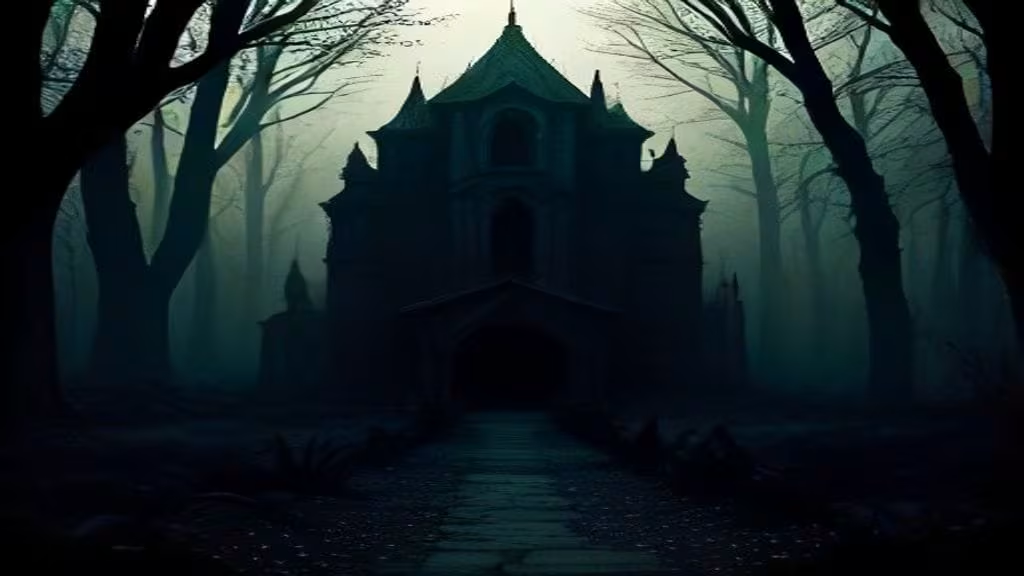
The manor house stood as a superb, menacing bulk of ashlar and rubble masonry, capped by a Moorish tile roof deeply battered by hail. As I crossed the threshold of the front door, its oak panels groaning like a hanged man's bones, an unbearable stench of dampness, rancid wax, and woodworm greeted me. Gloom blanketed the furniture, draped in yellowish shrouds. My grandfather had been a learned scholar, a man devoted to fine horology and arcane astronomy who, in his final years, had abandoned all contact with Madrid society to seclude himself behind those walls of ancestral stone.

That first night, sheltered beside the flickering hearth in the main hall, the silence of the old manor felt absolute, dense, almost solid. Yet, as midnight took its toll on the kerosene lamp and the embers began to die, I perceived for the first time that phenomenon. It did not come from outside, nor from the wind battering the wooden shutters. It came from the uppermost reaches of the building, from the forgotten attic tucked beneath the roof beams. A rhythmic, dry, metallic snap. Tick-tock. Tick-tock. Tick-tock. It was a mechanical yet unsettlingly heavy pulse, as though a colossal bronze pendulum were cleaving the air of the forgotten room.
Chapter II: The Chains of the Sealed Room
At dawn, a brittle frost glazed the windows of the old house. Determined to find the origin of the sound that had kept me awake through the small hours, I explored the upper floor. Upstairs lay a long corridor, flanked by oil portraits of ancestors whose dark pigment eyes seemed to follow my steps with a blend of mischief and dread. At the far end, hidden behind a frayed tapestry depicting a mythological hunt, I found the spiral staircase leading to the garret.
The wooden steps groaned in agony beneath my weight. The air grew progressively denser, heavy with a strange stench of rusted metal and something cloying and sickening that reminded me of sun-dried meat. Upon reaching the top, I found myself in a narrow corridor ending abruptly in a solid wooden door, unlike any other in the house. It had neither knob nor conventional lock. Instead, the door leaf was crossed by three heavy wrought-iron chains, secured with enormous padlocks coated in a greasy green patina. Furthermore, the gaps in the frame had been sealed with a crude mortar of plaster and black wax, as if someone had desperately tried to keep the air from within from escaping… or something from getting in.
I approached the sealed wood and pressed my ear against the upper plank. The sound breached my eardrums with the force of a macabre revelation. Tick-tock. Tick-tock. Tick-tock. The pulse echoed deep within my own teeth. It was the cadence of a colossal clock, yet it lacked the brisk lightness of wall mechanisms. Every stroke brought with it a microscopic tremor that traveled through the wood right down to the soles of my feet. How could a mechanism possibly still be running in a room sealed off for decades? My grandfather had died three weeks ago, and according to the executor's papers, the attic had been boarded up for over forty years, ever since the mysterious disappearance of my grandmother Leonor.
Driven by an irresponsible blend of morbid curiosity and the inherent arrogance of city men, I went down to the shed in search of a chisel, a heavy hammer, and an iron crowbar. If my grandfather had walled up some artifact in the attic, it was my duty as his sole heir to uncover what kind of madness had consumed the final days of his life.
Chapter III: The Artifact Without Hands
Breaking through the mortar demanded hours of exhausting labor. Dry plaster chipped away in splinters that cut my hands, releasing a fine dust that wrung dry coughs from my chest. The padlocks, weakened by the passage of time and the corrosion of the Castilian damp, finally yielded to the sharp blows of the crowbar. When the last link of the chain dropped onto the oak floor with a metallic clang that reverberated through the old manor, the attic door ajarred a couple of centimeters on its own, releasing a gust of freezing air that snuffed out the flame of my handheld lantern.
I was left in the darkness of the hallway, listening as the ticking grew exponentially louder, more cavernous, almost physiological. I struck a match with trembling fingers. The yellowish light revealed the interior of the forgotten loft. The room was spacious, its sloped ceiling crossed by massive beams of black pine. The floor was covered in a thick layer of soot and a tangle of geometric inscriptions drawn in white chalk and what appeared to be charcoal: concentric circles, degraded astronomical symbols, and mathematical formulas that defied the laws of Euclidean geometry.
And right in the dead center of the attic, illuminated only by the gray light filtering through a filthy skylight, stood the object.
It was a monumental grandfather clock, nearly three meters tall, carved from wood so dark it seemed to swallow the room's meager light. Its design was grotesque; the lateral columns were not smooth, but sculpted into the shapes of starving human figures writhing upward toward the heavens, their mouths frozen open in rictuses of deathless agony. Yet the most horrifying part was the dial. The face was crafted from a polished black stone, likely jet or basalt, gleaming and utterly devoid of a single fissure. It bore no numbers. It bore no notches. It bore no hands.
And yet, from deep within the monolithic casing came the thunderous ticking that held the entire house in thrall. The massive wooden cabinet vibrated with every heavy pulse of the hidden mechanism. Through the beveled glass of the lower door, the pendulum was visible: a misshapen mass of brass and lead from which protruded—with a blood-freezing shudder—what appeared to be fragments of human bone fused directly into the molten metal.
Chapter IV: The Journal of Don Baltasar
Beside the device, resting upon a workbench crowded with jars of chemical reagents, vials of dried human teeth, and notched precision instruments, lay a lambskin-bound notebook. It was my grandfather's personal journal. With my heart hammering wildly and the impact of the tick reverberating against my ribcage, I opened its pages, covered in an increasingly erratic and feverish hand.
The earliest entries dated back to 1978. My grandfather recounted how he had discovered within an Arabic manuscript at the University of Salamanca the instructions to build the «Clepsydra of Unelapsed Time», a horological machine designed not to measure the passage of human hours, but to attune to the cardiac frequency of the entities that dwell within the dark folds of space—those that existed before the sun ignited matter.
«November 14, 1982», read one of the pages, stained with red wax. “Leonor understood the design’s true purpose far too late. She believed she was building an astronomical clock to forecast eclipses. She failed to grasp that for the machine to function, it demands an anchor of flesh. Time is no straight line; it is a parasite feeding upon the vibration of mortal life. I have been forced to remove the hands from the dial. The pointers are an illusion meant for blind men. The machine does not need to tell the hour; the hour tells us. Should I ever refit the hands, the cycle will close, and whatever sleeps beneath the scraped crust of the earth will wake to claim its harvest.”.
A few pages further on, the handwriting deteriorated into a frantic, nearly illegible scrawl:
«I have heard her footsteps in the attic ash. The pendulum no longer moves by the force of the spring or by gravity. It moves because Leonor's heart, trapped within the bronze alloy, continues to beat inside the casing. As long as the hands remain withdrawn, the horror will linger at the threshold. But the ticking will never cease. If anyone finds this diary, if anyone breaks the iron chains… may the Virgin of la Fuencisda have mercy on their soul!».
Cold sweat soaked my brow. An abstract, absolute, and ancestral horror tightened around my throat. Slowly, I shifted my gaze toward the workbench. There, resting upon a frayed velvet cloth, I saw two pieces of black metal, slender, elongated, and sharp as stilettos: the hands of the clock.
Chapter V: The Trap of Eternity
A creak behind me made me jolt. I whipped my head around in terror, but there was no one. Only the garret door which, driven by a draft of freezing air rising from the bowels of the house, slammed shut with a dry crack. The exterior latch dropped into its housing with the finality of a guillotine.
I was trapped in the gloom of the sealed room. I ran to the door and beat my fists against the wood until they bled, but the planks, reinforced by mortar and an oak frame, did not yield a single millimeter. The air in the chamber rapidly grew thin, turning dense, heavy, and impregnated with a pestilence of the abyss and scorching ozone.
The ticking of the clock shifted its rhythm. It was no longer a measured, steady cadence. It had grown rapid, frenetic, runaway. Tick-tock, tick-tock, tick-tock. The sound did not enter through my ears; it reverberated directly in the center of my brain, making my eyeballs vibrate. I stared at the jet-black face devoid of numbers or markers. The smooth surface of the stone began to ripple like the face of a mercury lake.
From the center of the black dial, a thin fracture of violet light emerged. An irresistible gravitational pull began dragging me toward the artifact. The portraits of my ancestors seemed to echo in the air with stifled laughter, while the wooden frame of the clock began to ooze a viscous, dark fluid that smelled of freshly turned graveyard earth.
I understood then the final, heartbreaking truth that my grandfather had discovered too late. Baltasar Olmo had not walled up the clock to protect the world from the creature dwelling within; he had walled up the room to prevent the creature from breaking out to seek a new engine for its pendulum once my grandmother's heart finally burned away within the bronze alloy.
Across the velvet cloth, the two black metal hands began to move on their own, dragging themselves like iron scorpions toward the empty dial. I heard a whisper from behind the clock's wood, a voice woven from the echo of thousands of parched throats, calling me by my given name from the other side of time.
I fell to my knees on the garret floor, unable to breathe, as the clock hands embedded themselves with a final, decisive click into the center of the black stone. Human time stopped within the manor on the high moor. And as the pendulum of bronze and bone reached its final pulse, I understood that eternity is neither light, nor rest, nor peace… but the ceaseless vibration of a blind mechanism waiting in the darkness of forgotten attics.
📜Investigation • Frequently Asked Questions
Documentary Archive and Analysis of the Occult • Relatando.com
What anthropological symbolism does the figure of the Olmo Manor enclose within neo-rural narrative and Iberian gothic?
The Olmo Estate operates as an architectural totem of abandoned Spain, a monolith of brown limestone embodying total geographic and moral isolation. Carlos Nieto utilizes this liminal space to contrast the urban rationality of the protagonist, Julián, against the chthonic atavism and hermetic warnings of the locals in Sepúlveda de las Ánimas.
In what manner do Castilian folklore and superstitions regarding the Night of the Dead structure the fictional pact of the narrative?
The innkeeper's testimony introduces elements characteristic of popular demonology and the dread ancestral dread of isolation. The mention of the hearth burning 'old things that should not be burned' evokes pagan rituals of transmutation and the transgression of boundaries between the living and the dead on key dates of the rural liturgical calendar.
What hidden meaning lies in the duality between fine watchmaking and arcane astronomy in the figure of Don Baltasar?
Baltasar Olmo's obsession with measuring time and the stars suggests a desperate attempt to subvert linear temporality. By retreating into the attic with precision instruments and hermetic lore, the grandfather sought not social isolation, but the construction of a metaphysical mechanism capable of defying human decay and death.
How does the acoustic device of the mechanical 'ticking' operate within the psychological atmosphere of the opening chapter?
The rhythmic and heavy sound descending from the attic acts as a catalyst for psychological terror and foreboding. Far from being a mere suspense device, that metallic heartbeat represents the countdown toward the hidden truth of the inheritance, marking the awakening of an ancestral presence that transcends material logic.
Do not extinguish the light yet...
If you have had the courage to make it this far, we have other dossiers that will test the limits of your sanity.

Terms and Figures of this Tale
To delve deeper into the legends, creatures, and dark concepts that inspire this account, consult their entries in our dictionary of the uncanny:




Tu correo no se publica ni se comparte con terceros: solo sirve para notificar la respuesta.