The weight of molten lead in his legs wasn't mere fatigue; it was the physical certainty that the night shift at Sanctuary Station never truly ended, merely rotting beneath the skin. Carlos spat out a bitter taste of rancid grease and cheap disinfectant, squeezing his eyelids shut against the reverberation of neoprene and rust. Fourteen hours standing on his feet wiping down tables on the platform of the forgotten leave an indelible mark, a furrow where hopelessness settles and nests. The facade clock, perpetually frozen at 11:57 with its second hand bent downward toward the floor like a broken limb, was a macabre joke that his cell phone contradicted with the cold precision of 12:03 AM. Outside, the mist didn't float: it weighed heavily. It clung to the galvanized iron posts like a mantle of damp ash slipping through the seams of his coat. It was at that exact moment, when the silence of the moor threatened to deafen, that the tracks began to vibrate. It wasn't the familiar, rhythmic clatter of the commuter train promising a warm cot; it was a deep contraction of the earth's crust, a metallic groan rising from the very foundations of the dead siding.
I. The Iron and Rust Anomaly
FSHHHHHHHH… The sound tore through the air with the violence of a high-pressure valve blowing open in the nether hells. From the opaque mass of the fog emerged a behemoth that defied all railway and cartographic logic. It was a train of cyclopean proportions, forged from a dull, matte black iron that seemed to swallow the meager light of the lanterns until it was utterly extinguished. It bore no registration numbers, no corporate insignia, not the slightest trace of urban graffiti; its surface was scored by a network of wrinkles and blisters that disturbingly recalled a charred, desiccated circulatory system. The windows, rather than betraying the warmth of a compartment lit by tungsten bulbs, exuded a viscous, sickly greenish glow, akin to flesh left to rot slowly in the gloom. The platform remained deserted, spectrally mute save for the tapping of condensation drops against the rails. Carlos felt his rationality slipping through his fingers like fine sand. Fatigue operated as a cerebral anesthetic, whispering to him that any destiny, however uncertain, far outweighed the prospect of spending yet another freezing dawn waiting for a convoy that perhaps never ran for the living. ‘A freight train, a mere technical anomaly, a strayed relic… anything will do if it gets me out of this wasteland’, he thought with a desperate docility, dragging his heavy boots toward the point where the doors parted with a pneumatic sigh, completely devoid of friction.
II. Inside the Rolling Mausoleum
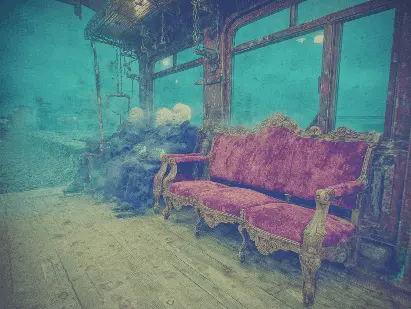
The interior was no passenger car; it was a reliquary of dead memories and heavy silences. Seats upholstered in a crimson velvet so dark it bordered on black, moth-eaten and stained with blackened splatters that evoked fluids dried decades ago. The air lacked fresh oxygen; it smelled thick, of dust accumulated in catacombs, burnt ozone, and a nauseating, metallic sweetness identical to an abandoned slaughterhouse after a fire. Not a living soul was in sight. Letting himself drop into the first available seat, the upholstery did not yield with the elasticity of ordinary wear, but felt strangely warm—possessing an organic, pulsatile heat that turned his stomach. The doors slammed shut behind him with a dry, airtight thud, a definitive seal. Instantly, the train lurched forward with a brutal jolt, a demented acceleration that violently hurled him against the cushioned backrest as the outside landscape erased itself into a blackness so absolute it seemed to devour the very concept of distance. He pressed his forehead against the cold window glass, searching for the familiar lights of the town in the distance. He found no hamlets, no roads. What stretched beyond the glass was an impossible topography: forests of charred trees whose branches twisted in gestures of eternal supplication, ghostly cities of collapsed structures beneath a firmament the color of a festering bruise. And across the barren fields, static and mute, humanoid silhouettes cut out against the blackness, all featureless of face, turning synchronously in unison to watch the train pass with a blind, ravenous attention.

The nightmare is not that the train leads you to hell; it is discovering that hell is not a place you arrive at, but the seat that was always reserved for you.
III. The Fracture of Certainty
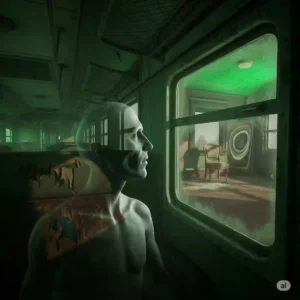
A murmur began to wind its way through the recesses of his mind, a foreign current of thought born not from any external loudspeaker, but from the very depths of his cortex. It was a genderless voice, cold as frost upon metal, articulating disjointed fragments of his own most intimate and silenced terrors: ‘No one is waiting for you… The shift never ends… This seat was already taken before you were born’. Carlos bolted upright, his heart hammering against his temples with a murderous fury. Glancing back at the seat he had just abandoned, a jolt of pure paralysis seized him: the exact shape of his body remained pressed into the velvet, yet it now radiated the same sickly, corpse-green fluorescence as the windows. Terrified, he bolted down the central aisle. The connecting doors were welded shut by aeons of rust; the glass withstood the desperate impact of his fists as though they were blocks of black granite. He was trapped inside a metallic centrifuge hurtling at impossible speeds toward absolute nothingness. Reaching the far end of the carriage, his trembling fingers brushed against a small plaque of polished brass, concealed beneath layers of historical grime. He wiped it with his coat sleeve, searching for a serial number, a route code. What he read left him bloodless: it was the full name of Santuario's last station master, a man swallowed by the fog and officially declared missing fifty years prior. His strength gave out all at once; his legs buckled like wet paper, sliding down the metal floor as the voice inside his head drowned out the final remnants of his identity. His final flicker of consciousness mirrored in the dark glass of the front door: it was no longer his own face staring back, but that of a gaunt old man with hollow sockets and a grimace of infinite resignation. The following morning, when a pale, useless sun finally managed to pierce the frost of the moor, the new station master unlocked the Santuario office and found an old notebook resting on the desk, opened to the last page, bearing a single handwritten line in fresh, trembling ink that had not yet fully dried.
📜Investigation • Frequently Asked Questions
Documentary Archive and Analysis of the Occult • Relatando.com
What origin or documented testimony inspired this story?
What are the telltale signs or anomalies that precede this phenomenon?
Witnesses and historical accounts report a drastic alteration in the perception of time, an abrupt drop in metal temperatures, the sound of unpowered machinery, and a persistent, suffocating fog.
Is there any documented psychological or scientific explanation?
From a psychological standpoint, it is interpreted as an extreme episode of chronic fatigue, sensory deprivation, and hypnagogic hallucinations stemming from prolonged occupational isolation during night shifts.
How do folklore and tradition react to this case?
Popular folklore strictly warns of the necessity to ignore any railway whistle that fails to match the printed official schedules, viewing it as a lure cast by wandering entities.
Do not extinguish the light yet...
If you have had the courage to make it this far, we have other dossiers that will test the limits of your sanity.

Terms and Figures of this Tale
To delve deeper into the legends, creatures, and dark concepts that inspire this account, consult their entries in our dictionary of the uncanny:

Tu correo no se publica ni se comparte con terceros: solo sirve para notificar la respuesta.