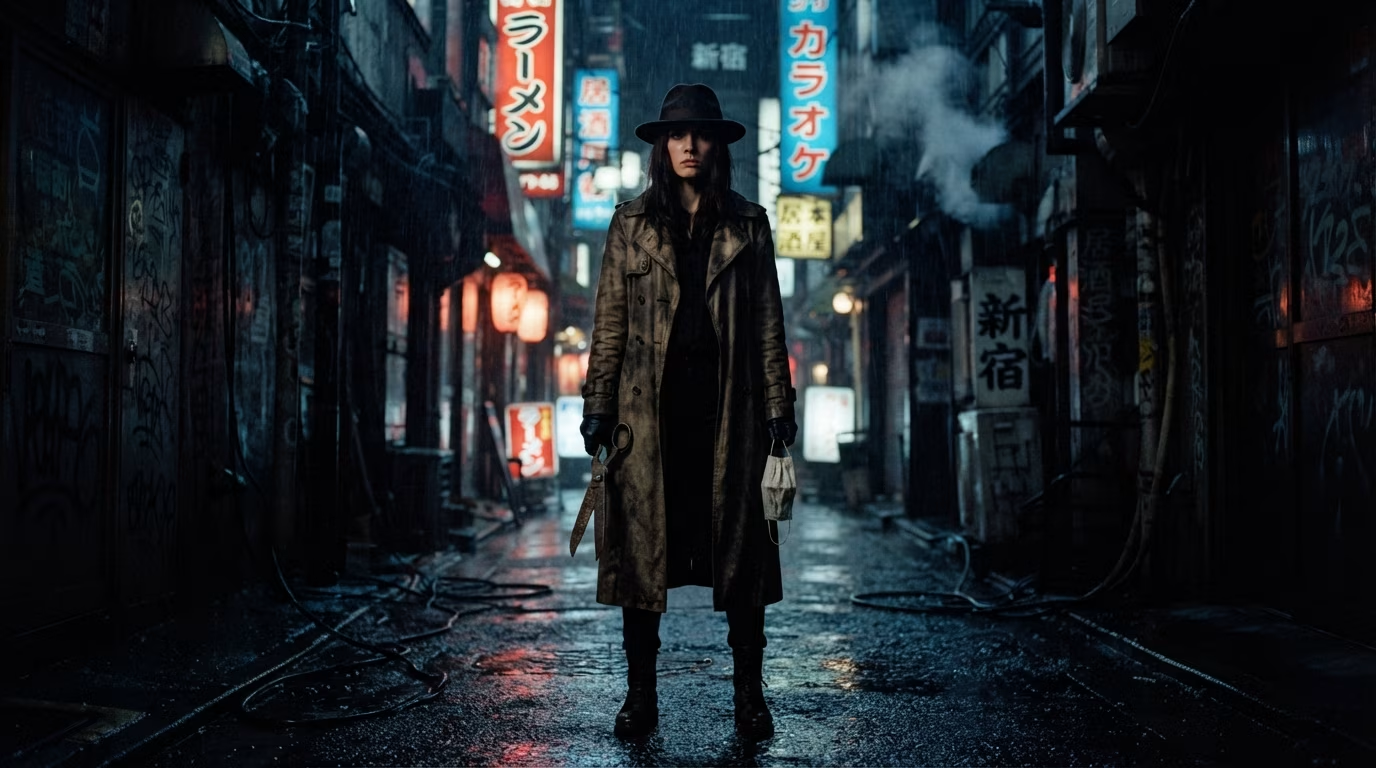
Tokyo's water does not fall; it collapses with a deaf, heavy insistence, as though the leaden sky meant to burst open upon the asphalt and swallow the city once and for all. Kenji Takahashi walked with his body drawn in beneath his black suit, already soaked to the marrow after sixteen uninterrupted hours in the offices of an investment bank in Marunouchi. His leather shoes seeped a brownish fluid with every step across the alley's hydraulic tiles. The neon of the Shinjuku signs, flickering and sick in tones of magenta and acid green, spilled into the puddles like watered-down blood. It smelled of wet asphalt, of stale noodle soup drifting up from a basement skylight, and of the metallic rust of air-conditioning ducts that hummed on a constant, low note, boring into the base of his temples. No one remained. At three-thirty in the morning, the back alleys that snaked behind the Isetan department stores became labyrinths of blind shadow where service doors sealed shut looked like the maws of vertical tombs. Kenji pressed the leather briefcase against his left ribs, feeling the cold that pierced the bone, cutting through the wool of his coat and seeking the heart with the precision of a needle. It was then, just as he turned the corner by the secondary Hanazono temple, where the stench of old incense vied with the damp of garbage heaped in large black vinyl bags, that the silhouette materialized. It came from nowhere; it simply passed from not being there to being there, occupying the narrow passage with an insulting stillness that defied the logic of urban motion. A tall woman, straight-shouldered and with a martial rigidity, wrapped in a beige trench coat of classic cut that reached almost to her heels. She carried a black umbrella, large and sober, tilted by a hair's breadth forward to conceal her features beneath its dome of gloom. And on her face, a white surgical mask, immaculate, of the kind Tokyoites wore out of sanitary habit, but which at that ungodly hour, amid that desert of concrete and drizzle, took on the grotesque aspect of a morgue bandage.
I. The First Sign
Kenji stopped dead. His sneakers splashed one last time before falling into absolute silence. The distance between them was no more than three meters. The sound of rain drumming on the canvas of the stranger's umbrella was a dry patter, like beetles scratching at the inside of a wooden box. The office worker tried to convince himself she was a delayed night-shift cleaner, or perhaps a worker from the nightlife establishments of Kabukicho who had missed the last train and was wandering aimlessly through the storm. He tried to step to the left, skirting around her with his gaze fixed on the ground, calculating the available space between the damp brick wall and the silhouette. But the woman slid with an unsettling fluidity, identical to a mannequin mounted on invisible rails, and cut him off again. She blocked the exact center of the alley. The umbrella tilted back a fraction. From the shadows cast by the brim of the raincoat, a voice emerged. It was not a scream nor a harsh whisper; it was a modulated, honeyed emanation of sound, of a sickly sweetness, almost childlike, that contrasted atrociously with the gravity of the Tokyo midnight.
¿Watashi… wa… kirei? (Am I beautiful?)
The question hung suspended in the vapor-heavy air. Kenji felt a dry whipcord snap at the base of his neck. The hairs on his arms stood on end with physical violence, a sharp, stinging pain in his epidermis that forced him to swallow hard. His throat was bone-dry sandpaper. Kenji's brain, atrophied by years of spreadsheets, sterile meetings, and corporate automatisms, tried to seek refuge in administrative sanity. He thought of some sick prank by his section coworkers, an internet social experiment, some contemporary stupidity recorded by hidden cameras. But the atmosphere had nothing modern or artificial about it. It smelled of ancestral dampness, of remote earth turned over in the rain, of something old and ravenous that had spent centuries waiting in the gloom of this very neighborhood. The figure remained static, arms hanging straight down by her sides, perfectly rigid, hands concealed deep within the pockets of her trench coat. Kenji did not answer immediately. The silence between them stretched like a gut-string about to snap, absorbing the distant murmur of cars on the main avenue. His mind, trapped in a loop of Horror imminent, tried to process the woman's geometric anomaly: she was far too tall for Japanese standards, her limbs appeared disproportionate, and the way rainwater slid down her trench coat seemed to halt before touching the fabric, as if an internal fever were evaporating the moisture instantly.

II. The Fracture of Reason
—Excuse me —Kenji managed to articulate, his voice broken, unrecognizable, a metallic thread drowning between the concrete walls—. I'm in a hurry. The train… the last train has already left, but I must reach my apartment in Nakano. Please, let me pass.
The woman did not move a single centimeter. The white surgical mask shifted slightly with the rhythm of a breath that seemed to come from a cavernous lung, dry, devoid of moisture. And then, she repeated the question, this time with a slightly more hissing nuance, prolonging the vowels with a macabre delight that froze the blood in his arteries.
Am I beautiful?… Tell me. Do you think I'm beautiful?
Panic ceased to be a mental abstraction and became a physical weight upon Kenji's chest. The air he inhaled tasted of rust and of dread pure. He remembered suddenly, with the blinding clarity of lightning, the tales his grandmother used to tell him on winter nights in the outskirts of Kanazawa, stories of urban ghosts, of creatures born of resentment and abandonment that prowled dark street corners seeking the validation life had denied them. The Legend of the slit-mouthed woman. Childish nonsense, a myth folklore artifact designed to frighten students returning home late. But this was no story. The dawn chill was no longer weather; it was the presence of something inhuman exhaling its breath upon his face. With an uncontrollable tremor in his fingers, Kenji tried to take a step back, but his heel caught on an empty soda can that rolled across the ground with an unbearable metallic clatter amid the alley's silence. The woman took a step forward. Her shoes made no sound whatsoever as they stepped into the puddle. With a deliberate, slow movement, choreographed like that of an actress in traditional Noh theater, she raised her hands from the pockets of her trench coat. Her fingers were excessively long, knobby, with nails painted a red so dark it looked black beneath the flickering neon. They grasped the upper edge of her surgical mask. A second later, those fingers yanked the fabric downward, revealing the hidden face.
III. The Abyss Beneath the Cloth
What appeared before Kenji's eyes did not belong to the world of the living. The mouth was not a human mouth; it was a horizontal wound, colossal and open from ear to ear, an infinite seam held by shreds of necrotic flesh and exposed cartilage that curved upward into a perpetual, blood-soaked smile devoid of lips. The teeth, piled and yellowed like broken tombstones in an abandoned cemetery, gleamed with the viscous drool oozing from the opening. The stench of putrefaction and coagulated blood struck Kenji with the force of a punch to the gut, making him double over and vomit bitter bile onto the pavement. And from the folds of that horrific cavity, the voice emerged again, now distorted, multiple, reverberating off the alley walls as if a hundred throats spoke at once.
And now?… Am I still beautiful?
The long, bony hands moved inside the trench coat pockets and withdrew an object that cast a dull gleam beneath the dying light of the neon sign: giant tailor's shears of heavy steel, their blades stained with blackish rust and dry remnants of textile fibers and human hair caught in the central screw. The mechanism of the scissors opened with a metallic snap, a dry sound that echoed in Kenji's mind like the verdict of an imminent execution. Survival instinct, primitive and savage, swept away any trace of rational thought. There was no escape. The alley was a dead end, blocked at the far end by a blind brick wall crowned with barbed razor wire. Kenji stumbled backward over his own legs, collapsing to his knees in the freezing mud. The creature she advanced, gliding over the wet ground without lifting her feet, her head tilted slightly, her eyes fixed upon him—vacant, white as opaque glass marbles that had never known the sunlight. The snap of metallic shears echoed again, closer this time, keeping time with his dying heartbeat.
IV. The Broken Mirror of Dawn
The hours that followed dissolved into a vortex of feverish delirium and shadow. When the first rays of a pale, indifferent sun finally pierced the layer of smog and mist over Shinjuku, the municipal sanitation crews found the alley deserted save for a puddle of dirty water and a black leather briefcase discarded against a brick wall. There was no trace of Kenji Takahashi, nor his umbrella, nor the woman in the beige trench coat. Only a white surgical mask lay on the ground, spotless, bearing a faint trace of dried blood along the inner seam. Police reports filed the case away as a voluntary disappearance driven by chronic work-related stress—the classic jouhatsu of a salaryman crushed by debt and the relentless pressure of the metropolis. Yet the street sweepers who cleared that exact zone the following week swore they heard, right as the midnight streetlamps flickered to life, the distant echo of a honeyed voice asking any unsuspecting passerby in the dark whether death possessed a human face, while the metallic snip of old shears sliced through the capital's silence.
Is there a limit to the terror a modern city can hide beneath its cobblestones?
📜Investigation • Frequently Asked Questions
Documentary Archive and Analysis of the Occult • Relatando.com
What true origin or documented testimony inspired this enigma?
The myth of the Kuchisake-onna has its roots in the urban legends of the Shōwa period in Japan, spreading with unusual force in the late 1970s and enduring within the collective psyche as an archetypal fear of the dark.
What are the telltale signs or anomalies that precede this phenomenon?
Folklore accounts and midnight tales agree on the apparition sudden appearance of a figure in deserted alleys, accompanied by a sharp drop in ambient temperature and an unnatural silence.
Is there any documented psychological or scientific explanation?
From the standpoint of analytical psychology, these apparitions are interpreted as projections of the subconscious confronted with mass urban isolation, guilt, and the extreme social pressure of the great metropolises.
How do folklore and tradition react to this case?
Japanese oral tradition suggests evasive or contradictory answers to unnerve the entity, though contemporary horror literature prefers to explore the victim's absolute mental collapse.
Do not extinguish the light yet...
If you have had the courage to make it this far, we have other dossiers that will test the limits of your sanity.

Terms and Figures of this Tale
To delve deeper into the legends, creatures, and dark concepts that inspire this account, consult their entries in our dictionary of the uncanny:





Tu correo no se publica ni se comparte con terceros: solo sirve para notificar la respuesta.