Chapter I: The Memory of the Rock
There are places in the geography of the north where the earth is not mere mineral matter, but a scarred skin that smothers ancient screams. Zugarramurdi is one such place. For the summer traveler, the great cavern of Navarre is little more than a geological whim, a cathedral of stone pierced by the current of the Olabidea stream —the Regata del Infierno—, varnished by the soot of tourism and sweetened narratives. But for me, after a decade unearthing the files of the Tribunal of the Holy Office of Logroño and comparing them with the uncharted topographies of the Baztán valley, that tunnel of rock represented a mouth. A mouth that continued to chew.
That twenty-first of December, the winter solstice had buried the town beneath a layer of impenetrable frost. The air cut the lungs like shards of ground glass. The locals, heirs to an atavistic dread that modernity had failed to extirpate, barred their farmhouses tight before midnight. No one roamed the meadows of Sorgin Leze when the night reached its nadir. No one except me.
I carried with me the precision instruments: an industrial-grade infrared pyrometer, a dual-axis fluxgate magnetometer, and my old leather-bound notebook. My hypothesis was purely geophysical—or at least that was what I kept trying to persuade myself in a vain exercise of sanity: I intended to prove the existence of a thermal anomaly of tectonic origin, a pocket of slowly digesting gas, or a deep magmatic upwelling that, in antiquity, had fed the villagers' superstitions and inspired the myth of witches and their unholy bonfires.

I vaulted the metal gate that blocks tourist access. The silence of the high mountains was a solid block, broken only by the crunch of frozen scrub beneath my boots. As I crossed the cavern's threshold, the ambient temperature plummeted. My breath thickened into a white cloud within the beam of my headlamp. The limestone walls, sculpted by millennia of water erosion, resembled the fossilized gullet of an antediluvian beast. The stream ran at my feet, a ribbon of black, swift water that whispered liquid blasphemies against the pebbles.
Chapter II: The Regatta of Hell
I walked some two hundred meters into the main chamber, to the point where moonlight relinquishes all jurisdiction. The stench of damp and bat guano was the usual, but as I advanced along the secondary gallery — a narrow passage that official maps classify as impassable — the air began to mutate. A dry breeze, almost desert-like, struck my face.
I glanced at the digital thermometer on my wrist. Outside it read three degrees below zero. At the cave entrance, four above. Here, fifty meters beneath the limestone surface, the screen flickered, registering eighteen degrees Celsius. And rising.
—Impossible —I murmured to myself. My voice sounded small, crushed under the thunderous weight of the rock.
The ground dropped away in a steep slope, polished by a clinging dampness that was not water. The rocks cast aberrant shadows that writhed in the sweep of my flashlight. I remembered the confessions extracted under torture by the inquisitor Alonso de Salazar y Frías in 1610: «And there in the grotto, hard by the cleft plunging down to the abyss, they would kindle the great bonfire that consumed no wood, and they worshipped the Great He-Goat in the likeness of a faceless black man...». Enlightened historiography had always dismissed those records as delusions induced by the strappado and the rack. I myself had written an essay defending that thesis. What stupid arrogance, that of the academic who believes he knows the world merely because he has catalogued its ashes.
As I gained depth, the magnetometer began to emit an erratic beeping. The needle of the analog compass spun wildly, unable to orient itself within that telluric labyrinth. But the most alarming thing was not the failure of the instruments, but the transformation of the thermal environment. At a hundred meters down, the temperature reached thirty-two degrees. I took off my mountain jacket, sweating profusely. The skin of my arms reacted with an instinctive bristling, not from the cold, but from an invisible presence that saturated the space with static electricity.
And then I heard it for the first time: a dull crackling, rhythmic, impossibly distant. The unmistakable sound of dry wood snapping under fire.
Chapter III: The Whisper of the Lime of the Dead
The conduit narrowed into a vertical crawlspace through which I had to drag myself. The stone was not cold; when I placed my bare palms on the limestone, I felt a subtle vibration, a pulsing that recalled the heartbeat of a monstrous, lethargic heart. The rock burned. I had to use leather gloves to keep my skin from searing. The air grew dense, saturated with an acrid stench that was not common sulfur, but a repulsive blend of rancid tallow, burnt resin, and something indefinable that evoked sweet flesh left in the sun.
I emerged into an uncharted cavern, an immense hollow shaped like an inverted amphitheater. When I shone my headlamp upward, the light found no end: only an absolute blackness that seemed to swallow photons. Yet the depths of the grotto were not dark.
A reddish glow, muted but unmistakable, seeped from a deep fissure at the center of the chamber. It was not a living light, flickering like that of any common fire, but a crimson phosphorescence, dense as liquid mercury, flowing from the bowels of the earth. I drew closer step by step, my heart hammering against my ribs until it hurt.
The laser pyrometer read ninety-eight degrees when aimed at the mouth of the shaft. Yet there was no smoke. No visible embers. Only the light and a radiant heat that threatened to blister my face.
When I leaned over the edge of the abyss, I saw the source of the heat. Some thirty meters below my position, on the bed of an unfathomable well, there was no magma, no volcanic deposits. There was a pyre. A colossal pyre composed of intricate forms that took me several terrified seconds to process. They were not oak or pine logs. Cabinetwork of calcified human bones, interwoven with surgical precision, and above them, floating in the dead air of the shaft, a flame of jet-black rimmed with violet.
The fire did not consume the structure; it nourished it. And around that impossible pyre, the light cast shadows upon the cave walls. Shadows that corresponded to no object and no person present. They were graceful silhouettes, naked, hand in hand, whirling in a frenetic, disjointed dance, spinning counterclockwise.
Chapter IV: The Undying Dance
My scientific mind struggled to shatter and remake itself in a mold of pure dementia. I fell to my knees on the searing stone. The heat pierced through the legs of my trousers, scorching my flesh, but I was utterly paralyzed by fascination and horror.
The dancing shadows on the wall were neither static nor mere optical illusions. They had depth. I could hear their footsteps: a constant hiss over the limestone, like thousands of vipers sliding in unison. And alongside the crackle of the black flame, a vocal murmur began to emerge. A chant in an archaic, guttural Basque, predating known syntactic structures, a language hewn with axes onto prehistoric stone.
—Akerbeltz... Etsai... Zugarramurdi... —the voices repeated. They did not rise from the chasm, but from the walls themselves, from the air thick with ozone, from my own inner ears.
I understood the dreadful truth that the Inquisition suspected but, in its dogmatic myopia, never truly grasped. The autos-da-fé of 1610, the human pyres kindled in Logroño, the tortured and executed women… none of it had destroyed the coven. The inquisitors had merely sheared the dead leaves from a tree whose roots sank deep into the abyss of time. The witches of Zugarramurdi did not burn firewood to warm their bodies on winter nights; they were the fuel. Their faith, their covenant with the primordial, their refusal to submit to the new god of the cross had sealed a thermal contract with the bowels of the earth.
The fire that fed the coven was no transient historical event. It was an eternal fire, an ember of creation that awakened each winter solstice, feeding on the echoes of spilled blood, the memory of pain, and the atavistic devotion the earth never forgets.
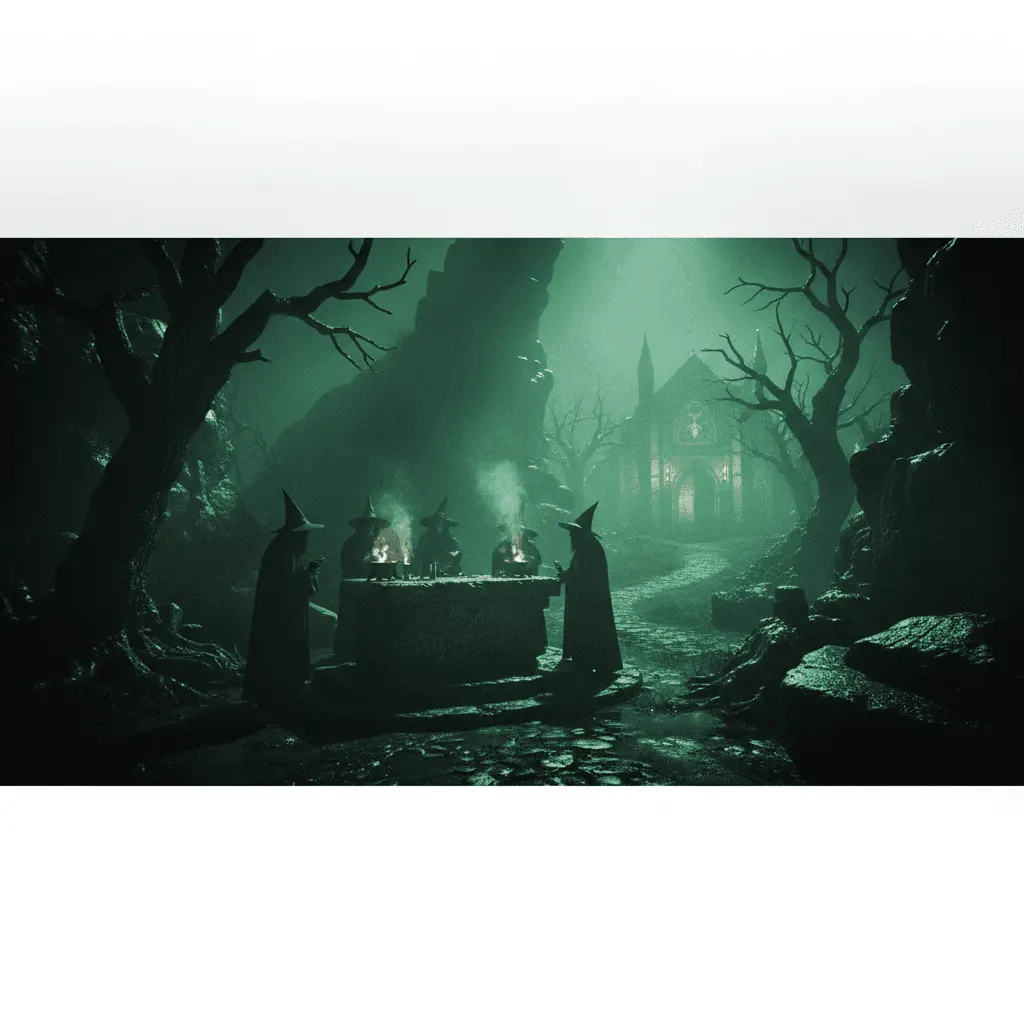
Suddenly, the shadows halted.
Silence returned to the cave, heavier and more suffocating than before. The dozens of silhouettes cast upon the stone slowly turned their abstract heads toward the ledge where I stood. They had no faces, yet I felt the unbearable weight of their invisible gazes fixed upon my small, trembling figure.
Chapter V: Flesh for the Cauldron
The black flame at the bottom of the well grew, rising like a column of dark plasma that defied gravity. The heat in the room became unbearable. My skin began to redden, the synthetic fibers of my clothing warped and clung to my body. My notebook, forgotten beside my hand on the stone, began to smoke; the pages browned before bursting into a spontaneous blaze without any spark touching them.
From the heart of the bone pyre, a figure began to emerge. It did not bear the crude shape of the goat-headed one depicted in medieval engravings. It was something far vaster and amorphous: a mass of living blackness, hulking, crowned with twisted antlers that resembled fossilized oak branches, its surface endlessly mutating between agonized faces and vertical pupils that wept crimson light.
The numen of the abyss. The true Lord of the Valley.
I tried to rise and flee, but my legs would not answer; the stone seemed to have melted the soles of my boots, welding me to the cavern floor. The heat did not kill me outright; it paralyzed me, slowly cooking my will while the entity climbed the shaft wall with the deliberation of one who knows that time is merely an illusion of the surface.
I understood then the purpose of my presence there. I had not come by chance, nor by the blind impulse of scientific inquiry. The anomaly had drawn me for years. The solstice demanded a renewal of the covenant. The coven's flame was not kept alight by memories alone; it required new blood, enlightened minds capable of grasping the magnitude of the horror before being consumed.
The shadow of a woman—tall, her hair drifting as if she were submerged in water—peeled away from the limestone wall and walked toward me. I felt the touch of her hands on my shoulders. They were not cold like a specter's; they burned like iron heated white-hot. Her breath on my neck smelled of scorched rosemary and ancestral ash.
—Dance with us —whispered a voice that resonated in the marrow of my bones—. Dance with us.
My headlamp died with a dull click. Absolute darkness enveloped me, but I no longer needed it to see. The black fire that burned at the bottom of the abyss illuminated the interior of my own brain. I saw the history of the world before the arrival of humankind, I saw the cold stars rising over the Pyrenees when the rock was still soft magma, and I saw the flame that never, ever, would be extinguished.
I stopped feeling pain. The heat no longer scorched me; it dissolved me. My physical body began to lose its rigidity, becoming malleable, integrated into the limestone, passing into the fabric of the cavern wall.
If you ever descend into the caves of Zugarramurdi on the night of the winter solstice, do not trust the stillness of the stone nor the innocent murmur of the stream. If you feel the air turn warm and dry, and you hear the crackle of firewood where there is no fire, do not look down. Flee. For the pyre still burns in the bowels of the abyss, and the shadows of the coven are always seeking a new hand to grasp, so that they may never cease their dancing.
📜Investigation • Frequently Asked Questions
Documentary Archive and Analysis of the Occult • Relatando.com
In what ways does the narrative intertwine inquisitorial archival research with field geophysics within the setting of Zugarramurdi?
The text establishes a fascinating tension between documentary rigor—represented by the legal files of the Tribunal of the Holy Office of Logroño—and the protagonist's empirical approach utilizing modern scientific instrumentation. This duality seeks to demystify the Horror ancestral through the measurement of thermal and magnetic anomalies, transforming superstition into a latent geophysical enigma buried deep within the Baztán valley.
What literary and historical symbolism does the cave of Sorgin Leze embody within both the folkloric narrative and the text itself?
Sorgin Leze is not conceived merely as a geographical accident, but as an organic, threatening threshold—a 'mouth' that continues to chew upon the collective memory of the north. By setting the incursion during the winter solstice, the narrative invokes the atavistic dread of the locals, contrasting winter isolation with the audacity of a researcher who defies the limits imposed by the myth.
What role does the use of precision technology play in constructing the atmosphere of suspense and intrigue within the tale?
Tools such as the infrared pyrometer and the fluxgate magnetometer serve as a psychological shield for the protagonist while simultaneously functioning as a narrative device that heightens the realism of the mystery. Through the collection of scientific data that soon begins to contradict itself, the subterranean environment acquires a supernatural agency that undermines the expedition's supposed rationality.
How does the imprint of Basque folklore and the trials of the Spanish Inquisition manifest within the structure of this chapter?
The work breathes the oppressive atmosphere of seventeenth-century witchcraft trials, evoking the covens that the Inquisition relentlessly hunted across the region. The text subverts the traditional tourist perspective to plunge the reader into 'Hell's Regatta'—a landscape where oral history, the dread ancestral, and documentary rigor converge to breathe new life into the legends of Zugarramurdi.
Do not extinguish the light yet...
If you have had the courage to make it this far, we have other dossiers that will test the limits of your sanity.

Terms and Figures of this Tale
To delve deeper into the legends, creatures, and dark concepts that inspire this account, consult their entries in our dictionary of the uncanny:

Tu correo no se publica ni se comparte con terceros: solo sirve para notificar la respuesta.