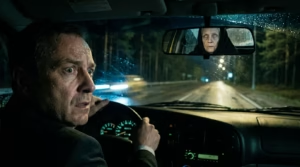
The fuel gauge needle had been trembling on the brink of exhaustion for the last twenty kilometers, an invisible, relentless ticking that seemed to mark the dying pulse of the six-cylinder engine. Outside, the darkness of the moonless Mojave night loomed over the windshield like a heavy, almost gelatinous substance, swallowing the beams of yellowish light cast by the headlights. There was no moon. No stars. Only a compact, absolute blackness, where the state highway stretched like a ribbon of cracked asphalt that seemed to lead nowhere. The desert's nocturnal cold, a dry, treacherous cold that pierced the bones with the precision of a blade, had begun to fog the corners of the windows, forcing me to turn on the heater, whose dull hum competed with the constant roar of the wind that rocked the car's chassis.
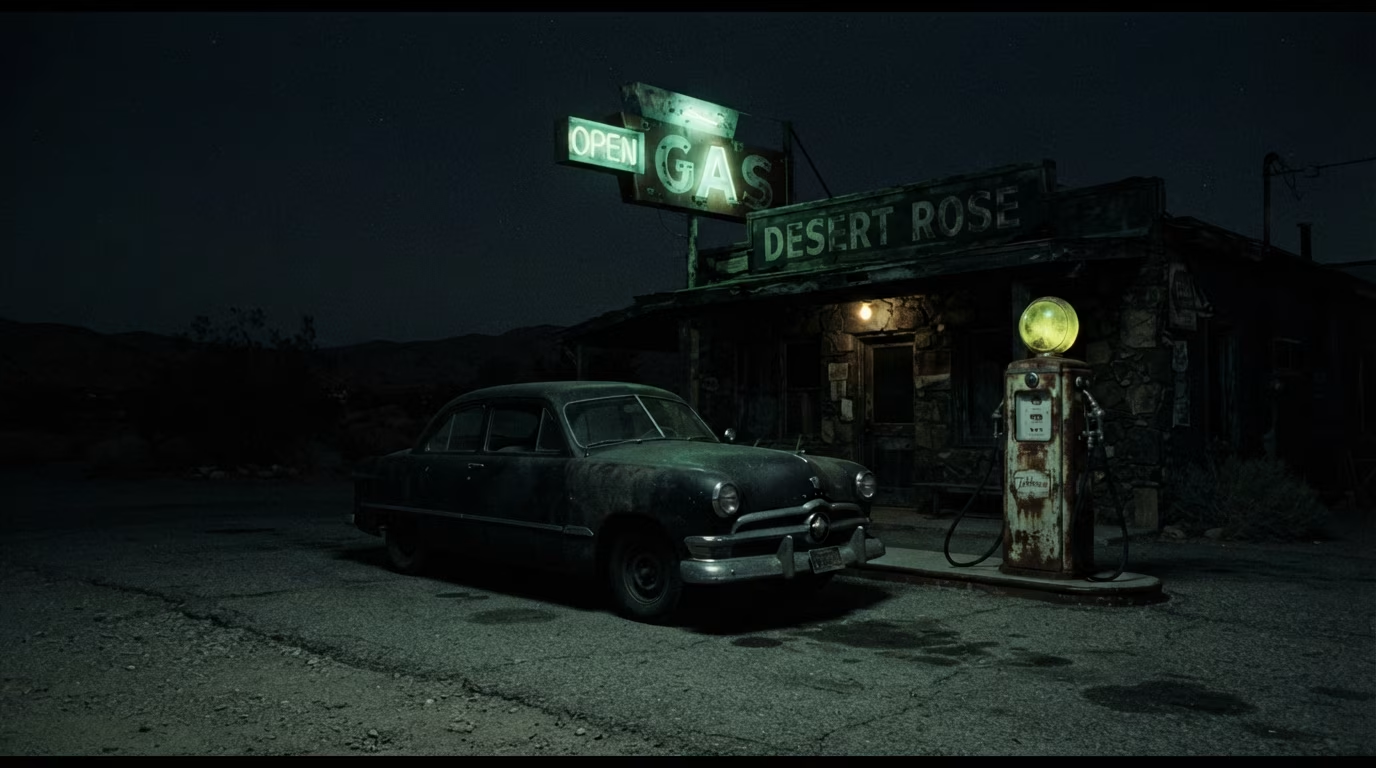
And then, silhouetted against the nothingness, the glimmer appeared. A greenish, electric flicker, a sharp buzz that sliced the air with intermittent hums: an old neon sign hanging askew over a low-roofed gray cement structure. GAS, read the sign, though the last letter flickered frantically before going out entirely in a sputter of invisible sparks. There were no towns nearby, no road signs announcing the turnoff, not even the reflection of another highway on the horizon. It was simply there, sprouting from the sand and the forgetting like a mechanical mirage. I wrenched the wheel, my heart hammering violently against my ribs, and veered onto the flat expanse of dry earth, feeling the tires crunch over loose gravel until I brought the car to a stop beside a single antique gas pump, the kind with a glass globe on top that looked like it had been torn from another decade.
I. The First Sign
I killed the engine. The silence that lunged into the cabin was so sudden and so heavy that my ears rang. Outside, the only sound was the rhythmic, metallic ticking of the engine block cooling, contracting in the gloom. I sat motionless for a few seconds, hands clamped to the wheel, breathing the stale air inside, thick with the smell of cold coffee from a crumpled cardboard cup and the lingering reek of old upholstery. The gas station looked abandoned at first glance; the windows of the small adjoining shop were coated in a layer of dust so thick it blocked any view of the interior, and the paint on the walls was peeling away, revealing the grayish, cracked plaster of the fifties.

Yet the neon light kept buzzing, and a tungsten bulb, dim and jaundiced, swayed faintly above the entrance door, stirred by the icy small-hours breeze. I got out of the car and shut the door with a dry thud that echoed with a harsh clatter across the vast emptiness of the plain. The cold struck me at once, puckering the skin on my arms. I buttoned my coat to the collar, shoving my hands into my pockets as I approached the pump. There was no automatic hose, no credit-card reader. Only a side lever of wrought iron and an analog dial with numbers faded by the scorching sun of the daylight hours.
The desert keeps no secrets; it merely buries them under layers of silence and sand until someone in too much of a hurry decides to dig them up.
I pushed open the store door. The screech of the metal hinges sounded like the whimper of a wounded animal. The interior was a claustrophobic cubicle, bathed in an amber half-light that barely revealed metal shelves crammed with cobwebbed tin cans and soda bottles bleached by the passage of time. It stank of burnt oil, stale black tobacco, and stagnant damp. Behind a counter of worm-eaten wood, seated in a wicker chair that creaked with every slight movement, sat an old man. His face was a topographic map of deep wrinkles, dark furrows tanned by decades of harsh weather, and his eyes, a pale watery blue, stared at me fixedly from the depths of sunken sockets, unblinking, with a curiosity that was not welcoming but surgical.
II. The Fracture of Reason
"Fifty liters," I said, trying to make my voice sound steady, though the words came out strangled by the dryness in my throat. "Or whatever it takes to reach the next town. Is the register open? I can't find a card reader."
The old man did not answer at once. He tilted his head to one side, studying me with a maddening slowness, as if he were weighing the heft of my bones or counting the pulse of my blood through the skin of my neck. He wore a red-and-black plaid flannel shirt, sleeves rolled to the elbows, exposing sinewy forearms marked by linear scars and old burns from hot oil. Slowly, he raised a gnarled hand and pointed his index finger outside, toward the underground tanks behind the establishment.
"Gasoline flows when the desert damn well pleases, boy," his voice murmured, rough as sandpaper dragged over stone. "But the tanks don't fill themselves. We don't take plastic cards here, nor crumpled paper bills that ain't worth a thing beyond these hills. Energy has a precise cost. Something for something. That's the law of the road."
A cold pang of unease knifed into the pit of my stomach. I tried to smile, a tense grimace that never reached my eyes. "You're joking, I assume. Tell me how much in cash and that's that. I'm in a hurry; the journey's been long and I need to make it by dawn."
The old man rose from the chair with a dry creak of joints. He walked with a shuffling gait, leaning heavily on the edge of the counter, until he vanished behind a curtain of faded plastic beads that separated the shop from a dark back room. After a few seconds, he returned dragging a metal drum of used oil, heavy and rusted, which he let fall to the floor with a dull thud that raised a small cloud of gray dust. He unscrewed the lid with an expert twist and stared straight into my eyes, an indecipherable expression on his lined face.
III. The Abyss in the Drum
"Take a look," the old man whispered, in a tone that brooked no reply, a hypnotic command that annulled my capacity for resistance. "Look into the oil. There lies the exact price of every kilometer you have left to travel in this world."
I stepped forward, driven by a morbid fascination and a Horror hollow dread that rooted my legs to the floor. I leaned over the gaping maw of the metal drum. The stench of thick, burnt motor oil was nearly suffocating, coating my nasal passages with a sickly, metallic sweetness. Under the dim, sickly glare of the overhead bulb, the viscous black fluid filling the container was far from empty. Floating upon the sluggish surface, half-submerged and trapped within bubbles of stagnant air, were small, gleaming car keys—some attached to cracked leather fobs, others fitted with modern electronic remotes bearing unmistakable signs of wear.
I tried to look away, to back off, to flee in terror toward the door, but my muscles would not respond. My eyes remained fixed on one key in particular, a key with a small, worn plastic tag hanging from a stainless steel ring: a keychain bearing the logo of a hotel in Phoenix, the exact same model of car my older brother had driven, the brother who had vanished without a trace on this very cursed highway three years ago.
—They too were in a hurry to arrive —whispered the old man behind me, his icy breath grazing my nape—. And they all paid for their fuel before starting up one last time. What will you leave at the bottom of the drum to make your engine roar again?
Silence swallowed the gas station once more as the neon sign outside finally went completely dark, plunging the exterior into an absolute and irrevocable darkness, with no light left to offer an escape route back to the world I once knew.
📜Investigation • Frequently Asked Questions
Documentary Archive and Analysis of the Occult • Relatando.com
What true origin or documented testimony inspired this enigma?
The account draws from the urban legends lore surrounding cursed stretches of Route 66 and the unexplained disappearances of travelers in the remote expanses of Nevada and California.
What are the telltale signs or anomalies that precede this phenomenon?
The sudden plummet of the fuel gauge, the absolute loss of cellular signal, and the apparition anomalous appearance of infrastructure entirely absent from official maps.
Is there any documented psychological or scientific explanation?
Psychology attributes these experiences to highway hypnosis, sensory deprivation hallucinations, and extreme fatigue in lone drivers at night.
How do folklore and tradition react to this case?
Local desert folklore warns of places where time stops and the souls of the lost remain trapped forever in impossible transactions.
Do not extinguish the light yet...
If you have had the courage to make it this far, we have other dossiers that will test the limits of your sanity.

Terms and Figures of this Tale
To delve deeper into the legends, creatures, and dark concepts that inspire this account, consult their entries in our dictionary of the uncanny:


Tu correo no se publica ni se comparte con terceros: solo sirve para notificar la respuesta.