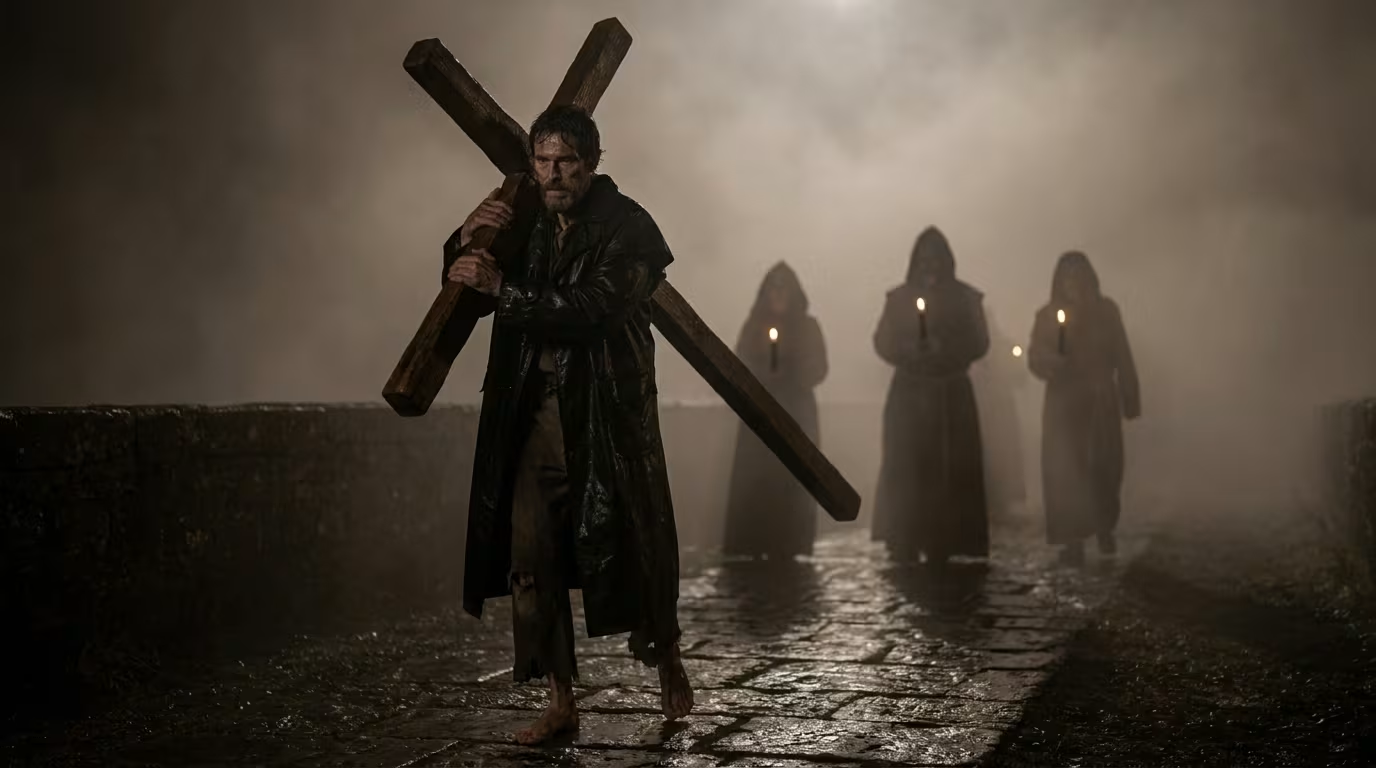
The taste of rancid brine and tar clung to the palate like a scab of pus. The air in the narrow tracks of Carnota was not breathed; it was swallowed with the revulsion of a lump of cold grease. Xoel dragged his rubber boots across the stone slicked by the Atlantic dew, seeking the turnoff toward his home, where the watery cabbage stew awaited on the hearth. The fog did not come from the sea; it seemed exhaled from the very bowels of the humus, a thick, grayish mass that erased the low stone walls and turned the gorse into silhouettes of hanged men. The oil lamps were far behind, extinguished by the damp. There existed only the dull thud of boot soles against moss and the rhythmic dripping of shark oil from his canvas slicker onto his thighs. It was then, rounding the bend where the path strangles between two cyclopean walls of damp granite, that the shadow ceased to be a shadow. There was no crack of branches. The figure simply coagulated amid the haze: tall, gaunt, draped in a black cowl that smelled of an old cassock kept in a chest of rotting oak for centuries. It had no face, only a hollow of deep shadow where the eyes should have been dead embers. Without emitting a breath of air, the thing thrust forward its skeletal arms and deposited a beam of yew wood upon Xoel's shoulders. The impact buckled his knees. The timber was freezing, heavy as a lead sarcophagus, and gave off an acrid stench of dried sweat and freshly dug grave soil. Xoel tried to scream, but his throat tasted of bile and sand. The figure dissolved into the vapor, leaving a metallic chill embedded in his collarbone.
I. The Smell of Humus and Rust
For three days, the weight did not abandon Xoel's flesh. The invisible beam, or perhaps a terribly real one, dented his left shoulder until his skin turned a bruised green that his mother watched with the mute silence of Galician mourners. The young man no longer went out to fish. He sat in the low kitchen, staring at the whitewashed wall where damp stains traced maps of viscera. He tried to throw a piece of firewood into the hearth, but his fingers refused to obey; his tendons cracked like dry vine-shoots every time he tried to close his fists. The smell of the sea had vanished from his clothes, replaced by a sickly-sweet stench—the smell of flesh beginning to strip from bone in the darkness of a damp crypt. At night, fever hammered his temples with a mechanical rhythm. He heard the sea crashing against the cliffs of Lira, but the sound arrived distant, drowned out by a metallic buzzing that resembled flies swarming over a bloated carcass in the meadow. His mother brought him a spoon of fish broth, but Xoel turned his face away; the mere contact of the warm liquid against his lips provoked bloody retching. His nails turned a grayish hue, brittle as the scales of an old sea bass. He looked into the sideboard mirror and barely recognized his sunken cheekbones, his sallow skin stretched tight over his skull like poorly tanned parchment. The wood was still there, invisible to everyone else, sinking millimeter by millimeter into his collarbone, seeking the marrow.
Wood does not weigh by its size, Xoel. It weighs by the dead who have not yet finished dying.
The words of his grandmother, buried in the churchyard of San Pelayo a decade ago, echoed in his skull with the sharpness of a knife slicing stale bread. He tried to rise from his pallet past midnight, but his legs trembled with spastic violence. The skin on the soles of his feet felt strangely parchment-like, insensible to the cold of the stone floor. Something inside him had broken, a delicate gear that separated man from beast of burden. The house smelled of burnt wax, though no candles were lit anywhere. The ticking of the wall clock had stopped precisely at a quarter past three—the hour when the village dogs stopped barking and began desperately scratching the earth at doorframes. Xoel felt his knees buckling backward, forcing him into a hunched posture, the exact posture of the tall figure beneath the fog of the crossroads. His own breathing sounded like a broken bellows, wet, expelling a thick vapor that clung to the windowpanes as tiny brownish droplets.

II. The March of the Blind
Midnight on the fourth day demanded no effort to unlatch the door. The iron bolts yielded of their own accord, eaten through by an instantaneous green rust that bloomed across the metal in mere seconds. The cold of the sunken country lane struck his face like a slap of saltwater mixed with crushed ice. Xoel stepped out barefoot. The mud of the path was hard, glazed by a black frost that crackled beneath his heels with a brittle, glassy snap. He was not alone. To his right, an endless file of silhouettes shrouded in identical rough wool habits marched in uniform cadence, dragging their feet in the continuous scrape of old leather against loose shale. They carried yellow tallow tapers that cast no illumination, merely exhaling a greasy penumbra that devoured the stars. Xoel walked at the head of the procession. His own hands now gripped the heavy yew cross, driving its terminal points deep into the flesh of his palms until a thick, black thread of blood welled up and dripped onto the stones. No one spoke. Every so often, the dry fracture of a broken vertebra snapped the silence, followed by the wet hiss of fog colliding with the low stone walls. The village houses slipped past on either side with their windows sealed tight, the shutters barred with heavy timber; the townsfolk knew precisely what walked the tracks when the air smelled of wet bones. Xoel's feet no longer belonged to him. They were flayed, his toes dangling in bloody strips that left a dark smear across the frost, yet he felt no pain—only the dull, grinding cold of the wood boring relentlessly into his collarbone until it grazed the pericardium. The procession pressed onward, unhurried, guided by a destiny invisible, lying beyond the stretch of sand, where the sea dissolved into the absolute blackness of the Galician horizon.
III. The End of the Road on the Sandy Shore
The murmur of the waves became a dull roar when the line of faceless monks reached the high-tide mark. The fine sand, usually white, looked here like a black, viscous mire where thousands of dead crabs piled up to form a crunching crust. Xoel stopped. His legs, reduced practically to bones covered in gray hide, sank into the damp sand up to his knees. Around him, his companions raised their tallow candles, whose black flames began to sputter, giving off a thick smoke that smelled of burnt hair and rancid whale blubber. The yew cross now weighed as much as the entire world; he felt the timber piercing his sternum, seeking to burst through his back in a silent orgistic frenzy of splinters and torn flesh. He opened his mouth to exhale a final death rattle, but no air came from his throat—only a dense cloud of blowflies that dispersed toward the darkness of the ocean. The silhouettes began to kneel one by one around him, driving their knees into the sand with the sound of dry bones snapping. Xoel looked down and saw that his own feet were no longer there; in their place, two knotty, blackened roots sank deep into the seabed muck, greedily absorbing the brackish water. The fog closed over his head like a shroud of wet wool, sealing his eyelids and filling his ears with the eternal roar of the undertrain. There was no longer cold, nor pain, nor memory of the kitchen with its cabbage stew. There remained only the wood, the endless night of Carnota, and the absolute certainty that, when dawn broke, another solitary traveler would cross that very same crossroads seeking the warmth of home.
📜Investigation • Frequently Asked Questions
Documentary Archive and Analysis of the Occult • Relatando.com
On what myth or dread reality is this tale based?
It draws inspiration from legends Galician upon the Santa Compaña, the procession of souls in torment that roam rural paths in the dead of night.
Are there documented real cases similar to this story?
There are no scientifically documented cases, yet the folklore of the Iberian northwest is rife with accounts of encounters with spectral night-walkers.
What does the ending of the story mean?
It represents the erosion of human identity and the protagonist's assimilation into the eternal cycle of torment and rural Galician purgatory.
Do not extinguish the light yet...
If you have had the courage to make it this far, we have other dossiers that will test the limits of your sanity.

Terms and Figures of this Tale
To delve deeper into the legends, creatures, and dark concepts that inspire this account, consult their entries in our dictionary of the uncanny:





Tu correo no se publica ni se comparte con terceros: solo sirve para notificar la respuesta.