The stench of scorched salt, aged pine wood, and roasting meat clings to the skin like a second layer of frost as the Atlantic gloom devours the last vestiges of daylight. This is no ordinary night at the edge of the Iberian Peninsula; it is the exact moment when time fractures and the tides of memory vomit up whatever the entire year sought to bury beneath silence. Welcome to the geography where the living and the dead share the same fire—a territory where reason dissolves before the relentless weight of tradition and the deepest mystery.
I. The Solstice of Shadows
The roots of this ritual plunge deep into a thick, ancient humus, long preceding the calendars we now dictate by our clocks. Ages before Christianity baptized the date in honor of Saint John the Baptist, the inhabitants of these lands already gazed upon the midsummer sky with a mixture of reverence and dull panic. They knew, with the stubborn certainty of seafaring folk, that the moment the sun reaches its zenith and the light begins its slow, agonizing retreat into darkness, the boundaries of the world grow perilously thin.
In Galicia, nature is no mere backdrop; she is a watchful entity, a living organism that breathes through fog-choked forests and undertow-battered cliffs. During Midsummer Eve, that wilderness reaches a mystical boiling point. The forces of life and death collide in a delicate equilibrium that tolerates no passive spectators. Here, fire is not simply an instrument of celebration; it is a desperate shield against whatever crawls back from the other side.

The fire seeks not to illuminate the night, but to draw an invisible line that the dead dare not cross.
II. The Dance of the Bonfires and the Great Beyond
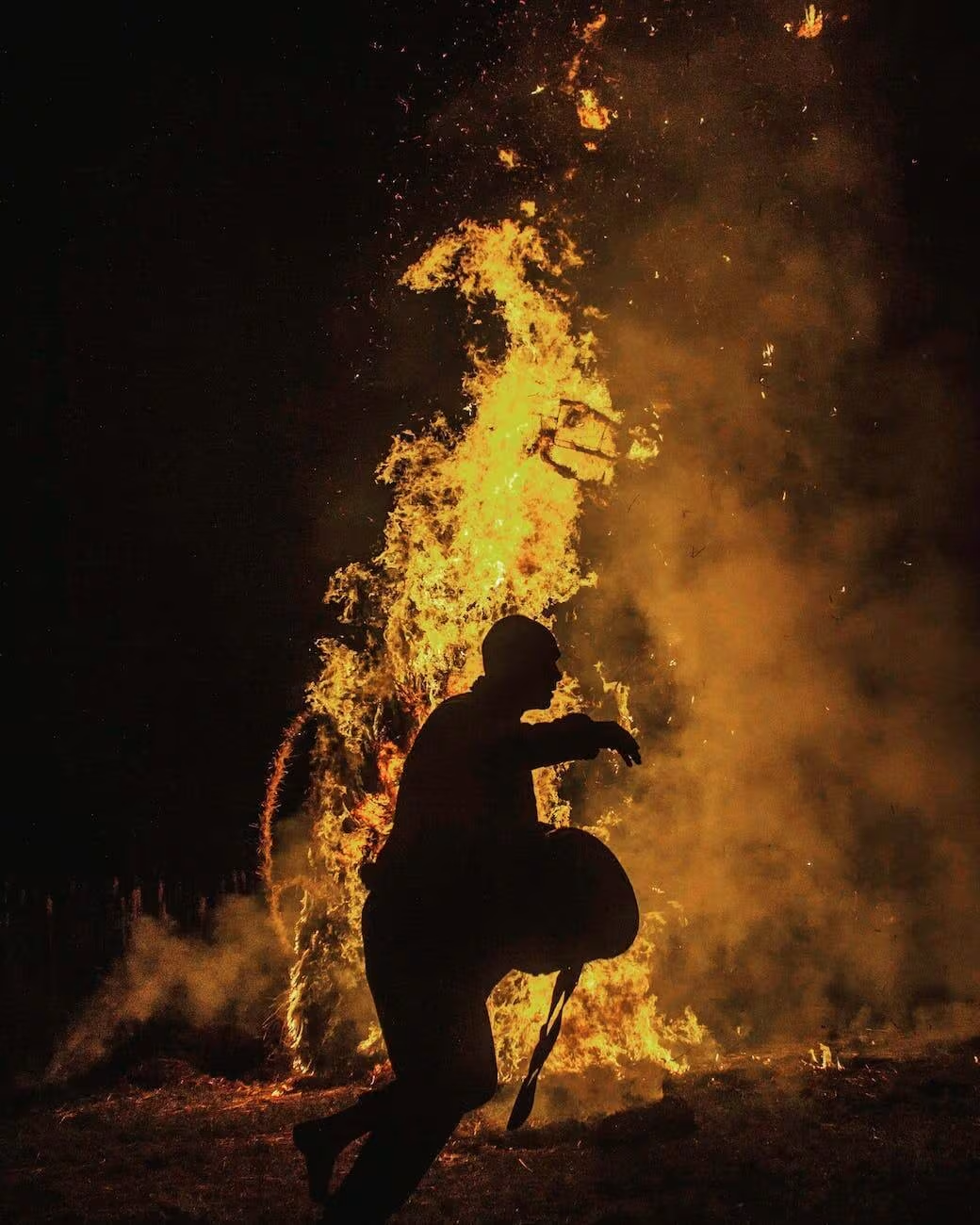
As night descends upon the Galician beaches, the horizon ignites with thousands of bonfires flickering like furious eyes against the blackness of the sea. The sand, ordinarily cold and deserted at this hour, transforms into a boiling anthill of living souls seeking, through heat and smoke, a desperate form of purification. People's faces, illuminated by amber flashes, take on an almost spectral grimace, as if they themselves were crossing the threshold.
It is at this precise moment that popular belief becomes flesh. Locals and pilgrims dare to leap over the flames, an act of visceral faith that promises to cleanse the soul of past guilts and ward off the malevolent spirits lurking in the dark. Yet the true danger lies not in the fire that burns the flesh, but in what watches from the opposite bank. The legends murmur that the spirits of the deceased—those who found no rest in the depths of the sea or the silence of village graveyards—return to mingle among the crowd, searching for the warmth they lost.
The tales told around the hearth are not childhood fables meant to chase away sleep; they are warnings burned deep into the collective memory. It is said, voices breaking over the low murmur of the surf, that should a woman dare to comb her hair before a mirror or gaze into the seafoam at the stroke of midnight, her reflection will cease to belong to her, instantly drawing the specters of sailors who never returned from their wrecks. And in the dark alleys of the coastal hamlets, old wives' tales insist that the *meigas* and wandering entities walk the night, hunting for unguarded faces to drag across to the other side of the mist.
III. The Triumph of Magic and Memory
As the pre-dawn hours bleed into their inevitable end, the clamor of songs and toasts begins to yield to the weight of a dense, supernatural exhaustion. The bonfires dwindle into mounds of embers that pulse like dying hearts in the beach's embrace of dark. It is then that silence reclaims its territory—a silence fraught with a strange presence, as though the world had subtly shifted its foundation while everyone looked away.
St. John's Eve in Galicia is no mere summer festivity; it is an annual reckoning with our fragility before the unknown. It is the hour when time stalls, allowing us to stare directly into the faces of our dead, our deepest terrors, and the inscrutable forces that command the earth. And when the first rays of sunlight finally tear through the Atlantic fog, scattering the last tattered wisps of smoke, we are left with the unsettling certainty that we have survived yet another night on the tightrope, suspended between two worlds that refuse to let each other go.
📜Investigation • Frequently Asked Questions
Documentary Archive and Analysis of the Occult • Relatando.com
What is the historical origin of St. John's Eve in Galicia?
Its roots plunge deep into pre-Christian Celtic and pagan celebrations tied to the summer solstice, later co-opted by the Catholic Church to honor St. John the Baptist, retaining a fierce syncretism with the cult of the dead and the natural world.
Why is it believed that the dead return during this night?
Galician folklore maintains that during the solstice, the membrane between the earthly realm and the beyond thins to its absolute limit, allowing the souls of the departed and wandering spirits to walk among the living.
What primary rituals are performed to protect against malevolent spirits?
The most prominent rituals include lighting and leaping over massive bonfires on the beaches, taking purifying midnight plunges in the sea, and avoiding hazardous practices like staring fixedly into mirrors or combing one's hair facing the ocean, lest one summon dark entities.
How are fertility and the Horror interwoven in this celebration?
While the solstice celebrates the peak splendor of nature, the harvests, and the fertility of the earth, the local Mythology tradition introduces a counterpoint of mystery and reverence toward the supernatural perils lurking in the darkness of the Galician forests and coasts.
Do not extinguish the light yet...
If you have had the courage to make it this far, we have other dossiers that will test the limits of your sanity.

Terms and Figures of this Tale
To delve deeper into the legends, creatures, and dark concepts that inspire this account, consult their entries in our dictionary of the uncanny:

Tu correo no se publica ni se comparte con terceros: solo sirve para notificar la respuesta.