The hand on the west wing's wall clock seemed to drift through a pool of thick oil. It was 3:14 in the morning. Daniel rubbed his eyelids with his knuckles, feeling the grit of accumulated exhaustion after thirty-six hours of continuous duty at Juárez Hospital. The air in the corridor smelled of the usual: a sterile blend of bleach, decaying bodily fluids, and that artificial chill that clings to the throat like sandpaper. On the terminal oncology floor, the silence was not peace; it was a fragile truce, threatening to shatter at the slightest sigh.
A sharp, distant metallic click broke the stillness of the hallway. Daniel raised his head from the Formica desk. His shoulders tensed instantly. The sound came from room 412, the cubicle where Don Tomás spent his final hours, devoured by a liver cancer that no longer respected even the most generous doses of morphine. The young intern rose, dragging his feet with leaden heaviness, prepared to face the routine of agony. Yet, before he could take his first step, an unusual scent halted the breath in his lungs. It was neither ether nor cheap disinfectant. It was the crisp, almost offensive aroma of fresh lavender and freshly ironed starch.
I. The Scent of Starch and Ether
Daniel stepped into the corridor. The dying light of the fluorescent tubes flickered with a dull hum, casting shadows that seemed to stretch and recoil against the flaking walls. In this hospital, built upon the remnants of tragedy and the accumulated agony of Mexico City, every corner seemed to harbor an echo. The young doctor tried to rationalize the scent. Perhaps a night-shift nurse had decided to use an overpowering fabric softener, or maybe exhaustion was beginning to play tricks on his olfactory cortex.

“Do not let exhaustion lead you astray, Daniel. It is only your eyes searching for shapes in the gloom,” he told himself, clenching his fists inside the pockets of his white coat.
But the scent was real. As real as the sudden cold that seeped into his bones—a chill that had no place in the building’s air conditioning system. As he approached the ajar door of 412, he saw a silhouette framed against the faint moonlight filtering through the window. It was a woman. She stood with her back to him, leaning over Don Tomás’s bed. She wore a nursing uniform of such startling neatness it felt almost anachronistic: a perfectly structured cap, a white dress without a single crease, stiff with starch, and stockings of such blinding whiteness they seemed to repel the filth of the surroundings.
Daniel stopped at the threshold. Something about the woman’s posture was deeply magnetic, and yet, profoundly disturbing. Her movements possessed a supernatural smoothness, as if she were hovering over the worn linoleum floor. With long, pale fingers, the nurse adjusted the old man’s IV line, whispering inaudible words that seemed to soothe the dying man’s spasmodic tremors. Don Tomás, who had spent the afternoon moaning in agony, now breathed with a peace Daniel had not seen in weeks.
II. The Graveyard Shift
“Excuse me?” Daniel managed, his voice raspy from disuse. His own breath materialized as a small cloud of vapor before his face. The cold in the room was now unbearable, a sepulchral chill that seemed to emanate directly from the floorboards. “Are you from the new support shift? I was not notified that we had additional staff on this floor.”
The woman did not flinch. She finished securing the adhesive tape over the patient’s sallow skin with meticulous deliberation. Then, slowly, she began to turn. Daniel felt his stomach lurch—an ancestral biological alarm urging him to recoil. His legs, however, remained rooted to the floor. Moonlight glanced across the nurse’s face. She was young, with fine features and a severe, almost sculptural beauty. Her dark, fathomless eyes lacked the weary glimmer shared by every healthcare worker at that hour of the night. Her gaze was a well of absolute serenity, though a cold one, utterly devoid of human warmth.
“His pain is finished for today, Doctor,” she said. Her voice did not seem to travel through the air, but rather resonate directly inside Daniel’s skull, soft as the brush of dry gauze against an open wound. “He can rest now.”
Daniel blinked, unsettled by the strange cadence of her words. He looked down for a second at the IV needle, confirming the medication administered was correct. When he looked up again to ask her name and log the procedure, the room was empty. The window curtain barely swayed. There was no sound of retreating footsteps in the hallway, nor the creak of the wooden door. Only the scent of lavender remained, and a sepulchral stillness. Don Tomás slept with a relaxed face, breathing in a steady, peaceful thread. The vital signs monitor displayed a stable, almost miraculous heart rate.
III. The Fracture of Reason
Daniel’s pulse quickened abruptly. Cold sweat began to soak his shirt collar. He hurried into the hallway, searching in both directions. The sixty-meter corridor was completely deserted, illuminated only by the intermittent flickers of a fluorescent tube at the far end that threatened to burn out. He ran toward the nursing station, where the head nurse, Sofía—a robust woman with over thirty years of service at the hospital—was nodding off over a cup of cold coffee.
“Sofía!” Daniel exclaimed, bracing his trembling hands against the wooden counter. “Who is the nurse that just entered 412? The one wearing the old-fashioned uniform—the starched one.”
Sofia started, blinking heavily before fixing her gaze on the young intern’s pallid face. Seeing his look of utter bewilderment, the rigidity of his shoulders, and the sweat trickling down his temples, the veteran nurse’s expression shifted entirely. The drowsiness drained from her eyes, replaced by a shadow of resignation and reverent awe. She crossed herself with a quick, nearly imperceptible gesture.
“You saw her, didn’t you?” Sofia asked in a whisper, as if speaking her name aloud might summon her back to the desk. “Tell me you didn’t touch her, Daniel.”
“What are you talking about?” he countered, trying to cling to the medical logic drilled into him at university. “She went into Don Tomás’s room. She administered something through his IV. I thought it was an analgesic, but when I tried to ask for her details, she vanished. There’s no one else on this floor, Sofia. It makes no physical sense. No one can move that fast without making a sound.”
Sofia sighed, pulled open the bottom desk drawer, and extracted an antique shift log, its leather covers worn thin by the years. She slid it across the table toward Daniel.
“There hasn’t been a nurse in a starched uniform on the active roster in this hospital for nearly forty years,” Sofia said, her voice leaden. “Open the log to the historical personnel section. Look for the year 1985.”
IV. The Archive Beneath the Rubble
With fingers numbed by a cold that seemed to cling to his very skin, Daniel turned the yellowed pages of the log. The paper crinkled under his touch, releasing a scent of dampness and oblivion. His eyes traced the lists of names written in elegant script, the black ink beginning to fade. Finally, he reached the page for the month of September 1985.
There it was. A black-and-white photograph, barely three centimeters wide, glued beside a technical record. The woman in the photo had the same high cheekbones, the same profound gaze, and the same impeccable uniform that Daniel had witnessed just minutes before. The name written beside it was *Eulalia*. Beneath her service history, a notation in red ink stood out with a silent violence:
“Deceased beneath the rubble of the hospital wing during the earthquake of September 19, 1985. Body recovered after four days of searching. Uniform found intact.”
—It cannot be —Daniel murmured, taking a step back, feeling the ground beneath his feet grow unstable.— This is a joke. Someone from nursing is dressing up like this to scare the new arrivals. It's impossible. Science doesn't… the dead do not dispense medication, Sofia.
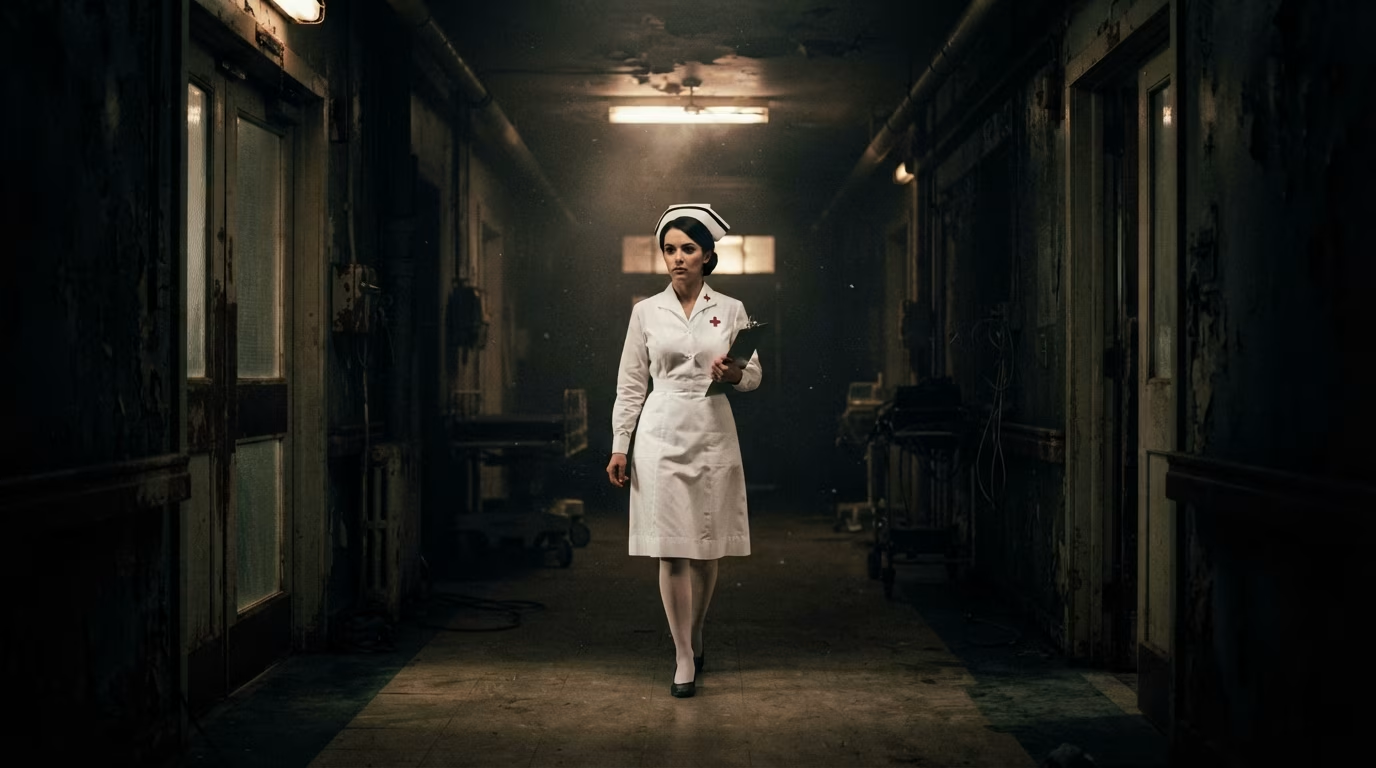
“She does not heal the body, Daniel,” Sofía replied, fixing her gaze upon his eyes. “She heals the passage. Eulalia was known as a disciplinarian, proud of her appearance, her uniform always pressed to perfection. Yet she was a woman who committed a grave error of the heart in life, abandoning a patient to meet her lover. Since the earthquake, her soul has been trapped within these halls, condemned to tend to those about to cross the threshold. She seeks no harm. She seeks only to redeem herself, one night at a time, easing the suffering of those beyond salvation.”
A hollow ache bloomed in Daniel’s gut. The shattering of his rationalist worldview brought on a physical nausea. He wanted to scream, to demand a logical explanation, to blame sleep deprivation or a psychotic break triggered by the pressures of his residency. But the memory of Don Tomás’s peaceful face and the lingering scent of lavender upon his own hands dismantled every attempt at denial.
V. The Certainty of the Shadow
Determined to prove to himself that it had all been an hallucination, Daniel returned to room 412. The silence within was absolute, broken only by the soft whistling of the wind against the windowpane. Don Tomás was no longer breathing. His face, however, bore none of the grimace of agony common to cancer patients; he appeared lost in a deep, serene slumber, a faint smile traced upon his withered lips.
Daniel approached the body to certify the death. As he took the old man’s hand, he noticed something that turned his blood to ice. Upon the nightstand, right beside the empty water glass, rested an antique glass syringe—a model the hospital hadn't used in decades. Beside it, etched into the dust accumulated on the metallic surface of the table, was a single word written in perfect penmanship:
“Fulfilled.”
A chill traced the young doctor’s spine. He felt a presence at his back, the subtle rustle of starched fabric stirring in the gloom. He dared not turn. He knew, with a certainty that defied both reason and science, that if he were to look back, he would meet those dark eyes staring from eternity, waiting for him to sign yet another death certificate.
Daniel simply recorded the time of death in his notebook. As he left the room, the scent of lavender slowly dissipated, surrendering once more to the industrial chill of the Juárez Hospital. The night shift dragged on, but he knew he would never again walk those halls alone without casting a wary glance into the shadows, searching for the pristine, luminous white of the nurse who never rests.
📜Investigation • Frequently Asked Questions
Documentary Archive and Analysis of the Occult • Relatando.com
What folkloric and historical significance does the scent of starch and lavender hold, which precedes the apparition appearance of "La Planchada" at the Juárez Hospital?
In Mexican oral tradition, scents act as thresholds between the profane and the sacred. The aroma of starch and lavender described in Carlos Nieto’s account breaks sharply against the hospital’s atmosphere of decay and bleach. Historically, it embodies the obsession with cleanliness held by Eulalia, the original nurse from the nineteenth century.
For folklorists, this sensory contrast is not merely a narrative device, but a "spectral signature" that spiritually cleanses the surroundings of the dying, transforming the transition of death from a degrading biological event into an act of dignity and near-liturgical order.
In what manner does the historical backdrop of the Juárez Hospital amplify the persistence of Legend Eulalia's legend within the collective imaginary of Mexican medicine?
Founded in 1847 to treat the wounded of the American invasion, the Juárez Hospital in Mexico City is built upon layers of collective pain and catastrophes, such as the 1985 earthquake. This soil, historically saturated with trauma, acts as a catalyst for phenomenon folklore.
For interns and physicians subjected to grueling night shifts, the figure of "La Planchada" transcends myth of Horrormere myth; she transforms into a projection of their own guilt over the involuntary abandonment of patients, or an archetype of the idealized compassion that hospital bureaucracy so often dehumanizes.
How does the anachronism of "La Planchada's" uniform function as a device of temporal resistance within the narrative of the modern hospital?
The apparition's perfectly starched uniform and rigid cap contrast sharply with the contemporary attire of the physicians. This anachronism serves as a tool of temporal resistance: it anchors the specter's identity to a golden age of Mexican nursing, an era when caregiving was regarded as a sacred vocation.
Manifesting with a neatness that defies the entropy of the modern hospital, "La Planchada" visually restores a lost ethical order. Her attire serves as a physical reminder of the oath of care, a visual relic refusing to be erased by the technological chill of modern medicine.
From the perspective of thanatology and myth analysis, why is "La Planchada" classified as a psychopomp entity rather than a hostile specter?
Unlike the vengeful specters of Hispanic folklore, Eulalia fulfills the classic role of a psychopomp: a spiritual guide for souls in transition. In the narrative, her presence beside Don Tomás inspires not panic, but a profound relief and a temporary cessation of physical pain.
Folklore analysis demonstrates that "La Planchada" humanizes death in a clinical environment prone to depersonalization. Her intervention provides solace to both the dying patient and the exhausted medical staff, assuming the burden of the final vigil and transforming the end of life into a passage assisted by eternal compassion.
Do not extinguish the light yet...
If you have had the courage to make it this far, we have other dossiers that will test the limits of your sanity.
Terms and Figures of this Tale
To delve deeper into the legends, creatures, and dark concepts that inspire this account, consult their entries in our dictionary of the uncanny:

Tu correo no se publica ni se comparte con terceros: solo sirve para notificar la respuesta.