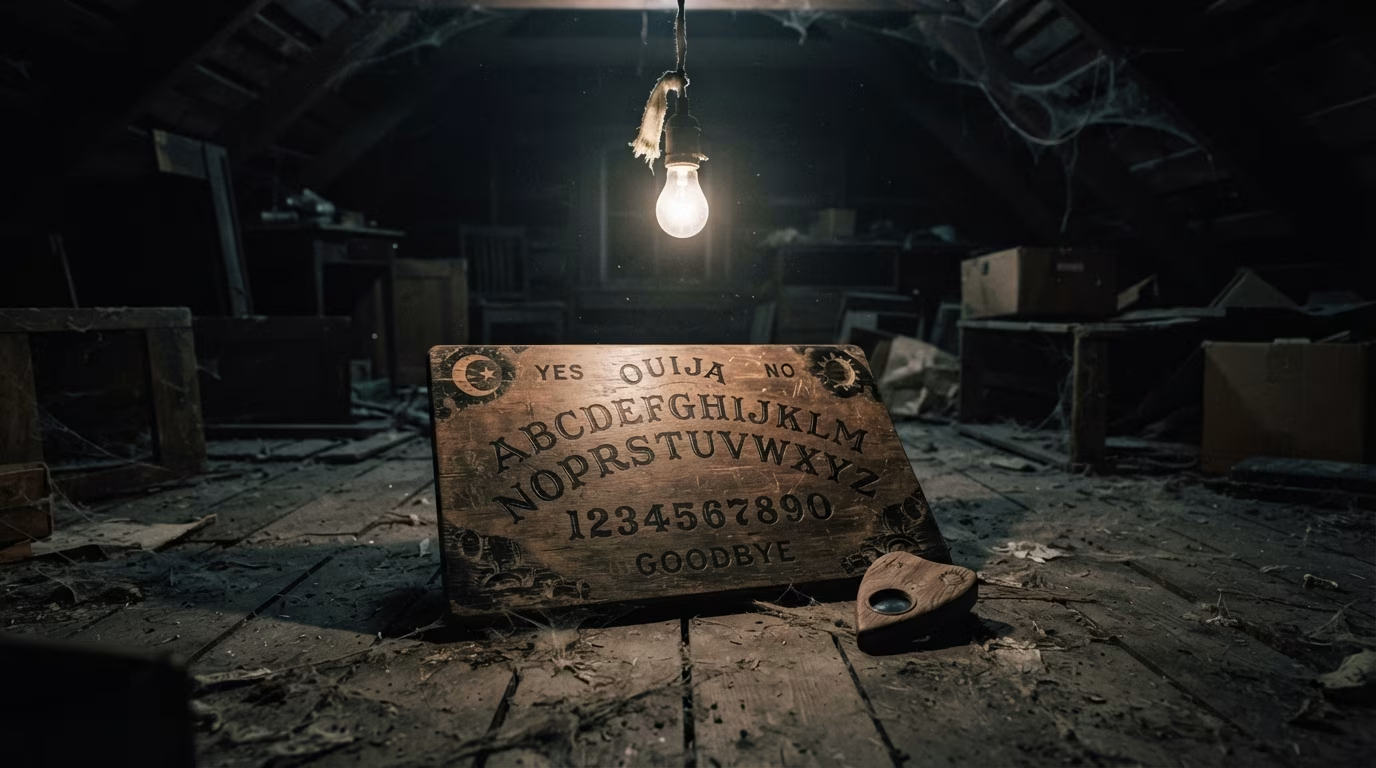
The attic dust smelled of dead time and rancid wool, a dense miasma that clung to the palate with the texture of wet ash. Outside, the fine drizzle of that autumn morning tapped against the slate tiles like the insistent, restless drumming of fingernails searching for a crack to slip through. Inside, beneath the single 40-watt bulb dangling from a twisted wire, the shaft of light fell solely upon the particleboard planchette. Its corners were gnawed away by dampness, and the alphabet letters were gouged in with clumsy, trembling patience characteristic of the sixties. No one had ventured up there in decades.
“Come on, Marcos. Give it a rest with the flashlight-under-the-chin routine; you look grotesque,” Elena said, crossing her arms to hide a subtle shiver that rippled through her shoulders. “The cold is bone-deep, and all we’re going to manage up here is a world-class case of pneumonia.”
“A routine?” Marcos replied, his tense smile barely reaching the corners of his lips. “I’m just saying, if the landlord rented us this house claiming it was clean, we should at least verify what the former owners left in the attic before we turn in. It’s a harmless joke. Just some bored college students being stupid.”

They pressed their fingertips onto the cold, splintered wooden board. The mahogany planchette—a crude, hand-carved indicator with an eye drawn in the center in black calligraphy ink—seemed to resist their touch. At first, the inertia of its weight and the pull of their own suggestion caused it to drift in slow, erratic circles, nervous laughter choking in their throats before it could fully escape. A sudden gust of icy air breathed from the dark corners, causing the lightbulb to sway with a dry, metallic shriek.
I. The First Sign
The marker took on a sudden, chilling autonomy that froze the laughter in the air. It was no smooth glide, but a sharp, rhythmic strike against the letter M, followed by a firm, almost aggressive trajectory that tore across the alphabet without hesitation. Marcos pulled his hands away abruptly, as if the wood had seared his skin.
“I didn’t push,” he whispered, breath held and eyes wide with a sudden jolt of panic. “I swear on everything holy, I didn’t apply any force.”
“Shut up, you idiot, this isn’t funny,” Carla snapped, though her voice sounded brittle, uncharacteristic of her usual confidence. She looked at the others, her knuckles white. “It was Mario. It had to be Mario.”
“My hands aren’t even moving!” Mario protested, arms held high, hovering four inches above the board. “Look at me. I’m not even touching it!”
The silence heavy upon the attic ceased to be merely an absence of noise and became a tangible presence, an invisible weight constricting their chests.
The planchette spun on its own axis with a dry, splintering creak and darted toward the bottom corner of the board, where an anonymous hand had scrawled the word NEVER. It then spelled out, letter by letter, a proper name none of the three had dared utter aloud since arriving in the village: JULIA.
II. The Fracture of Reason
The human brain seeks refuge in logic when faced with the incomprehensible. Elena swallowed hard, her mouth parched, and forced her mind to process sensible explanations: thermal expansion of the aged wood, collective suggestion, the wind vibrating the foundations from outside. She tried to smile.
—It's pure statistics. The most common letters… subconscious memory traces patterns—he argued in a thread of a voice that failed to convince even his own shadow—. Someone wrote this down here beforehand, and the grain arrangement… wood warps with humidity.
The planchette stopped dead. Then, with chilling precision, it spelled out a complete sentence without spaces, letter by letter, at a dizzying speed:
JULIASRINGWASNEVERINTHEWELL
The air seemed to evaporate from the room. Marcos felt cold sweat trickling down the back of his neck, an icy trail that raised the hair on his arms. That secret, the exact spot where the police had searched in vain for the body of the young woman who vanished in the neighboring village three summers ago, was a detail that had never leaked to the local press. Only the investigators and the killer—if indeed there was one—knew the detail about the ring.
—Enough —Carla said, springing up and knocking her chair backward with a violent clatter—. This is a sick, macabre joke. Someone must have been investigating us before we even rented this place. We’ve been watched.
—Who, Carla? —Mario asked, his eyes locked on the gloom of the ceiling rafters, where the shadows seemed to crouch over them—. Who could have possibly known what we discussed in the van last night regarding the Julia case? We drove straight from Madrid. No one knows us here.
III. The Certainty of the Shadow
The lightbulb flickered violently and died, plunging the attic into a total, thick darkness—suddenly warm and heavy with the acrid scent of wet earth and subterranean damp. In the absolute murk, the creaking of wood multiplied. It was no longer just the attic; it was the floor below, the walls, the very foundations of the house, all seeming to draw breath in unison like an old, diseased pair of bellows.
No one dared to move. The dread had paralyzed their limbs, turning them into statues of trembling flesh amid the blackness. In the center of the room, upon the low table, the ouija planchette emitted a faint scraping sound against the board, as though someone were tracing the letters with a fingernail in the absolute darkness.
—I’m turning on my phone’s flashlight —Elena whispered, her teeth chattering with such uncontrollable force that she could barely articulate the words.
The intense, bluish beam of light slashed through the gloom. The board was still there, but the planchette was no longer on the letters. It had slid to the very edge of the table, pointing directly toward the stairwell leading down to the bedrooms. Beside it, carved into the raw wood of the tabletop, were three fresh initials, oozing a dark sap that had not yet fully dried.
At dawn, when the listless, gray light of a new day bled through the skylight, the three friends fled down the stairs in silence. They did not gather their packs; they did not look back. They were escaping the intolerable weight of that rural house. Yet none of them dared speak a single word on the journey home. For deep within their minds, beneath a persistent chill that had settled into their very marrow, a mute certainty scorched their consciousness: the attic board had not been moved by any external force. It had answered to what each of them buried in the deepest, darkest recesses of their memory—the secrets they swore they would take to the grave.
📜Investigation • Frequently Asked Questions
Documentary Archive and Analysis of the Occult • Relatando.com
What does the use of the attic and the autumn drizzle symbolize as liminal elements in Carlos Nieto's narrative?
From the perspective of folklore and the anthropology of space, the attic represents the garret of the psyche and a material archive of oblivion. By situating the action in this liminal corner—lashed by a drizzle that acts as a solvent upon external reality—the author isolates the university students in a microcosm fertile for the irruption of the numinous. Their isolation is not merely physical; it is temporal and ontological.
In what way does the handcrafted board with gouge-carved letters subvert the industrial archetype of the commercial ouija?
The ludic object described is no standardized product, but a 1960s craft fashioned from particle board and a calligraphic ink-eye. This rudimentary construction grants the artifact a unique, atavistic, and testimonial weight. Lacking the branding of mass-market occultism, the board becomes a piece of local folk lore, a vessel improvised by former inhabitants who imbued its very frame with a latent, deeply personal energy.
How does the dynamic of denial and collective panic operate in the transition from youthful skepticism to the Horror supernatural?
The story exposes with clinical precision the deconstruction of rationalist skepticism in the face of the phenomenon inexplicable. The characters transition from the nonchalant mockery of 'bored college students' to bodily hysteria upon verifying the autonomy of the mahogany planchette. Mario's raised hands and Carla's white knuckles evidence the rupture of the pacts of everyday physics, forcing the protagonists to confront terrors that transcend their analytical framework.
What documentary and atmospheric implications does the figure of the witching hour and the 40-watt bulb hold within the aesthetic of Relatando.com?
The three o'clock hour—traditionally viewed as a mocking inversion of the time of Christ's death—acts here as a chronological threshold of high spectral tension. A single 40-watt bulb casts a claustrophobic cone of light that deepens the surrounding gloom, rendering the attic's shadows as active agents. It is a lighting technique that shrinks the space, drawing all focus to the ritual surface of the board.
Do not extinguish the light yet...
If you have had the courage to make it this far, we have other dossiers that will test the limits of your sanity.

Terms and Figures of this Tale
To delve deeper into the legends, creatures, and dark concepts that inspire this account, consult their entries in our dictionary of the uncanny:

Tu correo no se publica ni se comparte con terceros: solo sirve para notificar la respuesta.