The left wiper left a milky smear right at eye level. A rhythmic screech of dry rubber against tempered glass ticked off the seconds with the persistence of a rusted metronome. It was three-seventeen in the morning by the eastern wall of La Almudena. Outside, the November sleet refused to settle: it fell like a grayish slime over the fired bricks of the cemetery, sliding toward the gutters of Avenida de Daroca amidst wind-swollen plastic bags and rotting wreaths of flowers no one had bothered to clear from the crematorium dumping ground.
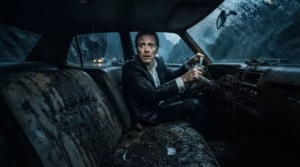
Julián cleared his throat. The instant coffee from the thermos, watery and bitter as gall, had left a gritty crust on his palate. He had been eleven hours behind the wheel of the white Octavia, his back pressed against the wooden bead seat cover that no longer eased the ache in his kidneys, but instead felt as though it were driving itself directly into his vertebrae. The taxi radio spat out a low static hiss, interrupted only on rare occasions by the cavernous voice of some colleague calling for relief at the Glorieta de Pirámides.
Then he saw her.

I. Rust in the Joints
She did not emerge from any subway entrance, nor did she cross from the residential sidewalks opposite. She was simply there, silhouetted against the perimeter wall of the civil cemetery, in a stretch where the sodium-vapor streetlights flickered with a dying, orange death rattle. Her right arm raised. Rigid. Her index finger pointed toward the wet asphalt, not toward the car.
Julián slowed down by sheer Pavlovian reflex. The car jerked over the damp cobblestones surviving beneath patches of tar. In that area, at that hour, it was normal to cross paths with junkies scavenging among fallen cypresses or some stray drunk from the Vicálvaro industrial parks. But the silhouette did not fit. She wore a navy blue wool coat, tailored in the old-fashioned style, with the velvet collar turned up against the downpour, and a dark woolen beret tilted low over her forehead. She carried no umbrella. Water streamed down her cheekbones without her making the slightest gesture to brush it away.
The taxi pulled up to the curb with the groan of soaked brake pads. The rear door lock sprang open with a metallic click. Julián did not roll down the window; the condensation inside the cabin was so dense it barely allowed him to see past the sticky vapor clinging to the glass.
The back door crept open with agonizing slowness. The hinges, poorly greased after months of dry winter, let out a long, almost vocal groan.
—Good evening —Julian said, his voice roughened by black tobacco and exhaustion—. Where are we headed?
A gust of wind preceded her into the car. It was not merely the chill of the street—that damp, three-in-the-morning Madrid exhalation smelling of exhaust pipes and open sewers—but a concentrated, freezing draft carrying a subterranean, vegetative stench. It smelled of rotting chrysanthemums festering in the green water of a zinc vase, of clayey soil freshly turned with a spade, and of the pale mold that thrives on walls never touched by sunlight. Julian felt a shudder ripple the hair on his arms straight through the lining of his anorak.
The woman settled into the seat behind the passenger side. She did not slam the door; she pushed it with a spectral delicacy until the latch clicked shut without a sound.
—To Santa Engracia, please —she said. Her voice was flat, devoid of the usual modulation of breath and effort, as though the words were not born of lungs but pumped from an old bellows wheezing in the gloom—. The stretch by the workshops. If it's no trouble, take O’Donnell.
Julian dropped the taxi meter flag. The mechanical click echoed with obscene clarity inside the car.
How long have you been waiting by that wall, ma'am? The cold out there is enough to split stone.
He did not dare voice the question. He simply eased the clutch out. The car glided toward the Daroca slope, pulling away from the reddish brick walls that hemmed in the thousands of leaning crosses. In the rearview mirror, Julian tried to catch her eye, but the shadow of her beret obscured the upper half of her face. He could only make out lips so thin they were nearly bloodless, and the stark pallor of a jawline sharp as the edge of a roof tile.
II. The Breath That Leaves No Frost
The car climbed toward Avenida de las Trece Rosas. The diesel engine vibrated with its familiar purr, but inside the cabin, the air began to thicken, heavy as molten lead. The heater was blasted to maximum, directed at the footwells and central vents, wheezing a dry air that burned the eyes; yet the temperature inside refused to rise. On the contrary, the cold seemed to drip from the ceiling straight down the back of Julian's neck.
It was the rearview mirror that gave him the first warning.
The front windshield was fogged by the heat of his own breath and the cold sweat of his palms gripping the plastic steering wheel. With every exhalation, a translucent vapor stained the glass. Yet in the rearview mirror, directly where the woman's head remained motionless, the rear window glass stayed completely clear. There was no breath on her side. No condensation blurred the tempered glass barely three centimeters from her nose.
—Hell of a night we've been handed —Julián remarked, forcing the cordial tone of a weathered cab driver, desperate to break the suffocating density of the silence—. For three weeks now, Madrid's felt like an open sepulcher. The rain doesn't wash away a damn thing; it just stirs up the filth.
She did not move. Her hands rested in her lap, folded over a black fabric handbag with a metal clasp. She wore white cotton gloves, the kind pious old women wore forty years ago to the eight o'clock mass, but the fabric was stained with a yellowish grime at the fingertips, as though she had been clawing through damp mortar.
—Cities grow by devouring their dead —she replied after an endless minute. The sentence came out so even, so flat, that it seemed to require no breath to form—. My brother used to say that beneath Alcalá Street the old streams still flow. The Abroñigal. He said water always seeks its channel, even if you bury it under three layers of asphalt.
Julián swallowed hard. His Adam's apple bobbed up and down his throat with a dry, painful click.
—Yeah… well, my father knew these parts before they built the M-30. All of this used to be orchards and scrubland. And the cemetery, of course. Always the cemetery.
—My family bought the plot back in sixty-two —the woman said. Her head did not tilt a single millimeter as they took the curve toward Alcalá—. In the San Froilán section. Back then you could see open fields all the way up to the mountains. Now the roar of the trucks won't let anyone sleep.
Julián frowned. The San Froilán section was one of the most dilapidated and ancient parts of La Almudena, a hillside of 1950s niches where the plaster gravestones flaked away from the damp, and many of the plots had already been declared structurally unsound or cleared into the common trench. He knew it well because his own uncle Paco—the one who died of tuberculosis in the San Carlos hospital—had rested there until the family stopped paying the fees back in the eighties.
He tilted the rearview mirror downward by a fraction of a millimeter just to catch her eyes. The amber glare of the streetlamps along the Ventas bridge swept through the cab in regular, rhythmic pulses. Light. Shadow. Light. Shadow.
Beneath the brim of her cap, the woman's eyelids remained utterly still. They did not even flutter when the headlights of an oncoming garbage truck washed over the interior with a stark, blinding glare. Her eyes were wide open: two glassy, arid pits stripped of life's watery sheen. The dead, unblinking gaze of a taxidermied beast staring intently at the back of Julián's headrest.
III. The Fall of the Needle
The taximeter clicked. The nocturnal fare had been ticking upward in steady jumps, but the glowing red digits suddenly began to shudder. The seven-segment numbers flickered, mutated into fractured eights, and abruptly started running backward. They were no longer counting pesetas or euros; the display flickered with impossible figures: 42… 38… 15… 00.
The radio emitted a high-pitched whine, like the grating slide of butcher knives scraping spine against spine. The dashboard indicators—the green of the low beams, the amber oil warning light—flickered with a sudden, suffocating agony. The diesel engine shifted its tone; the cheerful, steady rattle devolved into a muffled, choked gurgle, as though it were desperately drawing breath through thick, stagnant mud.
Don't turn around. Just drive. Keep your eyes on the road, Julián. Drive, and whatever you do, do not look back.
The cold in the cab was no longer a matter of temperature: it was a physical pain. The joints in Julián’s fingers grew rigid against the steering wheel; the chill seeped through his shoes, freezing the rubber soles and numbing his thumbs. Out of the corner of his right eye, he noticed that the front passenger seat was empty, yet an unnaturally heavy depression marred the synthetic leather of the backrest behind it, as though seated there was not a slender, sixty-kilo woman, but a deadweight bundle of lime, lead, and jagged granite.
—Are we far from the bridge? —she asked. Her voice sounded closer now. Not from the seat: it seemed whispered barely two inches from the nape of Julián’s neck, against the roots of his hair.
Julián glued his eyes to the asphalt. The windshield wipers shrieked on, but the rain no longer cleared away beneath the rubber; it fell like a viscous curtain that warped the lights of Madrid into oily, bleeding smears.
—We're… we're passing Ventas —he managed to get out. His jaw was trembling so violently that his molars clicked together with a metallic chatter—. In five minutes we'll be at Manuel Becerra. If you'd like… if you'd like, I can drop you off at the subway entrance. The car's heater is broken. It's freezing in here.
—I am not cold —the voice replied. A thin thread of putrid air grazed Julián’s ear. It smelled of stale formaldehyde, of clothes sealed in a camphor chest for half a century—. I am never cold anymore, Julián.
The taxi driver’s heart lurched savagely against his ribs. He had not told her his name. The identification card on the dashboard had been covered by the leather sleeve of his municipal permit for the past three months.
—You… you've got the wrong person —he stammered, stepping on the gas. The car failed to surge; the pedal felt spongy, as though the cable were about to snap—. I only work the night shift. I don't know anyone from Chamberí.
—Your mother used to wash clothes at the tanneries along the Manzanares before she married your father —she said, with a blood-freezing slowness—. And you had a medal of the Virgen de la Paloma sewn into the lining of your schoolbag when you made your first communion at the parish of San Justo. She sewed it in with waxed thread so you wouldn’t lose it in the quarries.
Julián gripped the steering wheel so hard his knuckles turned white. A viscous, freezing sweat trickled down from his temples into his three-day stubble.
—Who the fuck are you? —he roared, his composure shattering as blind panic began to flood his chest—. Who are you? If you want money, take it all, I don't give a damn. I've got ninety euros in the glove box, take them and get out!
Absolute silence fell over the cabin. The rattling of the engine died. The screech of the wipers stopped. Even the hiss of the tires against the water vanished, as though the taxi were gliding over a lake of thick mercury. The only sound left was the dashboard clock: a second hand stumbling forward in fitful jerks.
IV. Stop Requested
The car turned onto Alcalá Street without Julián remembering having taken the turnoff. Every single streetlamp had gone out. The clothing store displays, the tightly shuttered cafés, the bus shelters: everything dissolved into a mass of black shadows and blind silhouettes. Madrid looked like a necropolis emptied three centuries ago, a labyrinth of rain-soaked stone where the windows were nothing more than empty sockets in toothless skulls.
—Stop here —she commanded. It was not a request; it was a sentence.
They stood before a wrought-iron gate, eaten away by rust, wedged between two nineteenth-century buildings with balconies shored up by rotting timbers. Julián slammed on the brakes. The Octavia came to a dead stop, without skidding, as if the tires had instantly welded themselves to the pavement.
Julián squeezed his eyes shut. He breathed through his mouth, gasping, feeling the air tear at his bronchial tubes as though he were swallowing shards of crushed glass.
—How much… how much do I owe you? —he blurted out, losing his mind to the sheer absurdity of the dread.
Behind him came the rustle of coat fabric. The sharp snap of a clasp purse closing. A heavy, metallic sound dropped onto the front passenger seatback.
—Keep the change —she whispered.
The cold at the nape of Julián's neck intensified into a searing lash. For a fraction of a second, before he could stop himself, his eyes snapped open and sought out the central rearview mirror.
There was no one in the back seat.
The navy-blue coat, the wool beret, the white thread gloves: there was nothing there. Yet the seat was depressed, compressed by an invisible mass that continued to bear downward with relentless pressure. And upon the gray fabric of the upholstery, soaking into the foam padding, a dark stain of stagnant water was spreading, mixed with red clay and shreds of dried flowers reduced to black dust.
The back door didn't open. There was no click of a latch. Simply, the pressure on the seat vanished all at once with a prolonged hiss, like air escaping a lung deflating for the very last time.
V. The Frost Toll
It took Julián ten minutes to be able to move his fingers. When the stiffness in his hands finally allowed him to let go of the steering wheel, the taxi's engine sputtered back to life with a rough, trembling roar, coughing black smoke from the exhaust pipe. The streetlights on Alcalá street flickered back on all at once, blinding him with their artificial glare, and the distant rumble of a delivery truck slammed him back into the reality of the living city.
He sat motionless, listening to the furious beating of his own blood in his temples. The condensation on the windows began to slowly clear, swept away by the stream of hot air finally pouring from the vents.
With his left hand shaking like that of an old man, he reached across toward the passenger seat back, where the metallic impact had sounded.
There were no banknotes resting on the damp upholstery. There was a coin.
It was a thick, heavy piece of silver, tarnished at the edges and blackened by sulfur. It wasn't a euro. It wasn't even one of the pesetas he remembered from his youth. Stamped upon it was the crude profile of a Bourbon monarch with a hook nose, worn smooth by the friction of dead fingers, and a barely legible date in the lower exergue: 1892. It was so bitterly cold that when he touched it, the skin of his thumbpad adhered to the metal for an agonizing second, scorching his raw flesh.
Julián did not switch on the courtesy light. He slipped the coin into the deepest pocket of his parka, slammed the gearshift into first with a violence that made the transmission grind, and pulled away without looking back.
That night he did not return to the station taxi stand nor did he accept any more dispatches from the switchboard. He drove straight home, a gloomy ground-floor flat in the Carabanchel district that smelled of bleach and noodle soup, and crawled into bed fully clothed, pulling three woolen blankets up over his head, though they failed to quell the shaking in his bones.
Four months have passed since that November dawn.
Julián sold his taxi license two weeks later. He tells anyone who asks that it was because of arthritis, that his legs could no longer endure twelve-hour shifts dodging speed bumps and traffic lights. But every night, precisely at three-seventeen, he wakes in the gloom of his bedroom, his throat parched and his pulse racing. He sits on the edge of the mattress and stares at the damp stain creeping across the interior courtyard wall, listening as the silence of the house grows thick, heavy, laden with that persistent scent of wet earth and dead chrysanthemums.
And he knows, with a certainty that requires neither mirrors nor broken taximeters, that the journey is not yet over; that sooner or later, on some lampless corner of his own memory, he will hear once more the dry snap of a car door closing behind him.
📜Investigation • Frequently Asked Questions
Documentary Archive and Analysis of the Occult • Relatando.com
In what ways do the physical surroundings of the eastern wall of La Almudena cemetery and Daroca Avenue shape the gritty realism native to this urban tale?
The text employs a real, recognizable Madrid topography—the November sleet, the asphalt-patched cobblestones, and the crematorium's dumping grounds—to anchor the supernatural in everyday squalor. Carlos Nieto dispenses with the Horror traditional gothic and opts instead for a bleak, predawn Madrid costumbrismo, where the driver's chronic exhaustion and the reek of instant coffee act as a sensory counterweight that renders the traveler's apparition presence all the more deeply unsettling.
What symbolism is embodied by the Skoda Octavia taxi and the worn instruments of labor within the micromythology of Madrid's night owls?
The vehicle operates as both a rolling trench and a metallic confessional. Details like the wooden bead seat cover pressing into the lower back, the static-hiss of the radio, and the windshield wiper leaving a milky smear all mirror the protagonist's physical decay and existential erosion. In contemporary urban folklore, the night taxi stands as the ultimate liminal threshold where the living and the outcasts of the graveyard quietly converge.
How does the figure of the 'Cemetery Traveler' fit into the Hispanic tradition of phantom hitchhiker apparitions?
The apparition aligns with the universal archetype of the 'phantom hitchhiker,' yet is surgically adapted to Madrid's outer suburbs and industrial estates. Unlike legends lonely rural winding roads, here the city swallows the mystery whole: the old-fashioned navy blue wool coat and woolen beret suggest a temporal anachronism that subverts the bleak modernity of Madrid's asphalt.
What narrative function does the sensory intrusion of the cold and the subterranean stench serve in the excerpt's climax?
The abrupt shift in thermal and olfactory atmosphere shatters the fragile safety of the taxi's cabin. The subterranean stench clinging to the passenger acts as an otherworldly omen, marking the definitive boundary between Julián's mundane working routine and the encroaching horror waiting just beyond the back door.
Do not extinguish the light yet...
If you have had the courage to make it this far, we have other dossiers that will test the limits of your sanity.

Terms and Figures of this Tale
To delve deeper into the legends, creatures, and dark concepts that inspire this account, consult their entries in our dictionary of the uncanny:

Tu correo no se publica ni se comparte con terceros: solo sirve para notificar la respuesta.