Chapter I: The Midnight Synchronization
The night the mobile phone buzzed on the nightstand for the third time, Julián understood that sanity was a delicate coat of varnish about to crack. It was fourteen minutes past three in the morning. The bluish glow of the screen split the bedroom's gloom, casting long, misshapen shadows across the walls of the old flat on Calle de Atocha, a building of high ceilings and moldings battered by a century of Madrid's damp.
Julián raised his arm with the heaviness of one caught between drowsiness and unease. He unlocked the device, blinking against the blinding glare. A cloud notification stood out in the center of the panel: "Backup completed: 1 new file added to the gallery".
With furrowed brow, he tapped the notification. He expected to find some accidental screenshot taken during sleep, or perhaps a delayed image from the afternoon. Instead, the screen displayed a high-resolution photograph, captured with a lens of diabolical precision.

Julián's heart lurched with a dreadful jolt, a dry blow that left his lungs without air. The photo showed him—himself—lying on his side in bed, covered to the waist by the gray duvet. His face wore the absolute vulnerability of deep sleep. But what brought a cold sweat blooming at the nape of his neck was not his own sleeping figure, but the vantage point of the frame.
The image had been taken from a low vantage point, barely more than a meter above the floor. In the foreground, framing the scene on the left and right, two dark, vertical, plush silhouettes stood out: the lapels of his black trench coat and the sleeves of his wool overcoat. The photograph had been shot from inside his own oak wardrobe, a gigantic three-door piece he had inherited with the lease of the flat and had never managed to close completely due to the wood warped by woodworm.
The angle was unmistakable. Whoever—or whatever—had taken the photo had been crouched among her hanging clothes, peering through the three-centimeter gap left by the door ajar.
Julián sat up with a jolt, feeling the adrenaline scorch through his veins. Phone in his trembling hand, he lit the room. The bedroom was enveloped in a sepulchral silence, broken only by the hiss of the autumn wind against the windowpanes. Across from the bed, at the far end of the room, the enormous oak wardrobe stood erect like a vertical mausoleum. Its central door preserved that same black sliver, a half-open mouth that seemed to swallow what little light the room possessed.
Chapter II: The Flesh of the Wood
That night Julián did not close his eyes again. He searched the entire house with a kitchen knife in his hand: the converted coal kitchen, the narrow hallway, the bathroom with its pitted tiles, and finally, the inside of the wardrobe. He flung the coats aside one by one in a frenzy. Behind the garments he found only the rear wall of pine boards, covered in striped wallpaper that was peeling away in strips, and that acrid, rancid stench of camphor, old dust, and trapped damp. There was no one.
Convinced he had been the target of a sophisticated cyberattack—perhaps some spyware manipulating the camera of his old mobile phone left on the dresser—he changed all his passwords, logged out of every remote session, and left the device switched off in the living room before attempting to rest the following night.
However, the Horror defies all technological logic.
The following night, prisoner to his exhaustion, he fell asleep just past two. Waking to the racket of sparrows at first light, he hurried to the living room to turn on the phone. As the system booted, the cloud once again notified him of a synchronization performed at four and seven minutes in the morning.
Julián opened the image with clumsy, disoriented fingers. This time, the photograph was even more harrowing. The lens had shifted. No longer was it hidden behind the clothes; the shot had been taken with the wardrobe door wide open. In the photo, Julián slept on his back, but at the lower edge of the image a detail congealed the blood in his arteries: the bottom board of the wardrobe, where he usually kept his shoes, appeared covered by a thin layer of blackish, viscous mud, and upon that mud were stamped the imprints of fingers infinitely longer and thinner than those of any human being.
“Impossible”, he murmured in a thread of a voice that scarcely echoed against the walls of the parlor. "This is not a joke. It cannot be."
He went to the National Police station on Leganitos Street. The duty officer listened to him with a mixture of pity and paternal boredom. They analyzed the phone. The image's EXIF data indicated that the photo had been taken by Julián's own device camera… while it lay resting on the entryway table, more than ten meters away from the bedroom. The police officers kindly suggested he consult a neurologist or change the locks on his home if he suspected a former tenant still held spare keys.
No one could help him. He was at the mercy of what dwelt in the oaken abyss.
Chapter III: Flour and Paralysis
Determined to unravel the mystery before madness devoured him whole, Julián set a plan in motion on the third night. He bought three bags of flour from the neighborhood grocer's and dusted a thick, even layer across the parquet floor, from the base of the wardrobe to the foot of his bed. If something or someone came out of that wooden structure, it would leave an unmistakable trail.
He also barricaded the closet door by shoving his heavy chestnut desk against it. He lay down with a tactical flashlight under his pillow and swore to himself that he would stay awake.
The night crept on with an agonizing slowness. The hallway wall clock threshed the minutes with a metallic pulse: *tick, tock, tick, tock*. Around three in the morning, an anomalous density began to take hold of the bedroom air. The atmosphere turned gelid, steeped in a sudden reek of graveyard earth and rotted wood, a stench so dense it turned Julián's stomach.
He tried to lift his head, but his muscles did not respond. The sleep paralysis it chained him to the mattress. His eyelids weighed like lead, but his eyes, half-open, managed to fix on the gloom of the room.
Despite the heavy desk barricading the cabinet, he heard the creak. A dry, deep crack, like a bone fracturing. The wood of the wardrobe was not opening; it was *writhing*. Through the slit, the darkness inside seemed to turn liquid, dense, oozing out like an ink stain in water.
Julián tried to scream, but only a strangled whistle escaped his throat. He saw a pale, disproportionate limb—utterly devoid of knuckles or recognizable joints—emerge from the blackness above the desk. It did not tread upon the flour; the limb seemed to sprout from the furniture's own shadow, stretching across the ceiling like the branch of a withered tree.
At the end of that appendage of dead flesh there was no human hand, but a structure of cartilage gripping its own mobile phone. The flash blinded Julián for an infinitesimal second, illuminating the face of what peered out from the back of the wardrobe: a skinless face, a mass of pulsing woodworm holes from which sprouted fine threads of blind mould.
Then the blackness swallowed everything, and Julián lost consciousness.
Chapter IV: The Architecture of the Reverse
He woke to the noon light seeping through the blinds. He jerked upright, gasping, his heart hammering against his temples. The flour on the floor lay untouched. Not a single mark, not one disturbance on that white surface. The desk still held fast against the wardrobe doors.
Had it all been a delirium? A nightmare orchestrated by anxiety?
With his hands trembling uncontrollably, he groped for the phone on the nightstand. There it was. The screen announced the arrival of the nocturnal file. Synced at 03:33 AM.
He tapped the screen. The image opened.
The shot had been taken from atop the wardrobe, angled directly downward. In the photo, Julián lay on the bed, paralyzed, his eyes wide with terror, staring into the camera. But what revealed the true extent of the horror was at the back of the image: behind the bed, the bedroom wall was no longer brick and plaster. In the photograph, the wall had transformed into an infinite abyss of shelves and oak boards carved with agonized faces, an endless corridor burrowing into the bowels of nothingness.
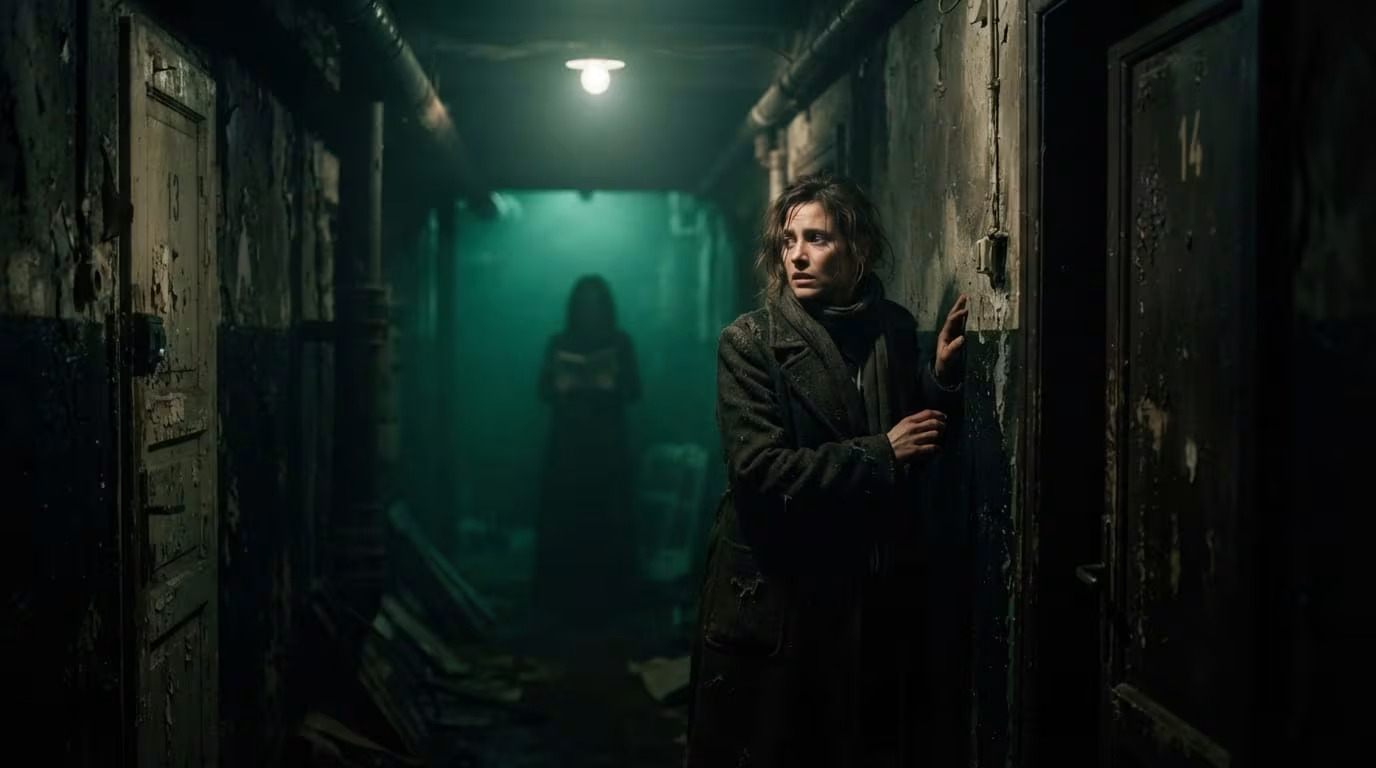
Julián could bear no more. Possessed by a primal fury for survival, he ran to the building's storage room and returned with an iron crowbar and a hatchet. He was going to destroy the piece of furniture. He would reduce it to splinters and burn what remained in the nearest vacant lot.
He hurled himself at the oak wardrobe. He brought the first axe blow down with every ounce of his strength upon the central door. The century-old wood gave way with a tearing groan. Splinters flew in every direction. Julián struck again and again, opening a gaping hole in the marquetry.
When the sawdust settled, he thrust the lantern through the opening to behold the rear wall he intended to tear down. What he saw froze his blood.
There was no brick wall. Nor was there the striped wallpaper. Behind the hanging coats there was no back. The beam of his flashlight lost itself in a limitless vertical vastness, a throat of worm-eaten wood that plunged and climbed toward an absolute gloom. And from the depths of that impossible hollow, thousands of tiny slits began to open in unison, like wooden eyelids revealing the blackness of thousands of watching eyes.
A smell of rotting vegetation and air stagnant for centuries burst from the hole, flooding his lungs.
Chapter V: The Endless Shutter
Julián dropped the axe and fled. He took no suitcase, no clothes, no money. He burst onto Calle Atocha running through the freezing rain, never once looking back, driven by a single purpose: to put distance between himself and that accursed building. He ran all the way to Atocha station and boarded the first commuter train departing for the sierra. He got off in a remote village, ringed by pine forests and fog.
He rented a room in a decaying roadside motel, a place of modern drywall, synthetic carpet, and plastic furniture. There were no old wooden wardrobes. No oak furnishings. Only a simple bed, a Formica table, and a window that looked out onto the national highway.
He locked himself in with a double turn of the key. He switched on every light in the room: the ceiling lamp, the bathroom sconce, the small lamp on the nightstand. He sat down in the middle of the room, on the carpet, far from any corner, his back pressed against the entrance door to make certain nothing could take him from behind.
«Not here», he repeated to himself like a manic prayer, pressing his knees against his chest. "There is no oak here. No cracks. Nothing at all."
Time crawled by in an agony of endless minutes. Outside, the rain hammered the windowpanes with the force of a thousand impatient knuckles. The hours pressed on until the digital clock on the nightstand blinked three-fourteen in the morning.
At that precise instant, the room's lights flickered and went out all at once. The entire hostel was plunged into an absolute blackness, so dense that Julián could not see his own hands.
In the dead silence of the night, the mobile phone in his trouser pocket let out a short, metallic tone. The screen lit up against his lap.
"Backup completed: 1 new file added to the gallery".
Julián's pulse stopped. His fingers, rigid with panic, touched the touchscreen almost involuntarily. The image opened in the darkness of the room.
The photograph had not been taken from a wardrobe. The shot was a top-down view, captured directly from the ceiling of the hostel room, aimed at the floor.
In the image, Julián could be seen sitting at the center of the rug, lit only by the blue glow of his own phone. But Julián's figure cast no ordinary shadow upon the floor. His shadow, born of the device's light, stretched backward, unfolding across the door wall like a great pair of black oak doors wrenched open into the gloom.
And from the depths of his own shadow, in the photograph, two infinite and disjointed arms emerged slowly, encircling his neck.
Julián looked up from the phone, but he never quite saw anything. The creak of dry wood echoed, not in the room, but inside his own bones, as the last spark of light went out forever.
📜Investigation • Frequently Asked Questions
Documentary Archive and Analysis of the Occult • Relatando.com
In what ways do the urban surroundings of Atocha Street and the atmosphere of Madrid function as a silent actant within the psychological architecture of the tale?
The Madrilenian geography of high ceilings, centuries-old damp and woodworm acts within the text not as mere scenography, but as an organism that absorbs and gestates the mystery. The old flat mirrors the weight of memory and the passage of time, where decadent architecture facilitates the permeability between the everyday and the uncanny, rendering plausible the invasion of intimacy.
What anthropological symbolism does the three-door oak wardrobe with its three-centimeter gap embody within the tradition of domestic terrors?
The wardrobe embodies the classic archetype of the threshold and the repressed—that liminal space where garments and unconfessable fears are filed away alike. The seam, flawed by woodworm, transforms a utilitarian piece of furniture into a perverse panopticon: a mechanical and organic eye at once, keeping watch over the sleeping subject's uttermost vulnerability.
How does the intrusion of digital technology and cloud notifications transform the nature of the traditional gothic tale in the work of Carlos Nieto?
Carlos Nieto masterfully updates the gothic horror trope by hybridizing it with contemporary hyperconnectivity. Automatic cloud synchronization functions as a relentless messenger that strips the protagonist of his false digital security, transforming an everyday device into an automated witness to the uncanny.
What psychological implications arise from the use of reverse high-angle perspective from inside the furniture regarding Julián's loss of control?
The photograph taken from a height of one meter, from the shadows of the coat, generates an absolute inversion of spatial security. Julián is no longer master of his private sanctuary; the intruder's vantage point reveals that he has been observed from a position of absolute dominance, destabilizing his fragile sanity.
Do not extinguish the light yet...
If you have had the courage to make it this far, we have other dossiers that will test the limits of your sanity.

Terms and Figures of this Tale
To delve deeper into the legends, creatures, and dark concepts that inspire this account, consult their entries in our dictionary of the uncanny:

Tu correo no se publica ni se comparte con terceros: solo sirve para notificar la respuesta.