The Haunted One of the Amazon River is a mythical creature river spirit of the South American Amazon, capable of metamorphosing into a handsome man dressed in white with a straw hat to seduce the unwary at riverside festivities, personifying the mystery and hidden dangers of the watery depths.
The Origin of the Myth and the Earliest Chronicles
When the first European explorers steered their fragile vessels into the labyrinthine waters of the Amazon River, they discovered not only an overwhelming green jungle that defied known geographical logic, but also a universe of legends that throbbed fiercely in the voices of the indigenous peoples. Amidst the morning mist and the dull roar of the heavy current, one of the most fascinating and persistent mythologies of the American continent was born: the Legend legend of the Boto, or the Encantado. For the river dwellers, the river is not merely a body of water meant for fishing or transport; it is a living, conscious, and often capricious entity that hides impenetrable secrets.
The chroniclers of the Indies already recorded in their logbooks disconcerting tales of aquatic beings that assumed human forms to confuse sailors. Yet it was in the heart of the Brazilian and Peruvian jungle that this belief acquired a profoundly human texture. The pink river dolphin (Inia geoffrensis), with its unique morphology, its rosy coloration, and its disconcerting intelligence, became the undisputed protagonist of these stories. Unlike its marine relatives, this cetacean inhabits murky waters, possesses unfused cervical vertebrae that allow it to turn its head in an unusual manner, and emits clicks that sound like whispers in the darkness. It was not long before the riverbank dwellers attributed supernatural powers to this animal, transforming it into a being capable of crossing the boundary between wildlife and humanity.

The myth legend of the Encantado does not arise from a vacuum, but from the ancestral need to explain the inexplicable. In isolated communities where the Amazonian night imposes an almost reverential respect, the jungle and the river represent both the source of life and lurking peril. Unexplained disappearances, drownings without apparent cause, and unwanted pregnancies among young women in remote villages found in the Boto a logical explanation within their worldview. The animal thus becomes a symbol of irresistible temptation, an embodiment of the deepest desires and most intimate fears that lurk in the corners of the human psyche. Oral tradition honed every detail, passing down from generation to generation the warning never to trust strangers who appear at local festivities wearing immaculate white clothing and a hat that conceals a suspiciously domed forehead.
Signs, Encounters, and Documented Testimonies
To venture into the communities that border the Amazon is to hear, with an inevitable shudder, firsthand testimonies from those who claim to have seen the Encantado in action. We are not speaking of mere childish fables told around a campfire to ward off boredom; these are firm accounts, narrated by grown men and women who look you straight in the eye when they swear the creature walked among them. The signs that herald the arrival of an Encantado are subtle yet unmistakable to the most seasoned locals. It is said to appear on nights of the full moon, especially during village celebrations, where music, alcohol, and dancing create the perfect breeding ground for illusion.
The shapeshifter's modus operandi remains invariably the same across popular chronicles. A handsome man, elegant in his gait and hypnotic in his gaze, appears at the feast. He dresses in rigorous white to conceal the absence of certain characteristics, and always wears a wide-brimmed hat that he never removes—not even under a roof, nor during the most spirited dance. Witnesses claim his presence exudes a strange magnetism, a blend of fascination and reverential dread that paralyzes the will of any who cross his path. He succeeds in seducing a young woman of the community and convinces her to walk toward the riverbank, where the definitive transformation is wrought before he plunges forever into the depths of the aquatic abyss.
‘My grandmother always told us that if we saw a strange man at the village feast with a large hat and clothes entirely white, we were not to even think of accepting a drink from him or looking him in the eye. She said it was the Boto, who came to steal the soul of careless girls and carry it down to his underwater kingdom’, recounts an old dweller of the Peruvian riverbank with a seriousness that freezes the air around him.
There are records from anthropological expeditions and folklore studies documenting cases of women who, upon returning from the riverbank after a night of celebration, exhibited a prolonged state of trance or claimed to have been with a man who, at dawn, vanished leaving behind a trail of murky water and the distant sound of a dolphin's blowhole. The persistence of these testimonies across the centuries shows that, far beyond zoology, we are confronting a phenomenon cultural phenomenon of colossal depth. Local fishermen avoid harming the pink river dolphin under the firm belief that killing one of these creatures brings down a terrible curse, a destiny tragic fate marked by misfortune and madness, cementing a tacit truce between man and cetacean.
Why Does This Enigma Both Fascinate and Frighten Us?
Having arrived at this point in our journey through the mists of the Amazon, it is inevitable that we pause to reflect on the profound reasons that sustain this myth in the contemporary era. What is it about the Encantado that still captivates our imagination in a world supposedly demystified by science and technology? The answer lies in our own complex nature. Humankind has always felt a visceral attraction to the liminal, to that which dwells on the borders of the known. The Amazon River represents untamed vastness, and the pink dolphin embodies the hidden intelligence of a world that does not entirely belong to us.
The shape-shifter myth operates as a flawless metaphor for otherness. The danger does not stem from a monster deformed and grotesque entity, like those populating traditional Western nightmares, but from something beautiful, seductive, and ostensibly harmless. This duality is profoundly unsettling. It reminds us that the greatest threats to our emotional and moral stability do not always present themselves with hostile faces, but often in the garb of beauty and charm. The Encantado is the mirror of our own repressed desires, of the temptation to cast off the shackles of civilization to merge with the wild current of nature.
Moreover, in the anthropological context of Amazonian communities, this legend historically served a very clear regulatory function. In traditional societies where the protection of young women and the maintenance of social order were matters of survival, the figure of the Boto served as an effective deterrent against the dangers of nighttime courtships and solitude in the jungle. Culture uses mystery to draw red lines that the community must not cross. Today, for us, the inhabitants of hyperconnected megacities, the Encantado is an urgent reminder that the earth still holds unfathomable mysteries, corners where Cartesian logic fractures and gives way to the feral magic of living myths.
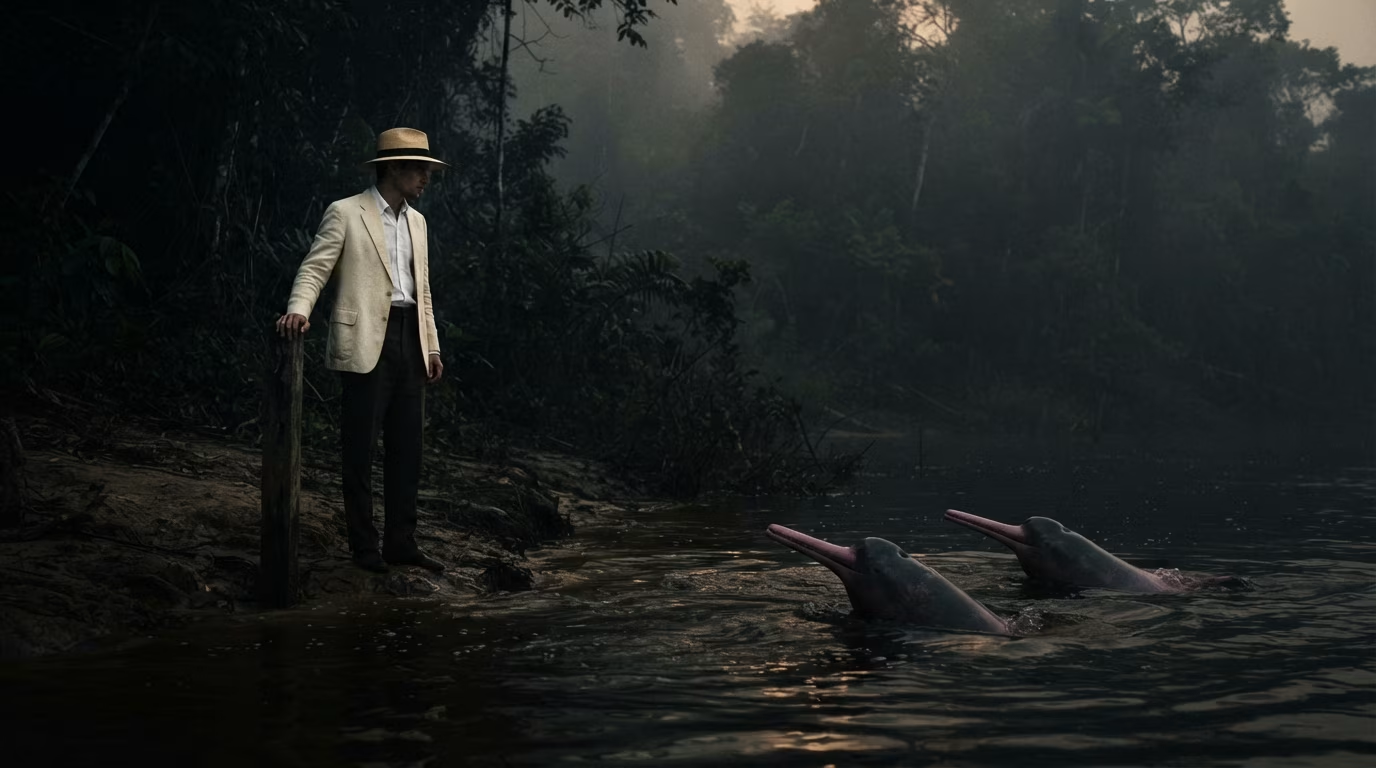
To close this journey through the dark waters of the Amazon leaves us with a sensation of beautiful vertigo. The pink dolphin still swims today beneath the turbid surface, utterly indifferent to the stories we weave about it above. And as long as the river keeps flowing toward the sea, there will be someone, on a moonless night of full moon, staring fixedly at the bank, waiting to see the silhouette of a man in white with a straw hat who returns to claim his tribute of mystery.
📜Investigation • Frequently Asked Questions
Documentary Archive and Analysis of the Occult • Relatando.com
What is the documented historical or folkloric origin?
The myth emerges from the oral traditions of the indigenous peoples of the Amazon basin, later nourished by the chronicles of European explorers who collected tales of aquatic beings capable of assuming human form.
How does it manifest, or what are its primary characteristics?
He manifests as a handsome man dressed in stark white, with a wide-brimmed hat that conceals his brow, appearing at nocturnal festivities to seduce the unwary and drag them down into the depths of the river.
What cultural or psychological hypotheses account for this myth?
Anthropologists note that it functions as a metaphor for temptation and otherness, having historically served a regulatory and deterrent role in isolated riverine communities against the nocturnal dangers of the jungle.
What contemporary accounts or chronicles exist on the subject?
Local inhabitants of the Amazon region continue to recount encounters with this entity, describing trance-like states, momentary disappearances, and a profound reverence and respect for the pink dolphin.
Do not extinguish the light yet...
If you have had the courage to make it this far, we have other dossiers that will test the limits of your sanity.

Terms and Figures of this Tale
To delve deeper into the legends, creatures, and dark concepts that inspire this account, consult their entries in our dictionary of the uncanny:






Tu correo no se publica ni se comparte con terceros: solo sirve para notificar la respuesta.