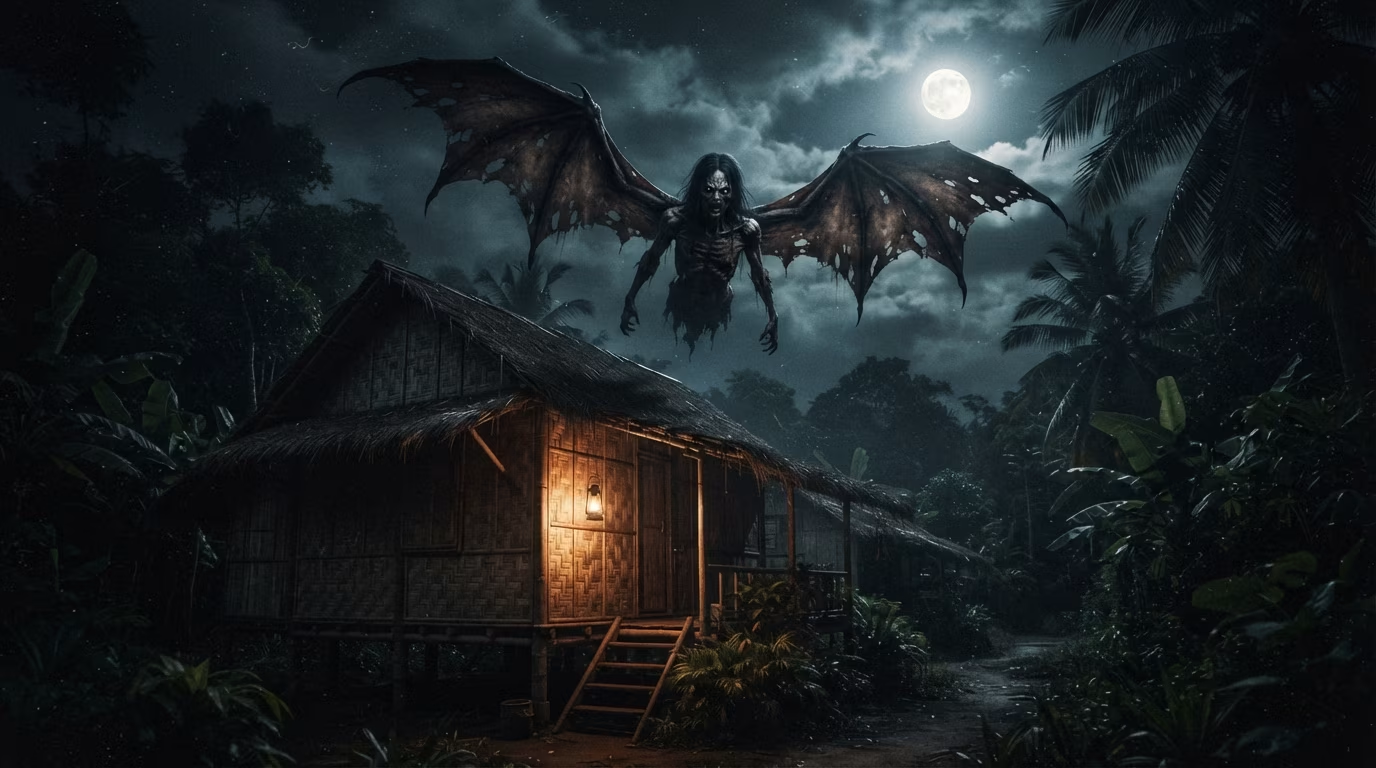
The Manananggal is a terrifying creature creature of Philippine folklore, capable of severing its upper torso from its lower half, unfurling membrane-thin, bat-like wings to hunt in the pitch of night, feeding upon the blood of pregnant women through a grotesquely long, needle-thin tongue.
The Origin of the Myth and the Earliest Chronicles
When we step into the shadowed depths of folklore from archipelagos as distant and haunting as the Philippines, we discover that the nocturnal dark harbors more than just universal human fears; it conceives hyper-specific entities shaped by centuries of oral tradition, cultural collision, and a deep-seated dread of the unknown. I am Carlos Nieto, and today I wish to unlatch the door of this study so we may descend together into one of Asia's most harrowing and singular legends: the Manananggal. We are not speaking of some dusty Old World vampire transplanted to the tropics, nor of a Phantom common, wandering through abandoned corridors. We are confronted with a grotesque and fascinating materialization of human duality, a creature that embodies the most disturbing physical transformation our collective imagination has ever managed to conceive.
To grasp the true magnitude of this entity, we must travel mentally to the rural expanses of the Philippines, particularly regions like the province of Capiz, the Visayas, and Iloilo. There, where electric light so often surrenders to the absolute, suffocating darkness of the jungle and the ceaseless friction of crickets, the myth takes on a disturbingly real existence. The earliest Spanish explorers to set foot upon these islands during the colonization recorded native accounts of nocturnal beings that terrorized local communities. Jesuit and Augustinian priests, within their journals and ecclesiastical accounts, documented with a mixture of wonder and dread the local beliefs in witches capable of cleaving their own anatomy. They understood them not through a modern lens, but as tangible proof of dark forces and pacts forged with demonic entities in those uncharted lands.

Etymologically, the term ‘Manananggal’ stems from the Tagalog word ‘tanggal’, meaning to sever, detach, or remove. Its literal translation is ‘the one who severs itself’. By day, this entity walks among us disguised as a beautiful woman—often quiet, reserved, or even deeply respected within the rural community. No one suspects her while the sun beats down on the rice paddies. Yet, as night falls and the moon swallows its own light, she seeks a secluded refuge—an abandoned hut, a dark hollow beneath a stilt house, or the suffocating density of the forest—to perform her macabre ritual. Through dark arts or formulas handed down across generations, the creature's body splits cleanly at the waist. The lower half, inert and stripped of apparent life, remains hidden on the earth, while the upper half unfurls vast, leathery bat wings and ascends into the nocturnal sky in search of its prey.
Signs, Encounters, and Documented Testimonies
Reader and friend, pause for a moment to consider the atmosphere. Imagine a warm, humid tropical night, the kind where the air turns sluggish and heavy, and the silence is broken only by the distant murmur of nocturnal fauna. In the rural settlements where whispers of the Manananggal still persist, life is governed by ancestral precautions that many continue to take with absolute deadliness. How does a villager know this creature is prowling the perimeter? Nature itself seems to recoil in its presence. Stray dogs howl in a peculiar, wretched cadence—simultaneously pitiful and petrified—gazing fixedly up at the black sky rather than the ground. Night birds, such as the owl or the bird locally known as the ‘tiktik’—whose ominous call is believed to portend the nearness of the monster—, redouble their frantic intensity whenever the flying torso glides across the thatch.
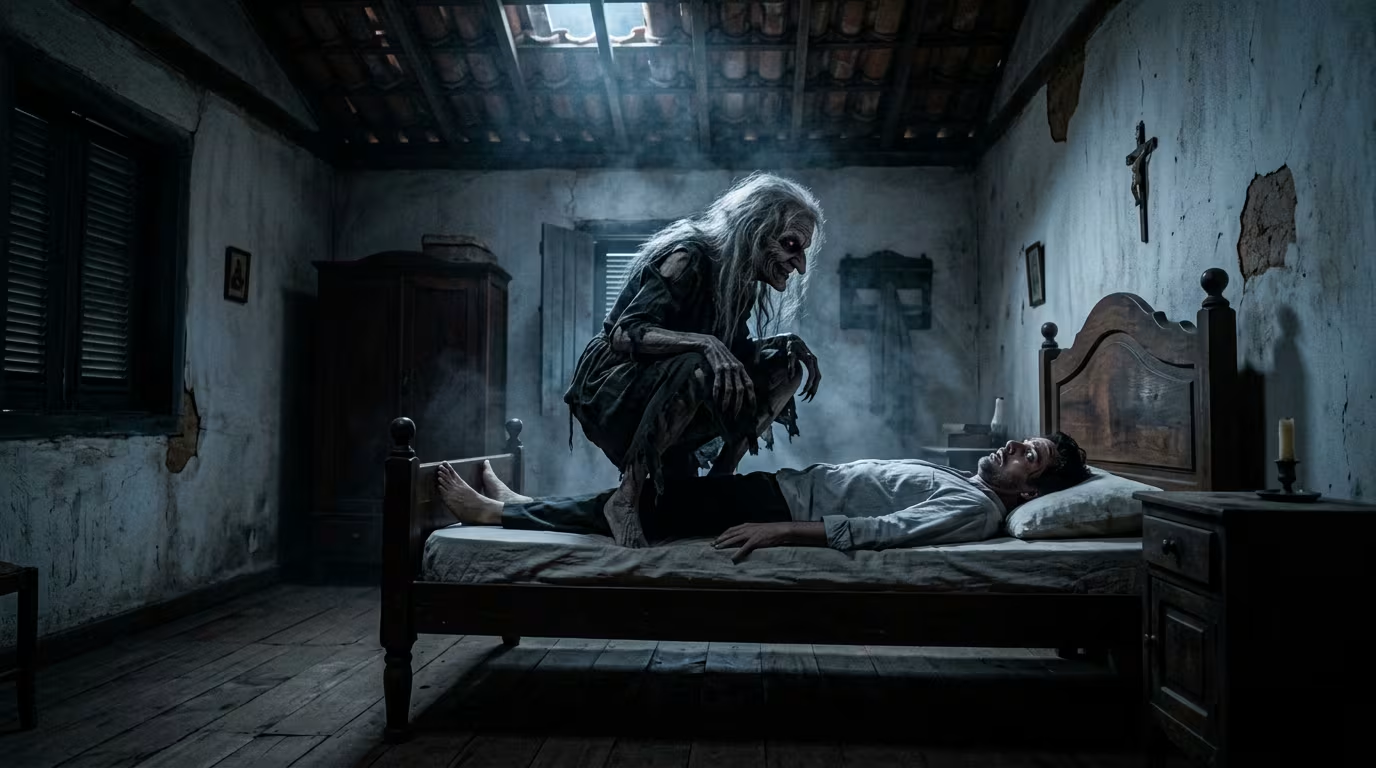
The primary objective of these nocturnal excursions are pregnant women. The Legend lore maintains that the Manananggal descends in utter silence upon the dwellings, perches atop the nipa and bamboo roofs, and extends a grotesquely elongated, flexible tubular tongue through the gaps in the walls or the straw thatch. This tongue hunts for the expectant mother's womb to draw out the fetus or her vital blood—an act of visceral vampirism that leaves its victims in a state of profound shock or, in the most tragic accounts, stripped of life entirely. It is a deeply unsettling image that strikes directly at one of the most sacred and vulnerable pillars of any society: maternity and the unbroken lineage of life.
If you ever find yourself in the darkness of a Philippine province and hear a strange flapping accompanied by a hollow sound, do not look up at once; seek salt, ash, or garlic, for the invisible hunter is searching for a place to hide its abandoned half.
Over the years, I have collected numerous testimonies gathered by local investigators of the anomalous. Elders from villages in Capiz recount stories of relatives who, returning late from work in the fields, glimpsed a floating silhouette cut against the lunar disc. Some brave souls, armed with carbide lanterns and blessed machetes, have attempted to trace the origin of these sounds. And here is where the myth takes on a fascinating tactical nuance. The Manananggal's vulnerability lies precisely in its other half—the one it leaves on the ground. According to tradition, if someone discovers the motionless lower body while the torso flies, they can neutralize the creature permanently. To this end, the eldest locals advise pouring coarse salt, ash, vinegar, or crushed garlic over the severed section. Unable to rejoin before dawn, the sunlight catches the wandering torso or prevents the creature from recovering its complete form, bringing about its definitive destruction. It is an almost ludic survival mechanic within the tragedy, a physical Achilles' heel for a supernatural threat.
Why Does This Enigma Both Fascinate and Frighten Us?
At this point, we must confront the fundamental question that guides every one of our investigations at Relatando.com: Why does this tale endure? What is it in the human psyche that needs to create and keep alive the figure of a flying torso that tears the life from the innocent? The answer lies not in zoology nor in traditional cryptozoology, but in the dark corridors of cultural anthropology and psychoanalysis. The Manananggal is, in essence, a projection of the deepest fears tied to social transgression, guilt, and double morality. Consider its double life: by day, an integrated, respected, and seemingly harmless woman; by night, a blood-thirsty monster. This dichotomy reflects the eternal human dread of never truly knowing those around us, of discovering that beneath the kindest surface a wild and destructive nature may lurk.
Moreover, in the agrarian and traditional societies of the past, high infant mortality and complications during pregnancy were everyday tragedies that proved very difficult to process emotionally. Attributing these inexplicable deaths to a supernatural entity like the Manananggal served as a mechanism of explanation and, in a sense, of psychological control. It was not chance or inevitable disease; it was a creature that could be fought through rituals, amulets, salt, and community vigilance. The myth bound families together, compelled them to keep their doors bolted, and reinforced bonds of neighborly solidarity on the darkest and loneliest nights of the year.
Today, in a hyperconnected world where science and technology strive to explain every corner of our existence, the Manananggal survives in pop culture, in contemporary Filipino horror cinema, and in late-night conversations around a campfire. And it does so because it strikes a deeply intimate nerve: the sense that the reality we perceive through our senses is only a thin veneer of lacquer, and that beneath it lie incomprehensible realities lurking in the half-light. When we switch off the light in our room and hear a creak in the ceiling, for a fraction of a second, our primitive mind accepts the possibility that the space we inhabit does not belong to us entirely. That emotion, that blend of vertigo and fascination with the unknown, is what drives us to keep investigating, to keep telling stories, and to keep the flame of curiosity burning before the mystery.
📜Investigation • Frequently Asked Questions
Documentary Archive and Analysis of the Occult • Relatando.com
What is the documented historical or folkloric origin?
The myth stems from the oral traditions of the rural regions of the Philippines, especially in Capiz and the Visayas, and was recorded by Spanish chroniclers and priests during the first centuries of colonization as part of the local beliefs concerning witches and shapeshifting beings.
How does it manifest, or what are its primary characteristics?
By day she manifests as a woman who, by night, severs her upper torso from the waist, unfurls bat wings, and hunts with a long, tubular tongue, habitually accompanied by the sound of the tiktik bird and the howling of dogs.
What cultural or psychological hypotheses account for this myth?
Anthropologically, it represents the dread fear of social transgression and hypocrisy, while historically serving as a mythical rationale for the tragic, sudden complications of pregnancy within isolated rural communities.
What contemporary accounts or chronicles exist on the subject?
There are numerous accounts from farmers and locals in Filipino provinces who claim to have heard strange nocturnal wingbeats and glimpsed floating silhouettes, keeping alive the traditional precautions against the creature.
Do not extinguish the light yet...
If you have had the courage to make it this far, we have other dossiers that will test the limits of your sanity.

Terms and Figures of this Tale
To delve deeper into the legends, creatures, and dark concepts that inspire this account, consult their entries in our dictionary of the uncanny:




Tu correo no se publica ni se comparte con terceros: solo sirve para notificar la respuesta.