The witch's knot is an ancestral amulet composed of four interwoven loops forming a cross and a central circle. A pagan symbol designed to break hexes, repel dark energies, and return any malice directed toward you to its source with startling efficacy.
Hello everyone, Carlos Nieto here. If you have been joining me on this journey at Relatando.com for some time, you know perfectly well that I have no interest in fleeting trends or cheap commercial trinkets. What truly keeps me awake is tracking the pulse of those artifacts that have weathered the centuries, retaining a mysterious, symbolic power. Have you ever felt the strange intuition that a mundane object, upon crossing the threshold of your home, completely alters the atmosphere of the room? That is precisely what happens when we encounter this geometric enigma.
The Origin of the Myth and the Earliest Chronicles
To grasp the true nature of the witch's knot, one must cast aside conventional textbooks and turn to the oral traditions of rural Europe, particularly within the Celtic fringe and the northern reaches of the peninsula. The ancient sages of the Early Middle Ages did not view knots as mere practical fasteners, but as genuine snares for human intent. The premise was as simple as it was unsettling: that which is bound on the physical plane possesses the power to tether or unleash forces in the unseen.

The earliest chronicles of this sigil trace back to the witch trials of the 16th and 17th centuries. Within the judicial records of that era, it was noted with dread how healers and supposed seers employed cords tied in geometric patterns to command the winds, safeguard their harvests, or ward off the evil eye cast by the envious. The geometry of the witch's knot is no accident. It is formed by the interplay between the vesica piscis cross—linked to the four elements and the cardinal directions—and a closed circle that acts as an impenetrable shield. The lines have neither beginning nor end; they represent the continuity of the spirit and the impossibility for any hostile force to find a fissure through which to slip.
Over the centuries, the custom of tying hemp ropes evolved into engraving the symbol onto silver medallions, lead amulets, or even carving it into the stone lintels of ancient manors. The objective has always been the same: to erect an invisible bulwark against that which we cannot see but undeniably feel lurking in the gloom.
Signs, Encounters, and Documented Testimonies
Throughout my years investigating occult folklore, I have collected dozens of accounts concerning protective amulets, yet the testimonies surrounding the witch's knot follow a disturbingly consistent pattern. People rarely speak of an immediate magical transformation, but rather of a sudden, jarring shift in sensory perception at the precise moment the talisman comes into contact with its wearer or a malevolent environment.
Many swear that upon donning this amulet for the very first time, they experience a sudden, marrow-deep chill in the chest, an almost imperceptible hum within the metal, or an abrupt, suffocating silence settling over rooms previously thick with unnameable tension. Yet the most thoroughly documented phenomenon phenomenon is the spontaneous fracture of the symbol. When the piece absorbs a psychic strike or a malignancy too dense to withstand, the silver or steel inevitably snaps cleanly down the center without physical cause, as though ruptured by a minute, internal detonation.
“It happened on a Tuesday in November. I was wearing the silver witch's knot I inherited from my grandmother. During a deeply strained family gathering, where arguments turned sour and heavy with ancient spite, I felt a lash of heat against my throat. When I reached for my chest, the medallion had cleaved into two perfect halves. The chain did not break; the silver engraving itself shattered as if it had intercepted an unseen blow. I have never doubted its purpose since.” — Testimony of Isabel M., Cangas de Onís.
Cases like Isabel’s number in the hundreds in villages where old ways refuse to die. There are also whispers of domestic animals—dogs and cats alike—that stare transfixed at the amulet immediately after its purification with sea salt, or of the sudden cessation of recurring nightmares and episodes of sleep paralysis after placing the engraving beneath the pillow. Is this mere psychological autosuggestion, or the manifestation of a physical law yet to be explained by modern science?
Why Does This Enigma Both Fascinate and Frighten Us?
A profound rationale underpins humanity's desperate need to forge defenses through symbols. Depth psychology long ago proposed that geometric archetypes serve as heavy anchors for our subterranean unconscious. The dread lingering dread of being watched, the prickling intuition of hidden malice, and the terror of losing sovereignty over our own domestic sanctuaries are all atavistic agonies that have hunted us since the days we huddled together in damp caves.
The witch's knot It fascinates because it is not a passive amulet; it is a defensive weapon. Unlike other talismans that merely seek to attract luck or health, the geometry of this knot holds an explicit promise of karmic justice: the 'mirror effect.' Whoever attempts to send malicious energy to the wearer stumbles into an infinite geometric loop that hurls the vibration back to its origin, multiplied threefold. This notion induces a profound relief in those who wear it, yet also a disquieting reverence: it reminds us that we dwell amid invisible currents where intent is as corporeal and perilous as a solid object.
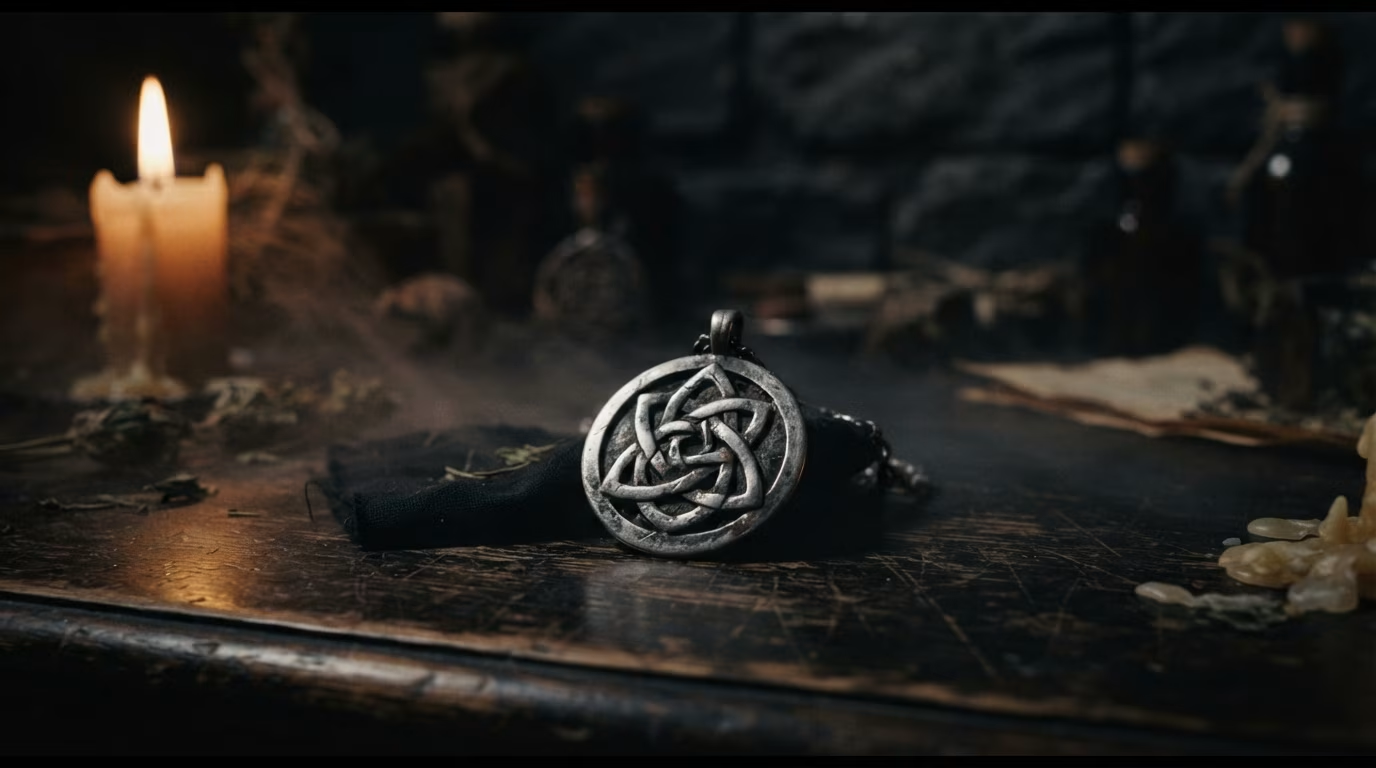
It terrifies us because it forces us to admit to the existence of the shadow. To wear a witch's knot is to acknowledge that malice, envy, and subtle presences are not merely fireside tales meant to frighten children, but forces that operate daily in the hallways of our hospitals, our offices, and the dark intimacy of our homes.
Perhaps the next time you see this symbol entwined at a stranger's throat or etched into an ancient stone, you should pause a moment to reflect. Do not wonder only at the aesthetic beauty of its loops; ask yourselves what manner of invisible threat it strives to keep on the other side of the threshold. As long as shadows lurk in the corners of our world, the necessity of binding evil will remain our most sacred shield.
📜Investigation • Frequently Asked Questions
Documentary Archive and Analysis of the Occult • Relatando.com
What is the precise historical connection between the geometric knots of the Middle Ages and the witchcraft trials of the sixteenth and seventeenth centuries?
During the inquisitorial and secular trials of the early Modern Age, judicial records frequently documented the use of twine and geometric knots by healers and witches. Far from being mere folk superstitions, these talismans were ritually employed to tame the winds, protect harvests, or ward off curses, laying the documentary foundation for the amulet we know today.
How do the vesica piscis cross and the closed circle intertwine within the sacred geometry of the witch's knot to repel dark energies?
The structure of the knot fuses a vesica piscis cross—representative of the four elements and the cardinal points—with a continuous perimeter circle. This geometric tracing, having neither beginning nor end, acts as an impenetrable shield, designed according to pagan tradition to ensnare hostile intentions in the invisible plane and cast them back to their origin.
In what manner did the material medium of the witch's knot evolve, from rural hemp to stone lintels and silverwork?
In its origins within the rural communities of the Celtic fringe and the northern peninsula, the knot was crafted from hempen cord. As the centuries passed, this practice grew more sophisticated, migrating the protective symbol onto silver medallions, leaden amulets, and even deep carvings upon the stone lintels of traditional manor houses.
What behavioral patterns and recurring testimonies have folklorists documented regarding the contemporary use of this amulet?
Unlike the cinematic magic of immediate effects, field research into the witch's knot reveals a subtle yet unsettling pattern: those who carry it or display it in their homes report no magical flashes, but rather a palpable shift in the mundane atmosphere and a lingering sense of sanctuary against invisible presences.
Do not extinguish the light yet...
If you have had the courage to make it this far, we have other dossiers that will test the limits of your sanity.

Terms and Figures of this Tale
To delve deeper into the legends, creatures, and dark concepts that inspire this account, consult their entries in our dictionary of the uncanny:

Tu correo no se publica ni se comparte con terceros: solo sirve para notificar la respuesta.