The bitter wind of the tundra does little more than freeze the flesh; at times, it brushes against the ears with unintelligible whispers carrying the echo of unseen footsteps across the fractured sea ice. In the farthest reaches of the Arctic, where the polar night swallows the world for months on end, the Inuit elders need not raise their voices to instill a reverential panic in the young. It is enough for them to utter a single name, an ancestral warning that drifts like a curse over the fissures of the pack ice: Qalupalik. I am Carlos Nieto, and in this exhaustive investigation for Relatando.com we will delve into the bowels of one of the most terrifying anthropophagous myths ever conceived by the human mind, unearthing the secrets of a creature lurking at the edge of the frozen abyss, bearing a macabre pouch of fetal leather.
Classified File
- Origin: Mythology and Inuit oral tradition (Canadian Arctic, Alaska, and Greenland).
- Nature: Amphibious humanoid entity, demonic and with a child-predatory nature.
- Hazard Level: Extreme. Regarded as an apex predator in the Inuit collective psyche, specializing in the abduction of minors.
- Weaknesses: The sound of traditional drums, rhythmic shamanic chants, and precise knowledge of its name and nature.
Origin and Etymology
To understand the genesis of the Qalupalik, we must immerse ourselves in the complex worldview of the Inuit peoples, a culture that has survived for millennia in one of the most unforgiving environments on the planet. The Inuit term for this creature evokes a constant presence on the periphery of human survival. In the traditional communities of Nunavut and Nunavik, the myth was not born as a simple fantastic tale to entertain beside the fire, but rather as a pedagogical tool for extreme survival. In a landscape where a single misstep upon thin ice means death by hypothermia or drowning in the frigid waters of the Arctic Ocean, parents faced the titanic challenge of keeping children away from the lethal ocean shores.
Anthropologists and polar folklore researchers have documented how the Qalupalik acts as the culmination of a series of warnings regarding the perils of nature. Unlike other monsters mythological beings that inhabit the darkness of the woods, this entity is inextricably bound to the constantly shifting sea ice, known in the region as 'sikuliaq'. The etymological and conceptual origin of the beast draws from the absolute respect the Inuit profess for the sea; the ocean is not merely a source of sustenance through the hunting of seals and whales, but a liminal territory inhabited by fickle, starving spirits who demand tribute in the form of caution and strict adherence to communal laws.

Anatomy and Appearance
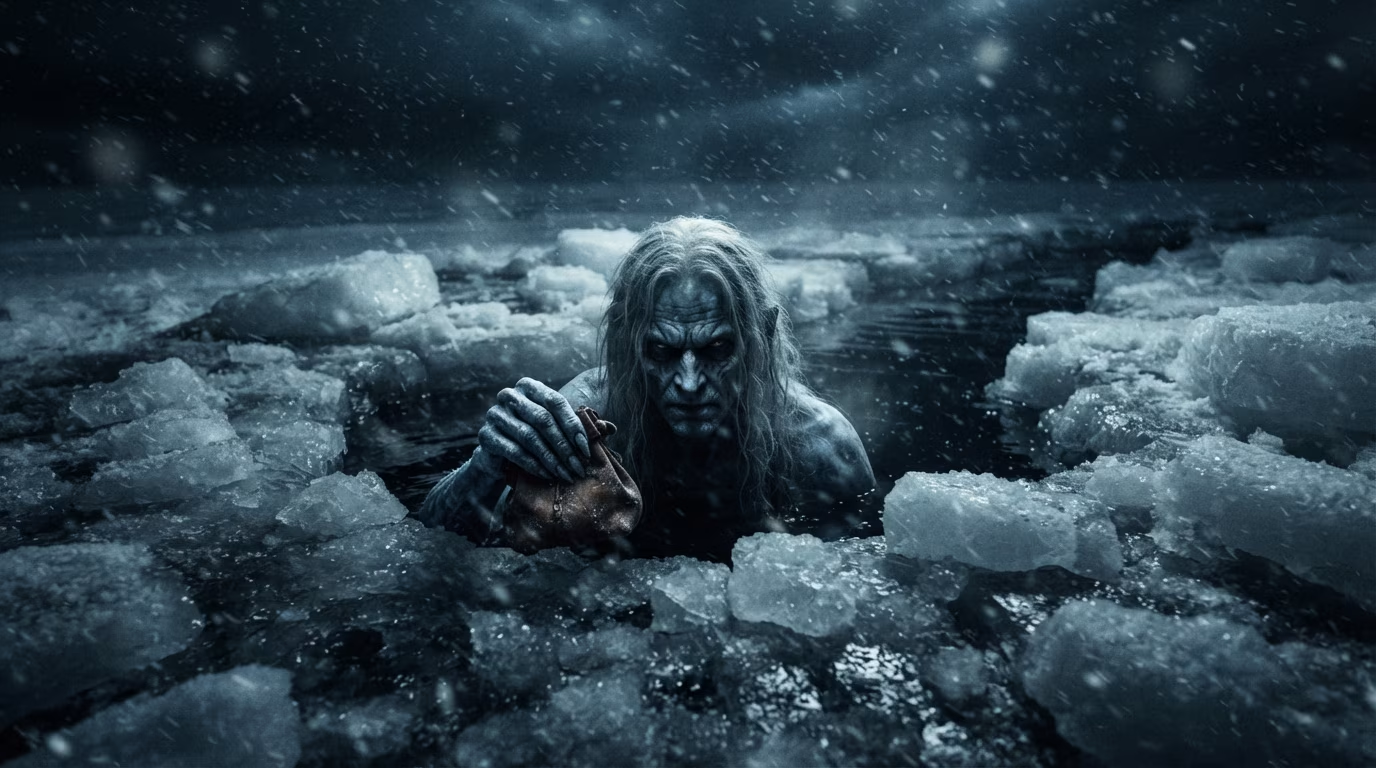
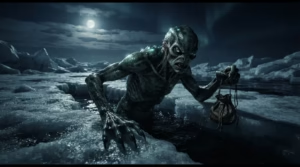
The descriptions passed down from generation to generation through traditional chants and tales paint a profoundly unsettling portrait of the Qalupalik. It is neither a simple wild animal nor an Phantom disembodied specter; it is a physical entity endowed with grotesque humanoid features adapted to life upon the ice and within the ocean depths. It possesses a long, scaly skin of greenish and bluish tones that camouflage it perfectly against the translucent sea ice and the dark waters of the Arctic. Its nails are claws formed of hardened bone or fossilized ivory, capable of tearing through thick seal hide and, naturally, fragile human flesh with startling ease.
Yet the most iconic and hideous element of its anatomy is its attire and primary accessory: the 'amautik', a modified and oversized traditional Inuit parka designed specifically to carry weight upon the back. In place of a human infant, the Qalupalik utilizes a monstrous pouch fashioned from fetal leather and cured hides of unknown origin to transport the children it manages to capture. Its face is described with exaggerated, terrifying features: large, bulging eyes that glow in the darkness of the polar night, capable of detecting the slightest movement miles away, and a lip-less mouth revealing rows of teeth as sharp as obsidian blades, forever poised to devour disobedient children.
Modus Operandi and Powers
The Qalupalik does not attack the camps head-on, nor does it destroy igloos in an orgy of blind violence; its method is infinite patience and psychological deception. The entity lurks in absolute silence beneath the ice platforms or remains motionless at the edge of the cracks, resembling a rocky formation or a drift of snow. Its principal weapon is the emission of a highly peculiar vocal sound: a rhythmic hum, a hypnotic crooning, or a honeyed murmur that imitates the voices of the child's relatives or nursery songs distorted by the echo of the polar wind.
When a child disobeys its parents and ventures too close to the water or to the unstable pack ice, it is caught within the radius of that magnetic song. The Qalupalik erupts suddenly from the depths or from behind a wall of ice with superhuman speed. Without uttering a single cry of warning, it extends its bony claws, seizes the child, and thrusts it violently into the great fetal-leather pouch slung across its back. Once the child is confined in the darkness of the pouch, the creature slips back into the freezing water or takes refuge in submarine caves unreachable by Inuit hunters, where the infant is kept for a time before becoming its macabre sustenance.
Weaknesses and Protective Rituals
Despite its terrifying nature and apparent invulnerability within its own element, the Qalupalik is no all-powerful god, and over the centuries Inuit communities have developed precise methods to neutralize its threat or rescue potential captives. One of its greatest weaknesses lies within its own auditory nature: although it utilizes sound to hunt, it is exceptionally sensitive to shrill, repetitive, and harmonic human-made noises, such as the rhythmic striking of ceremonial 'qilaut' drums and traditional throat-singing.
Likewise, the most effective protection against the Qalupalik is the strict adherence to communal norms and preventative education. In the past, shamans or 'angakkuq' would perform specific purification rituals at the ice cracks where the creature's presence was suspected, utilizing amulets carved from walrus ivory and burned whale blubber to drive away the malevolent energies associated with the entity. Knowing the true name of the Qalupalik and shouting it with authority into the teeth of the freezing wind is considered an act of empowerment that shatters the hypnotic spell of its voice, compelling the beast to drop its spoils and retreat into the ocean depths.
Documented Cases and Famous Legends
Within the oral tradition of the communities in the Kivalliq region of Nunavut, detailed accounts are passed down concerning specific incursions of the Qalupalik into coastal settlements during periods of acute hunting scarcity. The Legend most famous account tells the story of a young girl named Qatellik, known for her stubborn habit of ignoring her mother's counsel and running alone onto the sea ice to search for Arctic bird feathers. On a particularly freezing, blustery afternoon, the villagers heard a strange humming drifting from the pack ice, followed by a muffled scream that was swiftly extinguished.
Search parties discovered only the small boot prints of the child, ending abruptly at the edge of a newly opened fissure, alongside a strange viscous substance and a scrap of cured leather that the elders immediately identified as a fragment of the infamous fetal pouch of the monster. Though the child's body was never recovered, the tale became the cornerstone for educating entire generations on the mortal perils of the Arctic Ocean, transforming the grief of a loss into an immortal myth that endures to this day within the annals of polar mystery.
Comparative Analysis
When subjecting the legend of the Qalupalik to rigorous comparative analysis within global demonology and cryptozoology, it is fascinating to uncover striking parallels with entities from culturally and geographically distant lands, yet bound by the same archetypal 'child-snatching monster.' In the folklore of the Celtic peoples of Scotland and Ireland, we find the 'Kelpie' or the dark 'Sirens'—aquatic phantoms that lure the unwary into the depths through physical allure or deceptive siren songs. Yet, the Qalupalik diverges radically from these; its seductive nature is not rooted in physical beauty, but in grotesque deformity and the psychological terror pure.
If we compare it to the 'Cuco' or 'Coco' of Hispanic tradition, or Japan's 'Namahage'—figures likewise invoked to whip disobedient children into line—the Qalupalik far transcends mere pedagogical metaphor. Within the Inuit worldview, it solidifies into a tangible, biological, and spiritual entity that truly inhabits the arctic ecosystem. While the bogeyman is an invisible abstraction, the Qalupalik possesses skin, claws, a defined geographical habitat, and a physical pouch fashioned from fetal leather, placing it squarely on the razor-thin border between folklore and the darkest, most unsettling cryptozoology.
📜Investigation • Frequently Asked Questions
Documentary Archive and Analysis of the Occult • Relatando.com
What precisely is the Qalupalik within Inuit culture?
It is an amphibious, humanoid mythological creature that dwells in the Arctic sea ice and specializes in abducting disobedient children using a pouch of fetal leather.
How does the Qalupalik strike at its victims?
The creature lurks in the fissures of the ice and uses a hypnotic song or humming to draw children toward the water before seizing them with its bony claws.
Are there truly documented cases of this creature?
No actual scientific records exist, yet the myth is anchored in a rich oral tradition passed down by the legends Inuit regarding tragic disappearances upon the frozen sea ice.
How did the ancient Inuit defend themselves against the Qalupalik?
Shamans performed rituals with drums and rhythmic chanting, while families warned their children with stern stories to keep them away from danger.
Do not extinguish the light yet...
If you have had the courage to make it this far, we have other dossiers that will test the limits of your sanity.

Terms and Figures of this Tale
To delve deeper into the legends, creatures, and dark concepts that inspire this account, consult their entries in our dictionary of the uncanny:

Tu correo no se publica ni se comparte con terceros: solo sirve para notificar la respuesta.