The Rusalka of the Russian Lagoons is the wandering spirit of a drowned maiden, marked by her unmistakable green hair, who emerges from the aquatic depths to lure the unwary on misty nights. I am Carlos Nieto, and from Relatando.com, today we plunge into the blackest waters of Slavic folklore to unravel an ancient mystery that still chills the blood of those who wander near the desolate lakes of Eastern Europe.
The Origin of the Myth and the Earliest Chronicles
When we walk the shores of those ancient mirrors of water in Russia, Ukraine, and Belarus, the air seems to thicken, laden with a dampness that reeks of millennial silt and legends long forgotten by time. This is where the Rusalka dwells, an entity rooted deep in Slavic pagan mythology, long before Christianization sought to wipe out the ancestral cults of nature in one stroke. In those remote times, water was not merely a vital resource; it was a threshold, a permeable border between the world of the living and the unfathomable domain of the dead.
The ethnographic chronicles compiled during the nineteenth century by scholars such as Aleksandr Afanasyev reveal that the rusalki did not spring from nothing. They were, as a rule, young maidens who had suffered a violent death by drowning, often brought on by unrequited love, suicide in the wake of betrayal, or tragic accidents before marriage. Popular tradition held that souls departing this world with passions unfinished or violent found no rest in the underworld. Instead, they remained trapped in the cold, dark water, transformed into liminal creatures seeking to perpetuate their own suffering.

The most defining trait of these entities, and the one that exerts the deepest fascination upon those of us who investigate the arcane, is their hair. It is said that their green, long, and eternally damp locks possess hypnotic properties. Local lore recounts that combing this hair is their favored pastime during full moon nights, as they sit upon rotting wooden docks or the low-hanging branches of weeping willows that brush the dark surface of the lake. If an imprudent traveler crosses paths with a rusalka mid-grooming and dares to steal her comb, the creature acquires absolute dominion over him. That green hair is far from a mere aesthetic attribute; it is a vegetative trap, a trailing extension of the choking algae and river silt that dragged her down to her watery grave.
The peasants of the Novgorod and Pskov governorates observed rigid prohibitions during the so-called ‘Rusalka Week’, which coincided with the onset of summer. Not a soul dared to bathe in secluded lakes without carrying a wooden cross or a sprig of wormwood—a bitter herb believed to repel aquatic spirits. It was thought that if a young woman drowned, the water itself claimed her soul to swell its ghostly retinue. Ancient accounts speak of entire communities shunning specific cursed ponds, convinced that the nocturnal murmurs of the water were not the wind, but the mocking, breathless laughter of maidens luring men down into their lethal embrace.
Signs, Encounters, and Documented Testimonies
To investigate the phenomenon of the rusalka plunges one into a domain where dark ethnography brushes dangerously against contemporary anomalous phenomena. Although many dismiss these accounts as mere cautionary folklore designed to keep unsupervised children away from deep river currents, the stubborn persistence of these testimonies across the centuries demands a far more unblinking and analytical gaze.
In late autumn of 1984, near Lake Seliger, a local ranger named Grigori Petrovich recorded in his personal journal an encounter that shattered his perception of reality. During a night patrol to deter poachers, Grigori caught a honeyed song drifting from the fog. As he approached the shore, sweeping the ground with his carbide lamp, he claimed to have seen a female figure with translucent, almost phosphorescent skin, seated on a submerged rock. What struck him most, as he set down in notes now kept in private research archives, was the texture of her hair. It did not resemble ordinary human hair; it floated in the stagnant air, defying gravity, taking on verdant hues that shifted between fresh moss and the dark green of deep waters.
The singing stopped the instant my flashlight beam swept across her face. At first, I felt no dread fear, but rather a profound, irresistible sorrow—an absurd, aching desire to plunge into the freezing water just to console her. If not for my dog, who began to bark frantically and yanked me backward into the dark, I swear I would have walked straight into the lake until I vanished beneath the surface.
This testimony is not an isolated case. In the archives of Karelian oral tradition, a region of infinite lakes and boreal forests, stories repeat of fishermen who, after returning from solitary hauls, claimed to have heard their names whispered from the thick of the watery mist. Some describe how rusalkas take the form of helpless women pleading for aid, feigning to be trapped in the shore's muck. When the Good Samaritan draws near to help, the supposed victim transforms, revealing her true nature and dragging the unwary down to the depths with superhuman strength.
The physical signs of these encounters tend to be subtle yet unsettling. Locals who claim to have escaped a rusalka report a drastic, localized drop in ambient temperature, accompanied by a piercing stench of stagnant silt and rotted river blossoms, even at the height of summer. Likewise, domestic animals—especially horses and dogs—display irrational panic before bodies of water where the spirit is rumored to dwell, refusing to drink from the shore and exhibiting symptoms of absolute terror.
Why Does This Enigma Both Fascinate and Frighten Us?
Having reached this point in our investigation, we cannot help but pause to reflect on the profound reasons that make the Rusalka such a powerful archetype within the human collective imagination. What is there in this green-haired maiden that still resonates in our modern psyche as forcefully as it once did in the mind of the medieval Slavic peasant?
In depth psychology, water represents the unconscious, repressed emotions, primordial chaos, and death. An entity that rises from that element personifies our most intimate fears of the unknown—that which lies hidden beneath the placid surface of our everyday lives. The Rusalka is the perfect embodiment of duality: she represents the ravishing beauty of virgin nature combined with its lethal and merciless potential. She is an aesthetic trap; we are drawn to her precisely by that which destroys us.
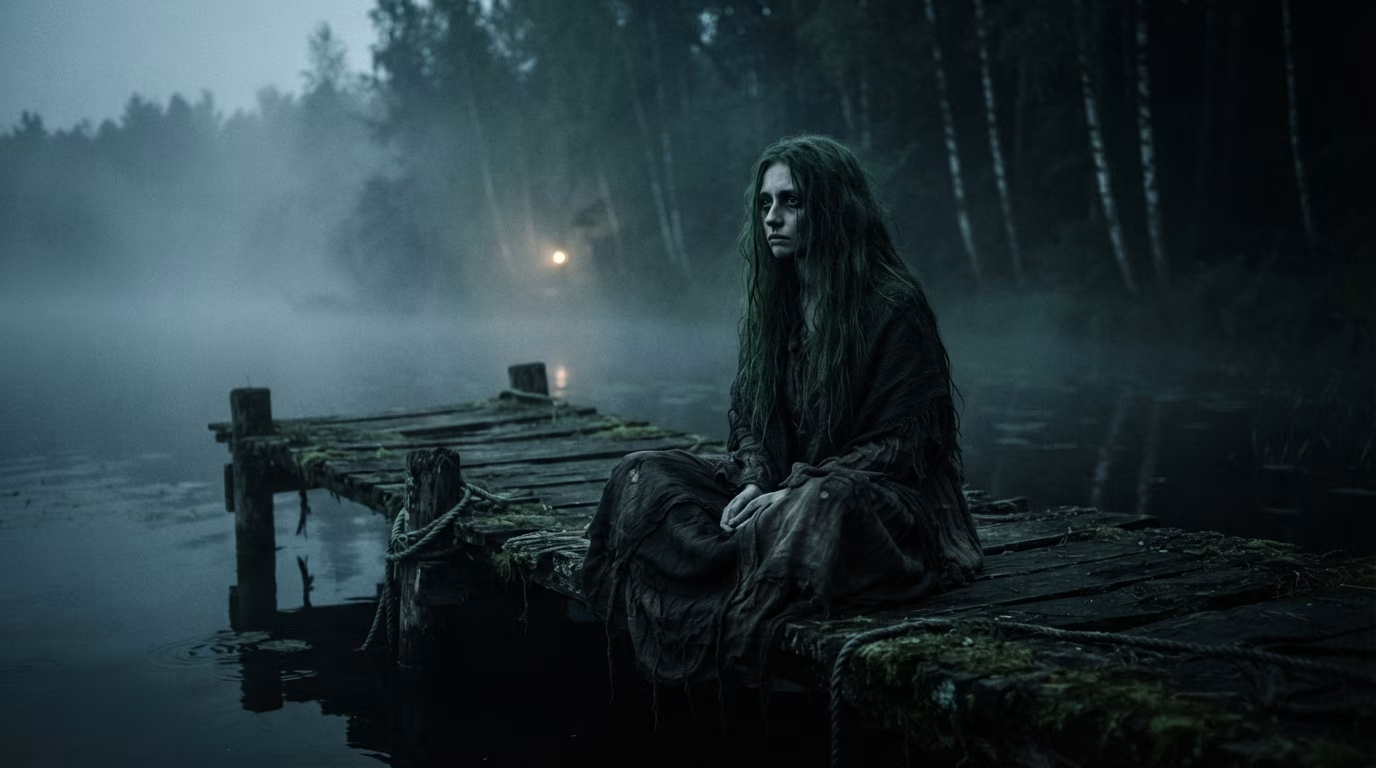
Furthermore, there is a deeply human and tragic dimension to the myth. The rusalka is neither an monster extraterrestrial horror nor some demon infernal fiend thirsting for blood out of pure malice; she is an eternal victim. Her destiny tragic fate stirs within the observer a strange, sickening blend of dread and pity. After all, who has not at some point felt the crushing weight of a grief so profound that they wished to drag the entire world down with them into the silence of oblivion? In this light, the Legend operates as a dark mirror reflecting our own unresolved mourning, the guilts that slowly drown us, and the hollow ache for what we lost to the relentless currents of time.
From the perspective of mystery, the persistence of these tales reminds us that the reality we perceive through our rational senses is scarcely a thin surface layer. Beneath it pulses a substratum of myths, energies, and presences that elude conventional science, dwelling in the corners where man has not yet managed to impose his absolute dominion. The Rusalka of the Russian Lagoons is still alive, not because she physically inhabits every pond, but because she is part of that sacred and fearsome geography that dwells in the deepest recesses of our consciousness.
Let us mind our steps when we draw near the shore of a lonely lake at dusk. For when the wind falls still and the water's surface turns to a perfect mirror, the gaze of a maiden with green hair may be waiting on the far side of the reflection, to remind us that we are not so alone as we believe.
📜Investigation • Frequently Asked Questions
Documentary Archive and Analysis of the Occult • Relatando.com
What is the documented historical or folkloric origin?
The myth descends from Slavic pagan lore, consolidated through nineteenth-century ethnographic chronicles documenting the beliefs surrounding drowned maidens transformed into water spirits.
How does it manifest, or what are its primary characteristics?
She is marked by her long green hair, her predilection for combing it upon the banks by night, the utterance of hypnotic songs, and the power to summon drops in temperature and the stench of silt.
What cultural or psychological hypotheses account for this myth?
From the standpoint of psychology, she embodies the unconscious and the fear of emotional drowning, and further personifies unresolved grief and the lethal duality of untamed nature.
What contemporary accounts or chronicles exist on the subject?
There are entries in the journals of forest rangers and oral accounts from regions such as Karelia and the shores of Lake Seliger concerning nocturnal encounters with translucent female figures beside the water.
Do not extinguish the light yet...
If you have had the courage to make it this far, we have other dossiers that will test the limits of your sanity.

Terms and Figures of this Tale
To delve deeper into the legends, creatures, and dark concepts that inspire this account, consult their entries in our dictionary of the uncanny:

Tu correo no se publica ni se comparte con terceros: solo sirve para notificar la respuesta.