My knuckles, stark white and clamped hard against the edge of the basin, betrayed a strain that went far beyond the physical exhaustion of three in the morning. I stared into the bathroom mirror, mottled with damp and water spots, and felt that freezing lash at the base of my skull known only to those who have brushed against the threshold of the inexplicable. It was not my own reflection staring back with that warped smirk; it was a crust of lime scale, a mere accident in the corrosion of the silvered mercury, which had assumed the macabre, geometric silhouette of hollow eyes and a lip-less grin. For one eternal second, the inert matter seemed to take on a will of its own—a taut, watchful breathing just on the other side of the glass.
Welcome to Relatando.com. I am Carlos Nieto. Today we descend into the abysses of human perception, onto that thin, brittle edge where sanity fractures to make way for one of the most intimate and persistent nightmares of our existence: pareidolia. This is no mere neurological curiosity meant to explain why we see rabbits in clouds or grins in the grill of an old car. It is something far darker—an evolutionary trap rooted deep within our genetic code that compels us to search for, beg for, and ultimately find humanity in the absolute chaos of nothingness.
I. The Hidden Mechanism of Survival
To understand why the human brain is a relentless engine for manufacturing ghosts, we must first descend to the most primitive roots of our species. Across the African savannah, in the heavy gloom of prehistoric caves where our ancestors barely clung to life at the mercy of nocturnal predators, the margin between life and death lay not in physical strength, but in the power of anticipation. The hominid who assumed a random snapping of branches was merely the wind ended up devoured by the fangs of a stalking feline hidden in the brush. Conversely, the one who interpreted an ambiguous pattern—two glowing points of light caught in the dark, a symmetrical silhouette amidst the foliage—as a hostile face, lived long enough to pass on their genes.

Evolution did not reward the skeptic who sought logical truth, but rather the paranoid who chose to see a face lurking in every shadow to secure survival.
That primitive software remains intact, operating in silence within the temporal lobes of our hyperconnected 21st-century brains. We live surrounded by an incessant tide of random visual and auditory stimuli, yet our neural machinery flatly refuses to accept the void. When we switch off the bedroom lights, when the shadows cast by the wardrobe assume humanoid proportions, or when we hear the static whisper of white noise from an out-of-tune radio, the mind rushes desperately to fill the gaps. It cannot tolerate the absence of meaning. And it is precisely upon that bridge stretched between chance and interpretation that the most enduring legends of the history of horror.
II. In the Gloom of Altered Perception
There are moments when this cognitive mechanism ceases to be a mere visual miscalculation and becomes the epicenter of a genuinely disturbing experience. Researchers of the anomalous know this well phenomenon under the term 'induced hypervigilance'. When isolation, sensory deprivation, or acute emotional terror collapse our rational filters, pareidolia runs wild, taking on the distinct nuances of an undeniable physical presence.
I recall the testimony of an old keeper of an abandoned lighthouse on the Atlantic coast, a man who spent entire weeks listening to the constant creaking of century-old timbers and the monotonous pounding of waves against the cliff. What began as mere mechanical sounds, through the passage of sleepless nights, began to articulate. The moan of the wind through the ventilation shafts took on a strangely human cadence, a guttural whisper that seemed to pronounce his name with a desperate urgency. When he peered through the cracks in the doors, the weathered grain of the wood formed grieving faces that writhed beneath the damp patina. Was it madness? Or perhaps the mind, exposed to the vastness of the void and absolute isolation, was tuning in to frequencies that common sense prefers to ignore?
The classic case of the Face on Mars, photographed by the Viking 1 probe in 1976, demonstrated on a planetary scale how capricious geology—sculpted by erosion and washed in a specific overhead light—could trigger in millions the unmistakable certainty of gazing upon an extraterrestrial burial monument. There was no conspiracy, nor cyclopean structures carved by intelligent hands; only light, shadow, and the desperate human need not to feel alone in the vastness of the cosmos. We see faces on the surface of the Moon, in morning toast, in the folds of sheets on an empty hospital bed. Every corner of the world is inhabited by the ghosts we ourselves fashion from the clay of our own imagination.
III. The Fracture of Certainty
At this juncture, the grand question that troubles philosophers, psychologists, and lovers of mystery continues to hang heavy in the dense night air: if we know scientifically that pareidolia is merely an error in sensory decoding, why does it still provoke such visceral, paralyzing panic? Why do the hairs on our arms rise with the exact same violence when we mistake the silhouette of a coat rack in the dark for an intruder as they would if the threat were real?
The answer perhaps lies in the very nature of the threshold. Pareidolia is the constant reminder that our senses are a merciful lie, a fragile interface built to keep us from going mad before the cold, chaotic reality of the universe. We fancy ourselves masters of our eyes and ears, absolute sovereigns of our own consciousness, until a single poorly cast shadow on the hallway wall is enough to freeze our hearts for endless, suffocating seconds.
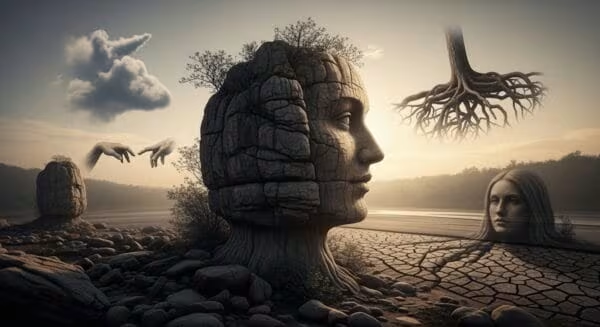
The next time you walk through your home in total darkness and believe you perceive a static figure at the end of the hallway, before you flip the switch and verify with relief that it is merely the coat hanging on the rack, pause for a single moment. Feel the cold heartbeat of that ancestral machinery residing within you. Think of the thin line separating the rational world from that other territory where inanimate forms take on a life of their own and stare back at you. For at that exact instant, as your brain struggles desperately to find a pattern in the chaos, you will know that the true nightmare does not lie in the monsters things that lurk in the dark, but in the terrifying ease with which our own minds are capable of manufacturing them.
📜Investigation • Frequently Asked Questions
Documentary Archive and Analysis of the Occult • Relatando.com
What exactly is pareidolia from a neurological standpoint?
It is a psychological and cognitive phenomenon in which the human brain imposes a meaningful structure—such as faces or human silhouettes—onto entirely random or ambiguous visual and auditory stimuli, driven by an evolutionary survival mechanism.
Why is pareidolia so often confused with paranormal experiences?
Because the ambiguity of sensory stimuli, combined with states of dread, sensory deprivation, or suggestion, compels the psyche to fill in the missing information, creating complex narratives regarding the presence of entities or ghosts.
What are the most famous examples of collective pareidolia?
Among the most celebrated are the 'Face on Mars' photographed by the Viking 1 probe in 1976, the countless photographs of supposed apparitions in haunted locations, and electronic voice phenomena (EVP) captured within white noise recordings.
How does current technology influence the manifestation of this phenomenon?
The proliferation of images generated by artificial intelligence and complex algorithms frequently produces unforeseen visual artifacts that users mistakenly interpret as recognizable faces or figures, intensifying the phenomenon in the digital age.
Do not extinguish the light yet...
If you have had the courage to make it this far, we have other dossiers that will test the limits of your sanity.

Terms and Figures of this Tale
To delve deeper into the legends, creatures, and dark concepts that inspire this account, consult their entries in our dictionary of the uncanny:


Tu correo no se publica ni se comparte con terceros: solo sirve para notificar la respuesta.