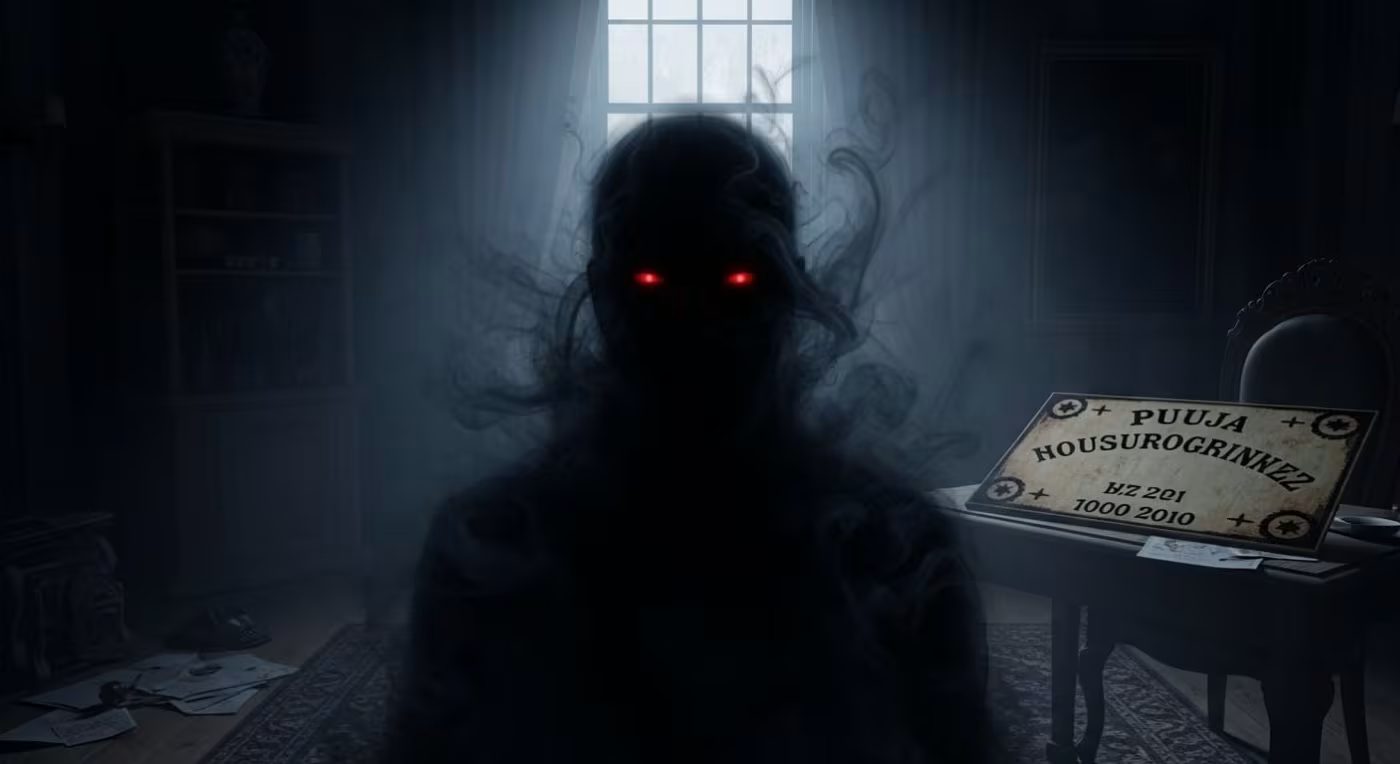
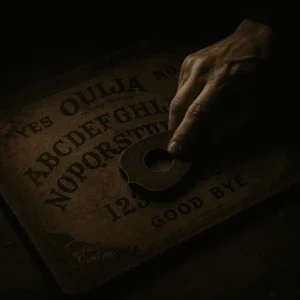
The cold emanating from the plywood board does not stem from the room itself, but from a deeper place—a hollow where the laws of physics and reason crumble beneath the weight of an unseen presence. Fingertips rest against the cold plastic of the planchette. The air in the room thickens, taking on a metallic, nearly suffocating density as the clock hands seem to drag. Someone whispers a question into the void, a blind invocation hurled toward the abysses of the beyond: Is anyone there? And then, with a mechanical and chilling precision, the small planchette begins to glide across the surface, spelling out over and over, with an almost hypnotic cadence, the letters that form a cursed name. A name that belongs to no ancient pantheon nor any treatise of classical demonology, but which resonates with the ancestral force of dread pure.
I. The Unknown Anomaly
Unlike the grand princes of hell cataloged with meticulous precision in medieval grimoires such as The Lesser Key of Solomon or the Pseudomonarchia Daemonum, Zozo lacks a formal lineage. There are no fallen celestial hierarchies to back his existence, nor forgotten temples whose ruins guard his memory. His genesis is modern, inextricably bound to the mass popularization of the Ouija board in the late 19th and early 20th centuries, when the Kennard Novelty Company transformed a supposed parlor game into a freely accessible portal for spiritual communication. However, to categorize him as a mere product of collective hysteria or an artifact of popular imagination would be to commit a grave perceptual error. Those who have crossed paths with him describe a persistent anomaly, a dark vibrational frequency that seems to emerge from humanity's collective subconscious to materialize into a tangible and malevolent entity.
The Horror most profound is born not from the monstrous and visible, but from the subtle certainty that something invisible and hostile has decided to take up residence in your very mind.
The etymology of the word lacks traceable roots in dead languages. It stems neither from ancient Hebrew, nor Aramaic, nor ecclesiastical Latin. It was born directly from the erratic movement of the planchette, responding with relentless, hammering insistence to the unwary seeking easy answers behind the veil of the occult. What began as a fairground curiosity rapidly transformed into a phenomenon recurrence, a constant in the reports of paranormal investigators documenting failed seances. The lack of a traditional historical origin does not weaken its Legend, but rather intensifies it, endowing it with an elusive, primordial, and opportunistic nature that seems to feed upon the very psychic energy of those who dare invoke it without weighing the consequences.

II. In the Gloom of the Stalking
When Zozo chooses to manifest, he rarely resorts to the cinematic display of the great literary demons. There are no sudden, catastrophic physical mutilations nor bursts of spectral fire in the early stages of contact. His modus operandi is infinitely more cruel and sophisticated: the systematic erosion of sanity. Witnesses agree that his visual appearances are vague, unsettling, and liminal. A shadow shifting at the edge of the eye with an unnatural density; a featureless humanoid silhouette outlined against a doorway in the gloom of the hallway; or an amorphous mass of cold energy that seems to swallow the light and warmth of the room. The absence of a fixed physical form is, in itself, one of his most terrifying defense mechanisms, forcing the human mind to project its own deepest fears in a desperate bid to give a face to nothingness.
The abilities attributed to this entity center on profound psychological manipulation. Whoever allows Zozo to cross the threshold via the Ouija board soon discovers that the spirit does not simply abandon the board when the session ends. It latches onto the person, becoming a constant presence that follows the victim everywhere. Alterations in the domestic environment are reported: unintelligible whispers brushing against the eardrum in the absolute stillness of the early morning hours, inexplicable sounds of heavy footsteps across wooden floorboards when no one else is in the house, and recurring nightmares of such intensity that they leave the sufferer physically and emotionally drained before dawn. The sleep paralysis becomes a frequent visitor, accompanied by an asphyxiating heaviness in the chest and the visceral certainty that a pair of invisible eyes is watching every move from the darkness of the corner.
III. The Fracture of Certainty
As Zozo's influence takes root in the victim's life, the harassment evolves into increasingly unsettling and desperate territory. The entity seems to take a sadistic pleasure in psychological suffering, feeding on anguish and fear as though it were physical nourishment. Cases have been documented where the entity not only manipulates the physical environment, but directly interferes with cognition, inducing episodes of acute paranoia, unexplained irritability, and mass hysteria among members of the same household. The communication that began with the apparent innocence of a letter board shifts into spontaneous manifestations: cryptic, threatening messages etched in faint marks upon steamy bathroom mirrors, across bedroom walls, or—in the most extreme and disturbing accounts—gasches torn across the victim's own skin in the shape of causeless scratches.
One of the most terrifying aspects of its behavior is the chameleon-like ability to mimic the voices of loved ones, friends, or deceased family members. It employs this supreme deception to lure targets into the isolated corners of the house or to sow absolute discord and distrust among the household. When an entire family falls under the siege of this presence—much like the notorious case documented by Ed and Lorraine Warren at the Perron farmhouse in Rhode Island, where multiple entities converged to torment the residents—the line between objective reality and nightmare dissolves entirely. Zozo does not seek to destroy the flesh immediately; it prefers to wear down the human spirit until nothing remains but an empty husk, proving that the portals we fling open out of idle curiosity sometimes lead to abysses from which there is no return.
📜Investigation • Frequently Asked Questions
Documentary Archive and Analysis of the Occult • Relatando.com
What origin or documented testimony inspired this story?
The Zozo phenomenon is primarily documented through modern accounts of Ouija board users who, since the late 19th and early 20th centuries, have reported the apparition recurrence of this name when establishing contact with supposed spirits.
Which signs or anomalies herald this phenomenon?
The signs include a sudden drop in room temperature, a suffocating heaviness in the air, mechanical and repetitive responses on the Ouija board, and the perception of furtive shadows at the corner of the eye after the session.
Is there any documented psychological or scientific explanation?
From psychology, it is attributed to an ideomotor effect during the use of the Ouija board, combined with collective suggestion, hysteria, and sleep disorders such as sleep paralysis, which amplify the sensation of a malignant presence.
How do folklore and tradition react to this case?
Modern folklore and investigators of the paranormal consider Zozo an opportunistic spirit or a form of parasitic energy that preys upon the emotional and psychological vulnerability of those who practice with the ouija board unprotected.
Do not extinguish the light yet...
If you have had the courage to make it this far, we have other dossiers that will test the limits of your sanity.

Terms and Figures of this Tale
To delve deeper into the legends, creatures, and dark concepts that inspire this account, consult their entries in our dictionary of the uncanny:

Tu correo no se publica ni se comparte con terceros: solo sirve para notificar la respuesta.