El susurro del viento helado en las cumbres de los Andes Centrales no es siempre el simple producto de la meteorología; a menudo, transporta el eco sordo de un salto solitario, un golpe seco y rítmico contra la tierra húmeda que anuncia la presencia de una de las entidades más aterradoras del folclore sudamericano: La Patasola. Como investigador de lo oculto y director de Relatando.com, he dedicado años a desentrañar los hilos invisibles que conectan la Legend con la realidad psicológica y territorial de nuestras montañas. En esta exhaustiva investigación antropológica y criptozoológica, nos adentraremos en las entrañas de los bosques nublados para diseccionar la anatomía, el origen, las tácticas de caza y los métodos de defensa contra este espectro de una sola pierna que acecha a los incautos caminantes, madereros y cazadores furtivos en la espesura de la noche andina.
Classified File
- Origin: Mythology andina y amazónica, con profundas raíces en el sincretismo colonial de Colombia, Ecuador y Venezuela.
- Nature: Vengeful spirit, shapeshifter, fierce guardian of the wild, and demonic entity of the deep woods.
- Hazard Level: Extreme (Lethal to unfaithful men, dishonest hunters, and solitary travelers).
- Weaknesses: Prayer to Saint Michael the Archangel, tobacco, consecrated machetes, guard dogs, and purifying fire.
Origin and Etymology
El término ‘Patasola’ proviene de la contracción popular de ‘pata sola’, una descripción literal y escalofriante de su anatomía morfológica. Sin embargo, para comprender el génesis de este myth, debemos remontarnos a los estratos más profundos del sincretismo cultural americano. Los cronistas de Indias y los historiadores locales han debatido durante siglos sobre la génesis exacta de esta creature, encontrando paralelismos tanto en las deidades protectoras de la naturaleza de los pueblos originarios muiscas y quimbayas como en los mitos ibéricos de mujeres adúlteras castigadas por la justicia divina y terrenal.
In its most prevalent version, the legend recounts that La Patasola was once a woman of dazzling beauty, notorious for her unfaithful, haughty nature and her defiance of the moral and familial norms of her rural community. Depending on the region of the Central Andes, it is said she betrayed her husband with his own compadre, or committed unforgivable sins against her own children. As the ultimate punishment for her moral transgression, the justice of men or an ancestral curse descended upon her: she was crudely mutilated, one of her legs amputated—and in some accounts, her breasts torn away—before being abandoned to her fate, to bleed to death in the impenetrable darkness of the mountain jungle.

No obstante, la muerte física no supuso el descanso para su alma torturada. Su espíritu, imbuido de un rencor inextinguible hacia la humanidad —especialmente hacia el género masculino y aquellos que quebrantan los códigos de respeto hacia el bosque—, mutó en una entidad monstruosa. La Patasola no es meramente un Phantom pasivo que deambula lamentándose; es una cazadora activa que ha convertido los Andes en su coto de caza personal. A través de las generaciones, la tradición oral ha preservado su figura no sólo como un cuento de advertencia para moralizar a los jóvenes, sino como una explicación sobrenatural a las desapariciones inexplicables de arrieros y viajeros que se aventuraban sin la debida precaución por los senderos escarpados de la cordillera central.
Anatomy and Appearance
The physical description of La Patasola is a geometric nightmare that defies the laws of conventional biology. At first glance, when she manifests before her victims in the forest gloom, she adopts the form of an incredibly beautiful woman, her long black hair cascading over her shoulders, her face possessing perfect but cold features capable of captivating even the most skeptical of men. This seductive facade is her primary weapon, used to lure the unwary into the depths of the thicket through an optical and mental illusion that clouds the observer's judgment.
However, this illusion shatters terrifyingly at the decisive moment. When the prey is close enough, or when the creature chooses to reveal her true nature, her human form distorts. The most distinctive feature, from which the entity takes its name, is her lower limb: she possesses a single, thick, muscular leg, devoid of a conventional foot, ending instead in a horse’s hoof or a sharp claw capable of carving deep furrows into the earth. This anatomical singularity does not hinder her mobility; on the contrary, La Patasola moves with staggering speed through prodigious, gravity-defying leaps, propelling herself with immense strength and emitting no sound other than a sharp, dull thud against the forest floor.
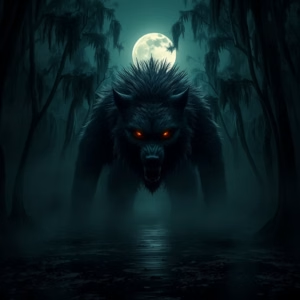
Beyond her solitary leg, her torso often bears the jagged scars of her original penance. In many traditional accounts, her mouth distends from ear to ear, revealing needle-sharp fangs akin to those of a great cat or a feral hound, primed to rend human flesh. Her eyes burn with a phosphorescent glare in the gloom—a crimson or sickly green hue that betrays her infernal nature. Her arms, frequently described as unnaturally long, terminate in hands tipped with steel-like claws, capable of seizing a victim with an iron grip from which no physical struggle can offer escape.
Modus Operandi and Powers
The Patasola’s predatory behavior follows methodical patterns rooted in psychological stalking. Her natural domain is the damp mountain forests, the desolate trails, and the banks of Andean rivers where the canopy is so oppressive that moonlight barely filters through in feeble slivers. The creature operates primarily during the dead of night, though the elders of the rural hamlets swear that on days of heavy mist and black storms, she can hunt in broad daylight.
Her preferred tactic is identity theft and the lure. The Patasola can mimic with uncanny perfection the voice of a lost relative, a strayed friend, or a woman crying out for help in the heart of the darkness. With this ruse, she draws solitary men away from the safety of the path, leading them to believe someone is in dire need. The traveler, guided by empathy or confusion, wanders into the undergrowth following a voice that recedes further and further, until he finds himself ensnared in a natural labyrinth from which there is no return.
Among her supernatural powers, the ability to project a field of spatial and temporal disorientation stands out. Those who have survived an encounter with the Patasola recount how the forest seems to shift its shape around them; trees multiply, familiar paths vanish, and time itself seems to stall or accelerate chaotically. Once the victim is utterly isolated and consumed by panic, the creature sheds her disguise and reveals her full monstrosity. She uses superhuman speed to lunge at the unfortunate soul, dealing devastating blows with her single leg or tearing open their throat with her fangs to sate an unquenchable thirst for human blood.
Weaknesses and Protective Rituals
Despite her terrifying nature and apparent invulnerability within her own territory, the Patasola is not omnipotent. There exist traditional methods, passed down through generations by Andean peasants, to repel her or survive her assault.
The first and most effective defense is prevention through companionship. The Patasola is a cowardly entity when faced with a crowd; she rarely dares to attack groups of two or more, always preferring the solitary traveler. Thus, the golden rule in the Andes is never to walk the mountain trails alone once the sun has dipped below the horizon.
If, despite all precautions, one finds themselves face to face with the creature, spiritual and material resources play a crucial role:
- The use of tobacco: Old hunters always carry leaf tobacco or a cigar. Offering tobacco smoke or casting it upon the ground can confuse the entity or momentarily appease her murderous fury.
- Blessed steel blades: A consecrated machete or a blade that has been sprinkled with holy water is feared by the creature. Showing the glint of the steel or making the blade ring can deter her, as pure metal disrupts spectral energies.
- Guardian dogs: Dogs possess an acute sensitivity to the supernatural. A good mountain dog will not only bark furiously to warn of danger, but its presence and courage can force the Patasola to retreat, as canines are considered natural protectors against wandering spirits.
- Prayers and sacred symbols: Invoking the protection of Saint Michael the Archangel or bearing a blessed crucifix forges a mystical barrier that sears and repels the creature, forcing it to flee in frantic, rhythmic bounds into the lightless depths of the jungle.
Documented Cases and Infamous Legends
Within the archives of the Central Andes' oral traditions, accounts of encounters with the Patasola permeate the rural chronicles of Colombian departments like Tolima, Caldas, Antioquia, and Cundinamarca, as well as the rugged foothills of the Ecuadorian cordillera. Though modern science dismisses these tales as mere animal attacks, hypothermic delusions, or geographical mishaps, local communities preserve oral records of cases that would curdle the blood of the most resolute soul.

Among the most notorious accounts is that of Don Eustaquio, a seasoned poacher from the coffee-growing heartlands who, in the mid-20th century, defied the elders' warnings and ventured into forbidden forest reserves under a new moon. According to the kin who sought him the following dawn, Eustaquio’s body was discovered at the base of a ravine, bearing the brutal marks of a colossal force, with a single hoof print pressed into the mire beside his remains. The locals maintained with grim certainty that he had fallen into the Patasola’s snare, lured by the hollow mimicry of a woman’s plea for help.
Another recurring testimony comes from the muleteers who once hauled freight across the mountain passes. Many swear to have heard those solitary, rhythmic leaps shadowing their caravans from the darkness, catching fleeting glimpses of a feminine silhouette that dissolved into the timber the moment a torch was raised. These are no mere nursery fables; they form the cultural fabric that sustains ancestral caution and the hallowed respect the Andean man must guard against the unfathomable mysteries of his terrain.
Comparative Analysis
To grasp the true mythological weight of the Patasola, one must look toward a comparative analysis of the one-legged entities found within the vast pantheon of global and Latin American folklore. At a glance, the physical constraint of a single limb suggests a universal archetype bound to themes of divine punishment, mutilation, and spiritual rot.
In the folklore of Southern Brazil and the Southern Cone, we encounter the Saci-Pererê, un duende travieso de una sola pierna que fuma pipa y causa travesuras en los campos. A diferencia de la Patasola, que es una encarnación del Horror mortal, la venganza y la perdición, el Saci es una figura más cercana a la travesura y al engaño menor, un espíritu elemental de la naturaleza sin intenciones homicidas directas.
Por otro lado, si nos trasladamos al folclore europeo, podemos establecer ciertos paralelismos temáticos con las brujas de los bosques y las entidades súcubos que seducen a los hombres para destruirlos. Sin embargo, la Patasola se diferencia radicalmente de estos mitos occidentales por su profunda conexión telúrica con el territorio americano. Mientras que las brujas europeas suelen volar en escobas o reunirse en aquelarres, la Patasola está inexorablemente anclada al suelo de la selva andina, utilizando su única pierna como un martillo de advertencia contra la destrucción del medio ambiente y la transgresión de los códigos morales tradicionales. Su figura no es solo la de un monster sediento de sangre, sino la de un tótem oscuro de la conciencia ecológica y moral de los Andes.
📜Investigation • Frequently Asked Questions
Documentary Archive and Analysis of the Occult • Relatando.com
¿Qué es exactamente la Patasola?
She is a malignant and vengeful spirit of Andean folklore who assumes the guise of a beautiful woman to seduce and slaughter solitary men within the woods.
¿Por qué la criatura tiene una sola pierna?
Legend whispers of a woman punished for her infidelity and malice, her leg severed before she was left to perish in the depths of the wild.
¿Cómo se puede escapar de un ataque de la Patasola?
It is advised to travel in groups, carry leaf tobacco, wield a machete of blessed steel, and keep the protection of mountain-bred guardian dogs.
Don’t douse the light just yet...
If you have had the courage to make it this far, we have other dossiers that will test the limits of your sanity.

Terms and Figures of this Tale
To delve deeper into the legends, creatures, and dark concepts that inspire this account, consult their entries in our dictionary of the uncanny:





Tu correo no se publica ni se comparte con terceros: solo sirve para notificar la respuesta.