The chill of the packed-earth floor crept up my ankles with the persistence of an invisible parasite, while outside, the blackness of the mountain range devoured the last silhouettes of the trees. It wasn't the wind. The mountain wind has a hollow, dry, predictable lament; this was a rhythmic, heavy scratching, like claws of impossible dimensions testing the flimsy thickness of the wooden door. I was barely nine years old when I first heard the breathing on the other side of the threshold: a thick, ragged gasp laden with the stench of carrion and wet brush, unfitting for any known beast. In the lands of Mesoamerica, the Horror is neither a literary metaphor nor a fireside fabrication; it is a physical presence waiting for the exact moment when human reason falters to remind us that the world does not belong to us.
I. The Veil of the Ancients
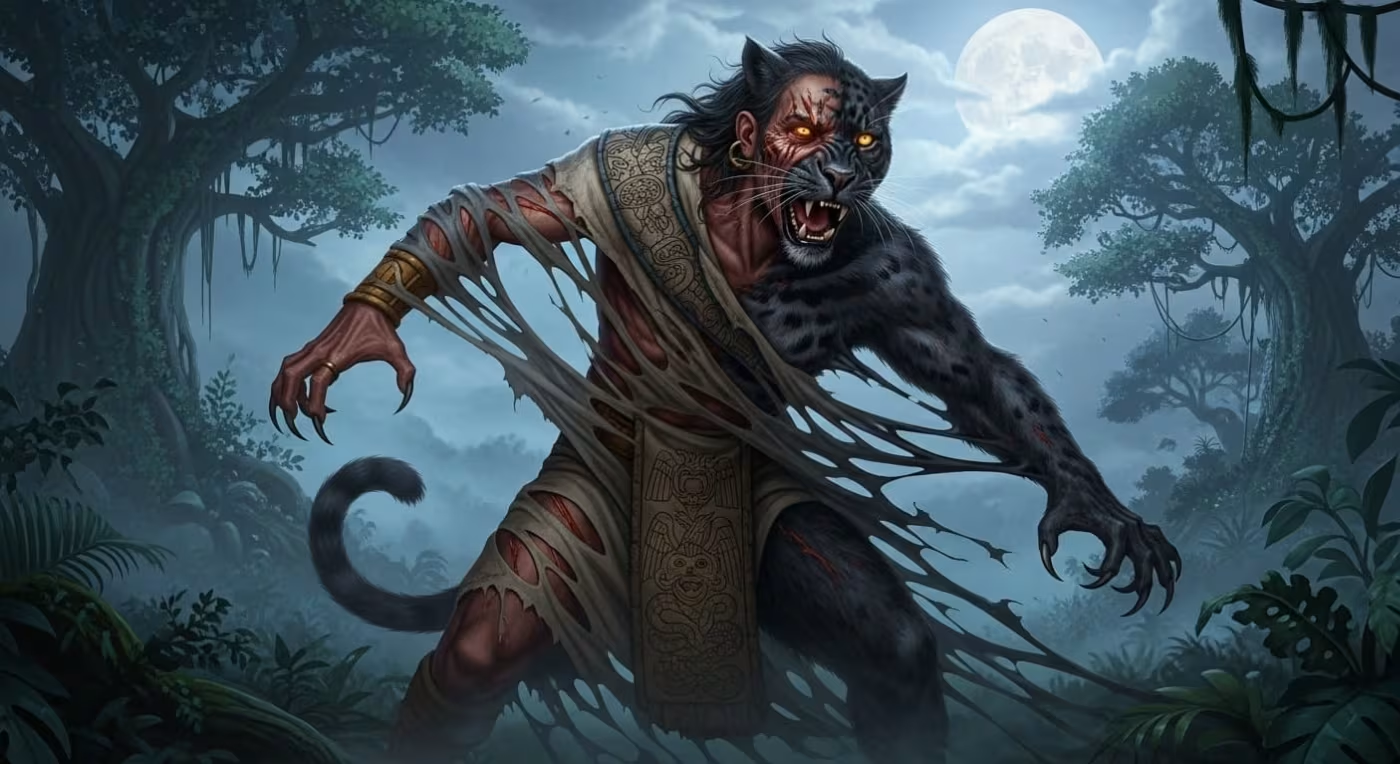
The roots of the nahual sink into the silt of a history prior to iron, prior to printed paper and the cartography that today pretends to explain everything. Since the Mesoamerican Classic period, in codices that survived fire and inquisitorial zeal such as the Borgia or the Florentine, warnings were already issued concerning this fracture in the nature of things. The Nahuatl word nahualli —that which cloaks or disguises itself— has never described a mere trick of illusionism or a biological mutation in the style of European bestiaries. It is something infinitely darker and more disturbing: a mutual possession where the human soul and the bestial essence fuse into a single creature nightmarish dread.
For the ancient Nahuas and Mayas, every individual was born accompanied by an animal alter ego, the tonalli or protective spirit. Yet, when that invisible line separating protection from transgression is crossed through dark arts, man ceases to be man, becoming instead the vessel for something feral and voracious. Following the Conquest, the Catholic Church attempted to eradicate this belief by christening it demonic witchcraft, but nahualism merely retreated into the clandestine shadows of the mountains, adapting, mutating, and surviving in the collective imaginary like a wound that never quite finished healing.

II. In the Gloom of Metamorphosis
When night takes absolute possession of the land, the laws of physics seem to lose their hold. The morphology of a nahual defies anatomical logic. Those who have had the misfortune of running into one along the rural paths of Oaxaca, Tlaxcala, or the highlands of Chiapas concur in their description of an unbearable visual anomaly: a quadrupedal silhouette—a jaguar, an immense coyote, or an owl of grotesque proportions—that flickers with a perverse intelligence and, worse still, a pair of human eyes burning in the dark with an absolute, millenary hatred.
The true horror of the nahual lies not in its razor-sharp claws or its capacity to tear flesh, but in the chilling certainty that beneath that bestial hide beats the cold, calculating consciousness of a neighbor, an acquaintance, someone who by day greets us with a smile in the village square.
The modus operandi of these entities follows a predatory and ritualistic logic. They stalk the most vulnerable: the child sleeping near an unblessed window, the sick who have lost the thread of their own consciousness, or the solitary traveler defying the dark without a protective amulet. They do not merely seek sustenance; they operate out of envy, vengeance, or an ancestral hunger for power. The old grandparents' chronicles speak of shadows scaling adobe walls, of dogs howling with unnatural desperation before tragedy strikes at a door, and of mornings breaking over mutilated livestock without a single drop of blood spilled anywhere near.
III. The Fracture of Certainty
To confront a nahual is to peer over the abyss where the boundary between reality and hallucination completely dissolves. Local tales insist that these creatures possess abilities defying all comprehension: they can rise into the air like bitter drafts of freezing wind, vanish in the glare of a torch, or manipulate their victims' minds until plunging them into a feverish delirium from which few return sane. It is said that stealing a person's shadow or soul is their specialty, leaving behind hollow bodies that languish unto death while medical science fails to find any logical cause.
However, the myth also harbors chinks of vulnerability. Traditions dictate that the use of blessed objects, the piercing toll of bells at dawn, the dense smoke of certain ritual herbs like copal, or even wounding the animal in its bestial form—with the certainty that that very wound will appear on the human body at daybreak—are the only methods to stem its advance. Even so, the dread persists. Every time a village's lights go out and the mountain silence grows heavy, collective memory reminds us that we still share the world with creatures that learned to hide their true nature beneath the skin of habit.
📜Investigation • Frequently Asked Questions
Documentary Archive and Analysis of the Occult • Relatando.com
What origin or documented testimony inspired this story?
The concept of the nahual is extensively documented in colonial chronicles such as Bernardino de Sahagún's Florentine Codex and in pre-Hispanic codices like the Borgia Codex, which detail rituals of shamanic and spiritual transformation in Mesoamerica.
What are the telltale signs or anomalies that precede this phenomenon?
Local traditions point to the erratic and desperate behavior of domestic animals, strange scratching noises against doors or roofs in the dead of night, and the presence of shadows with animal shapes that seem to possess human intelligence.
Is there any documented psychological or scientific explanation?
From the perspectives of anthropology and psychiatry, nahualism has at times been associated with clinical lycanthropy disorder or with cultural systems of social control used to explain mental illness and sudden deaths in isolated communities.
How do folklore and tradition react to this case?
Rural communities in Mexico and Central America continue to employ protective amulets, cleansing rituals using herbs like copal, and a strict adherence to the boundaries of the night to defend themselves against the alleged influence of these entities.
Do not extinguish the light just yet...
If you have had the courage to make it this far, we have other dossiers that will test the limits of your sanity.

Terms and Figures of this Tale
To delve deeper into the legends, creatures, and dark concepts that inspire this account, consult their entries in our dictionary of the uncanny:




Tu correo no se publica ni se comparte con terceros: solo sirve para notificar la respuesta.