The earth exhaled the heat held all day, a dense dampness that smelled of fermented manure, dry cane, and old dust. Don Eufemio dragged his boots along the dirt path, bearing the hoe on his shoulder as if it were an iron cross. The blisters on the palms of his hands throbbed in time with his blood. The sun had already been swallowed entirely by the dark outlines of the Malinche, leaving a strip of dry blood on the horizon that soon devoured the absolute darkness of the Tlaxcalteca field.
There was no light for miles. Only the insistent chirp of crickets and the dry crackle of corn leaves rubbing against the nocturnal wind. Eufemio spat to the side, his mouth parched from the dust swallowed during the irrigation hours. Then the scent shifted. The vegetal, earthy aroma vanished in an instant, replaced by a heavy stench of wet dog, scorched fur, and stagnant saliva. A whiff that lodged instantly in his throat, forcing him to cough violently.
I. The Shadow in the Furrow
The creature slipped out of the cornfields with an abominable naturalness. At first, Eufemio believed it to be the stray mastiff of some neighbor of San Bartolomé, a large, grumbling beast that prowled the pastures. Yet its proportions defied the logic of any creature living. It stood the height of a hunched man, its broad back draped in thick black bristles that resembled rusted wires, and a formless lump that trembled with dry spasms.

The beast did not run on all fours. It leaned over its hindquarters, pressing its front claws against the dry trunk of a ceiba tree at the road’s edge. Eufemio halted. The night’s chill pierced his woolen shirt, embedding itself in his shoulder blades like ice needles. His fingers clutched the wooden hoe handle until his knuckles turned white, trembling with a faint vibration he could not control.
The black mass turned its head with a crack of dry cartilage, a sound identical to a branch snapping beneath a heavy boot. The animal’s eyes did not glow with the green or yellow gleam of cats or coyotes in the dark. They were two smoky hollows, set deep in a flat, wrinkled snout that held a scandalously human grimace.
—Don’t you have a bit of tobacco, buddy? I’ve run out of cigarettes and the night is very cold —said the shadow.
The voice was neither a growl nor a beastly mimicry. It was a rasping, dry, weathered tone, worn thin by mezcal and the years of Don Celerino, Eufemio's companion who had succumbed to cirrhosis three winters ago, his remains buried beneath the parched earth of the municipal cemetery.
Eufemio felt the air itself refuse to enter his lungs. He opened his mouth to scream, yet only a wretched whistle escaped his throat, a choked rattling drowned by terror. His legs felt as if shackled to concrete blocks. He tried to run, but his heels tangled in the loose soil of the furrow, and he collapsed to his knees upon razor‑sharp stones.
II. The Weight of Foreign Flesh
The beast took two heavy strides forward. The rasp of its claws on dry earth rang like knives sharpening against a whetstone. The stench of rotting dog mingled with the sweet, putrid perfume of decomposing flesh, and the unmistakable odor of clothes kept in a smoky drawer for years. The animal leaned over him, casting a colossal silhouette that swallowed the scant stars left in the sky.
—Don't make faces, Eufemio— the creature growled, baring yellow, elongated teeth twisted in a chaotic snarl within a mouth that dribbled a thick, dark liquid—. Yet you remember the promises we made beside the jagüey. Vows of word do not linger in the cemetery.
Eufemio tried to lift the hoe, but the tool slipped from his sweaty hands. His fingers clawed the soil in vain, searching for a stone, a clod, anything to shield him from that which stared back with an unbearable familiarity. The dog pressed a heavy, shaggy paw against his chest. The weight was monstrous, as if a granite slab had collapsed upon him, crushing his ribs with a dull crack.
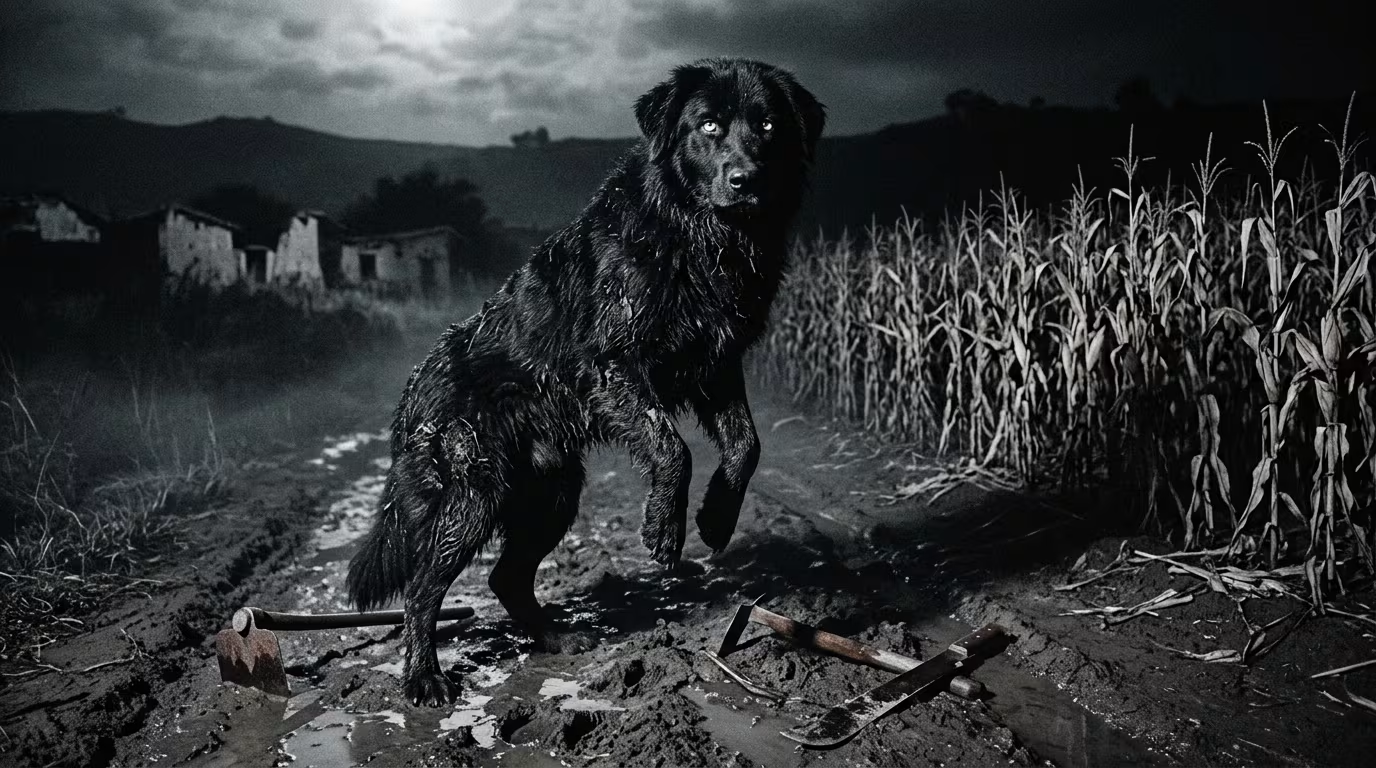
The creature's face pressed close enough that Eufemio could see the minuscule parasites crawling among its black, stiff hair. He could see the reflection of his own face, disfigured by the Horror in those turbid, aged, weary pupils, laden with centuries of hunger and solitary roads.
—Let's go —spit out the voice of Celerino, emerging from that beastly throat with a tone of everyday irritation—. I'm already hungry.
The darkness of night closed over them like a ravenous mouth. When the first rays of sun illuminated the cornfields the next morning, Eufemio's hoe lay discarded in the middle of the path, half-buried in the damp earth of dew. A few meters away, on the cracked bark of a ceiba tree, deep claw marks were etched, and beside them lay a crushed old cigarette butt exhaling an unbearable stench of dead flesh.
📜Investigation • Frequently Asked Questions
Documentary Archive and Analysis of the Occult • Relatando.com
On what myth or dread reality is this tale based?
It feeds on the Legend Mesoamerican nahuales, men who could transform into dark beasts to stalk the rural roads.
Are there documented real cases similar to this story?
There are no formal records, but the folklore of the towns of Tlaxcala is rich with oral testimonies of nocturnal encounters with zoomorphic entities.
What does the ending of the story mean?
It embodies the inexorable weight of guilt, and how the pacts and secrets of the past return to exact their reckoning amid the desolate hush of the countryside.
Do not extinguish the light just yet...
If you have had the courage to make it this far, we have other dossiers that will test the limits of your sanity.

Terms and Figures of this Tale
To delve deeper into the legends, creatures, and dark concepts that inspire this account, consult their entries in our dictionary of the uncanny:

Tu correo no se publica ni se comparte con terceros: solo sirve para notificar la respuesta.