The limestone dust clinging to his eyelashes tasted of old metal and dried spit. Rogelio spat onto the packed dirt floor—a dark stain that sank greedily into the withered roots climbing the estate’s foundation. San Sebastián exhaled the breath of an ancient neighborhood: a stench of wet quarry stone and rancid lard that seeped through the cracks of the newly hung doors. For three weeks he had paid a crew of masons who now, in the glare of noon, huddled in the central courtyard with their tools slung over their shoulders, refusing to cross the threshold leading down into the depths of the Porfirian estate.
“There’s nothing to fix down there, patrón,” Doroteo had said the evening before, the knuckle of his thumb trembling against the seam of his denim trousers. “The foundations are rubble masonry, sure, but that rear wall won't support a single beam. It was sealed with old mortar—the kind made with ox blood and quicklime. If we break it open, the whole house will come down on us. Or worse.”
Rogelio did not believe in rural omens or the tales of hanged men that the neighborhood elders traded on the benches of Guerrero Garden. He had bought the estate with ten years' worth of earnings from selling imported fabrics in downtown San Luis Potosí; he intended to turn the cavernous house into a boutique hotel where foreign tourists would pay in dollars to sleep beneath original timber beams. Yet as he walked the towering corridors, the air seemed to weigh heavy on his chest. It smelled of prolonged confinement, rot-soaked wool, and something cloying—like syrup forgotten in a dark pantry for decades.

I. The Wall of Mortar and Quicklime
The spiral staircase descended, carved from gray stone that time had rendered porous and slick. Rogelio went down carrying an oil lamp in his right hand, cupping the flame with his open palm to keep the draft rising from the depths from extinguishing it. The walls sweat fat droplets that hit the stone floor with sharp snaps. With every step, the smell of damp grew denser, almost chewable, laced with the acrid stench of bat guano.
He reached the bottom landing. The torch on his mobile phone barely illuminated a few feet before the gloom devoured the beam. Before him rose the wall Doroteo had warned about. It was no ordinary load-bearing wall; it was a solid block of black stone held together by thick, yellowish mortar webbed with spider-web cracks. As he brought his hand close, the cold radiating from the stone raised the fine hairs on his forearms. He pressed his palm against the rough surface. It was ice-cold, but not with the natural chill of the earth; it felt like a slab of steel pulled straight from a freezer.
A sharp, dull thud echoed from the other side.
Rogelio snatched his hand back with a start, catching his breath. The sound did not originate from outside, nor was it the ordinary settling of foundations beneath the building's weight. It was a rhythmic, methodical impact, struck with something heavy against the inner face of the stone. Tac… tac… tac… And then, the slow dragging of a heavy chain slithering across stone flags.
“There’s no one in there. It’s just the old storm pipe running through the party wall,” he repeated to himself in silence, his fingernails biting into his left palm until a line of red beads welled up.
He did not wait until the next day. He hired two day laborers from out by El Saucito—men who asked no questions as long as they were paid double upfront. He handed them a portable jackhammer and a steel crowbar.
II. Dust and Chains
The din inside the cellar struck like a deadened blow, reverberating against the ashlar arches. The vibrations rained scales of lime and grit onto Rogelio's shoulders as he watched from the edge of the landing under the glare of a halogen work light. Dust swirled through the cone of light in erratic shapes, resembling plumes of volcanic ash. One of the laborers, a skinny, bug-eyed lad named Efraín, was sweating profusely; his gray shirt clung to his shoulder blades, outlining the sharp ridge of his spine.
“Patrón, it’s hollow!” Efraín shouted over the engine roaring in the cramped space. “There’s a massive void in here—you can feel the draft blowing right through the joints!”
The chisel struck harder. A chunk of ancient mortar broke free, unleashing a cloud of dense dust that reeked of rotting meat and vinegar. The stench struck with such violence that Rogelio clamped his handkerchief over his nose, gagging as bile burned his throat. This was not the wet earth of before; it was the concentrated stench of a privy abandoned for fifty years, laced with the sickly sweet rot of a larder filled with spoiled meat.
Efraín drove the steel crowbar into the open breach. Rotting timbers groaned, followed immediately by a long sigh—a foul gust of air blowing straight into the workers' faces, snuffing out the gas lamp that illuminated the back in a single stroke. The men stumbled backward through the rubble, eyes wide with panic.
“Get the gear out of here!” Efraín stammered, crossing himself clumsily as he fumbled for the exit in the absolute dark.
III. What Lay in the Hollow
Rogelio was left alone in the basement. The hired hands had fled upstairs, trampling over one another and shouting into the gloom of the courtyard. The only light came from the halogen lamp left resting on a wooden crate, angling obliquely toward the breach carved into the wall.
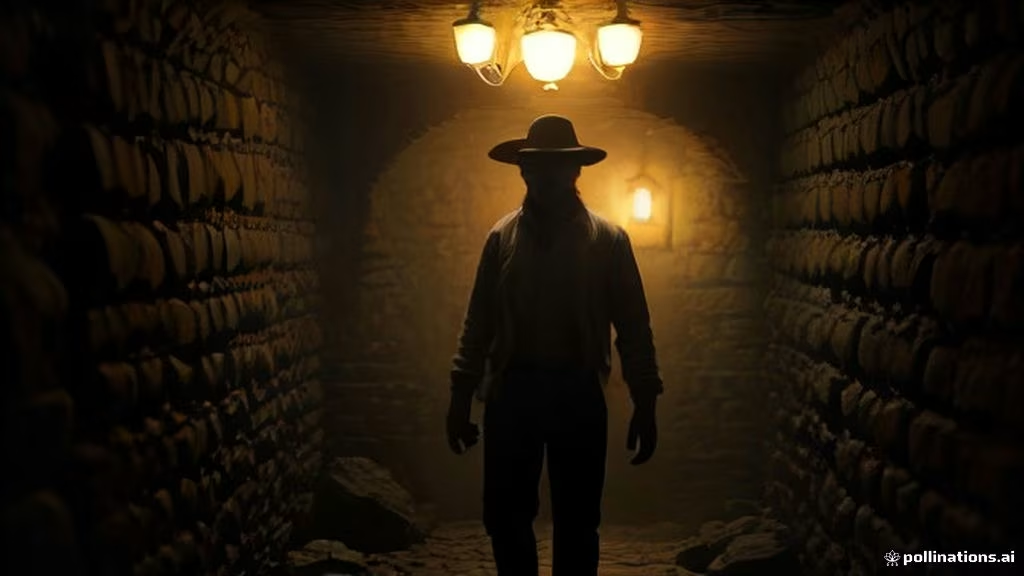
He approached slowly, his boots crunching over fragments of stone and mortar. The hole was rectangular, precisely the dimensions of a curled-up human corpse. When he peered in with his pocket flashlight, the beam died against a small, red-brick cavity, sealed completely on all sides. There was no outlet to the street, nor to any other room.
At the center of the cramped space, crouched on its heels with its head buried between its knees, lay a shapeless bundle wrapped in rotting burlap. Short lengths of rusted chain hung from its wrists, the links embedded deep within desiccated flesh, mummified by saltpeter and time. But the body was not the worst of it. The worst of it came when the bundle slowly raised its head.
No eyes remained in the empty sockets, only pale maggots writhing in the darkness of the orbits. The parched mouth stretched open in an impossible grimace, pulling blackened skin taut over yellowed teeth, and let out a wet snort—a death rattle that vibrated directly inside Rogelio's skull.
“You took your time opening it,” said a voice that resonated not through the air, but inside his own brain, raspy as sandpaper scraping against bone.
Rogelio tried to scream, but the air caught deep in his chest, thick and cold as a lead sinker. He took a step back, tripped over the halogen lamp’s cord, and fell backward onto the jagged rubble. The light flickered and died, plunging him into utter darkness.
In the absolute blackness, he felt the scrape of cold, gnarled fingernails clawing their way up his ankles, dragging the heavy metal of chains across the stone floor.
📜Investigation • Frequently Asked Questions
Documentary Archive and Analysis of the Occult • Relatando.com
On what myth or dread reality is this tale based?
Se inspira en el miedo ancestral al encierro involuntario, las urban legends de casas porfirianas en barrios tradicionales mexicanos y la claustrofobia.
Are there documented real cases similar to this story?
Newspaper archives in Mexico frequently recount tales of old estates where walled-in human remains are uncovered during urban renovations.
What does the ending of the story mean?
It represents the protagonist's assimilation by the house's dark past, where horror ceases to be an external threat and becomes a perpetual damnation.
Do not extinguish the light just yet...
If you have had the courage to make it this far, we have other dossiers that will test the limits of your sanity.

Terms and Figures of this Tale
To delve deeper into the legends, creatures, and dark concepts that inspire this account, consult their entries in our dictionary of the uncanny:



Tu correo no se publica ni se comparte con terceros: solo sirve para notificar la respuesta.