The London cobblestones do not forget the sound of a child's bones striking the iron banister. Dorothy was three when gravity chose to cast her down to the ground floor with a fractured skull and eyes blown wide, fixed upon an empty cornice where the physicians thought they saw death. But death does not take children; it merely evicts them so that other tenants—older and desiccated like papyrus kept in sandy tombs—might collect the rent of the flesh.
From that afternoon onward, the child's room at 39 Derby Road ceased to smell of London damp and laundry soap. It smelled of warm natron, rancid fish fat, and the heavy perfume exhaled by burial niches when limestone sweats in the dark. Dorothy no longer answered to the name she had been baptized with. She would sit on the wooden floor, legs crossed in a manner agonizing for her tender joints, and scratch at the planks with her fingernails until they bled, demanding to return to her true home—to the gardens where sycamores grew and ibises descended to drink green water.
I. The Weight of Wet Linen
Her parents took her to physicians who spoke Latin and prescribed bitter tonics to calm the nerves of an infant mind corrupted by wonder. The doctors palpated her skull searching for the bone fracture, convinced the blow had unhinged some gear of memory. They were ignorant of the fact that fractures do not always merely break; sometimes they widen the fissures through which bygone time slips in.

At the age of ten, a visit to the British Museum confirmed the domestic nightmare. Dorothy slipped her hand from her mother's grasp as they rounded a corner flanked by black granite monoliths and ran down the steps with blind desperation. She sought neither toys nor illuminated display cases. She threw herself to her knees before the feet of a Nineteenth Dynasty funerary statue, kissing the cold stone with a devotion so violent that the guards had to tear her away by force. She clutched the ankles of the effigy as though they belonged to an absent mother, screaming in an English shattered by guttural sobs that these were her people, that they had abandoned her in a world of mist and coal-smoke chimneys.
Do not leave me here with the truly dead; yours have neither names nor memory, only cold in their eye sockets.
The years passed, filtering the obsession through a sieve of silent endurance. Dorothy grew up with the certainty that her British body was a borrowed prison, a wrapper of pale flesh that stank of tea and damp wool. She learned to read hieroglyphs before mastering algebra, devouring dictionaries of the pharaonic tongue with a fluency that chilled scholars to the bone. She did not study them; she remembered them. She corrected university professors' pronunciation with the dismissive authority of a queen listening to a stammering servant.
II. The Temple in the Sand
When at last she crossed the Mediterranean and set foot upon the golden sands of Abydos, Dorothy needed neither maps nor tourist guides. She walked among the ruins of the temple of Seti I with the practiced ease of one pacing the corridors of her own home before turning in for the night. She was no longer the fragile British girl; she had been hollowed out and recast as Omm Sety, a creature weathered by the relentless desert sun, her skin scorched like ancient parchment and her eyes sunken deep within sockets carved by a chisel of unyielding years.
She lived in an adobe hut near the sacred walls, barefoot most of the time, sustaining herself on hard bread and black tea. The locals respected and feared her in equal measure. They said that at night, when the wind howled among the hypostyle columns dragging desert dust with it, she would wander through the forbidden chambers with no light save that of a tallow candle, murmuring prayers to deities whose jackal and falcon heads struck terror into the night guards.
Archaeologists sought her out whenever excavations stalled. Omm Sety would appear in her worn skirts and headscarf, gaze at a seemingly barren patch of earth, and point with a gnarled finger.
—Here—she would say, in a rasping voice that sounded like stone scraping against stone—. Go down a meter and a half. You will find the entrance to the underground garden of offerings. My lord Seti used to walk there when the Nile's floods drowned the outer courtyards.
The directors of the scientific expeditions scoffed at first, yet invariably ended up ordering the laborers to dig at the precise spot she indicated. And the earth never failed to yield its secret: buried adobe walls, jars sealed with the royal signet, unmarred reliefs that no history book had ever recorded. The descriptions Omm Sety recited from memory matched the newly uncovered stones down to the millimeter, as though she had walked those lightless tunnels just the night before.
III. The Night Without a Name
The end did not come with illness or the placid old age that European newspaper chroniclers envisioned for the eccentric Egyptologist. It arrived on a July night when the desert heat did not drop a single degree after sunset. The air was dense, heavy, reeking with a sickening odor of musk and withered blossoms foreign to the local flora.
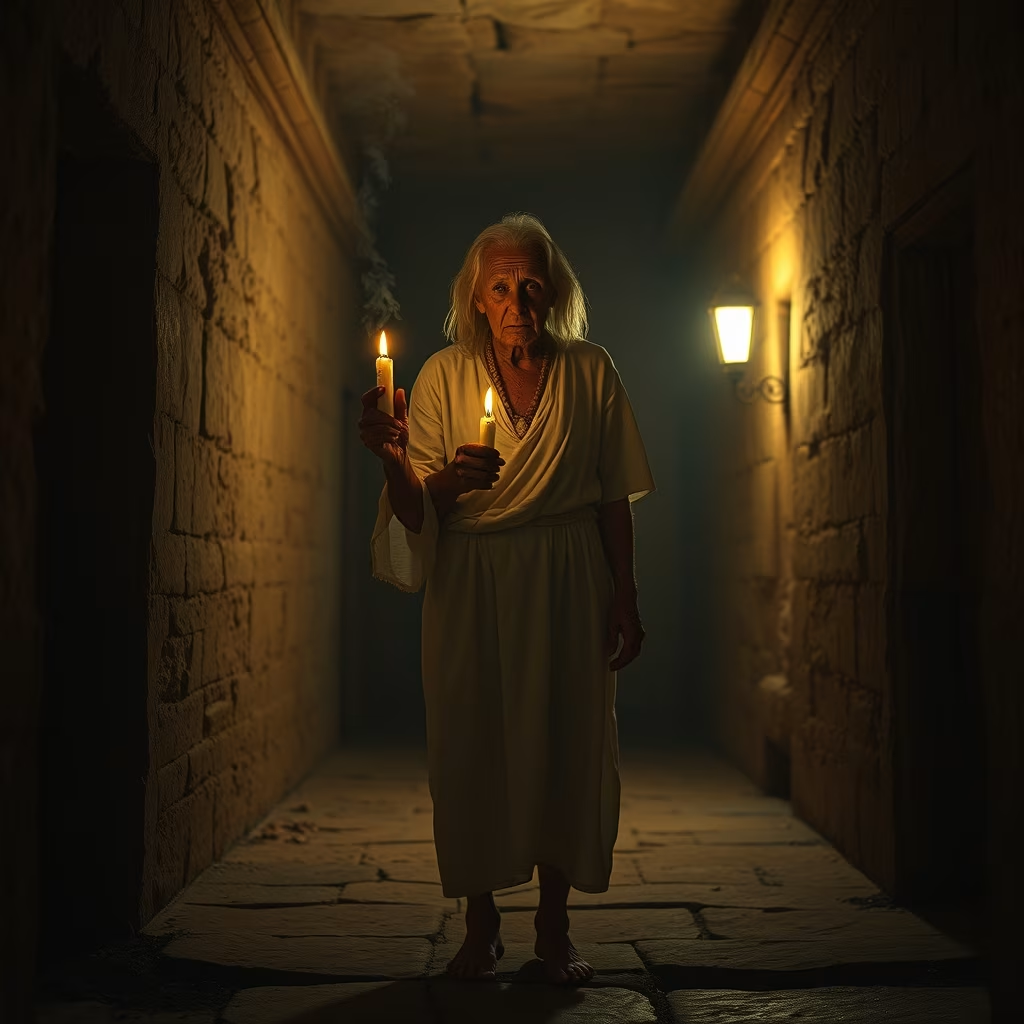
The temple workers saw her enter through the main gate shortly past midnight. She was dressed in a raw white linen tunic they had never seen her wear before, clean and immaculately pleated—attire that looked as though it had just been lifted from a freshly opened sarcophagus. No one dared stop her; the atmosphere surrounding her was so gelid and oppressive that it prevented anyone from approaching within ten paces.
The following morning, excavations halted because the sun illuminated the central courtyard with unbearable harshness. Omm Sety did not appear for tea time nor answer the foreman's call. They went to her hut to look for her, but the door was barred from the inside with a wooden stake carved with hieroglyphs that no one could decipher.
When they finally forced the door open with iron crowbars, the interior was utterly barren. There was no furniture, no books, no clothes, not even the bed where his worn body used to rest. Only a mound of fine sand remained in the center of the room, perfectly leveled, and upon it, a single object: a fragment of weathered papyrus bearing a name written in black ink that slowly dissolved before the stunned eyes of the witnesses, fading into absolute nothingness, much like the memory of men devoured by time.
📜Investigation • Frequently Asked Questions
Documentary Archive and Analysis of the Occult • Relatando.com
On what myth or dread reality is this tale based?
It is based on the Horror to the erosion of one's own identity and the quiet, creeping invasion of the mind by alien, incomprehensible memories.
Are there documented real cases similar to this story?
Yes, the narrative takes its inspiration from the real life of Dorothy Eady—known as Omm Sety—who lived in Abydos, fiercely claiming to be the reincarnation of an Egyptian priestess.
What does the ending of the story mean?
It represents the culmination of a calculated, microscopic obsession where the protagonist dissolves entirely into the past that has devoured her.
Do not extinguish the light yet...
If you have had the courage to make it this far, we have other dossiers that will test the limits of your sanity.

Terms and Figures of this Tale
To delve deeper into the legends, creatures, and dark concepts that inspire this account, consult their entries in our dictionary of the uncanny:





Tu correo no se publica ni se comparte con terceros: solo sirve para notificar la respuesta.