The first mistake was believing silence had physical weight. It does not. At least, not when you are a twenty-two-year-old boy with a scholarship gleaming in his file and a hunger to watch his own head be dismantled piece by piece. But at the forty-hour mark, when time ceased to be a straight line and became a thick, viscous liquid rising up the throat, Gustavo understood that the void is not empty. It is full. Full of a presence that smells of burnt ozone and old meat.
I. The Tide of Nothing
The chamber smelled of hot plastic and cheap disinfectant, a chemical stench that screamed against exposed nerves. There was no light. Not a single fissure to let the outside world filter in—that world where Montreal trains screeched and the St. Lawrence River churned. Here, inside the metal fetus McGill’s engineers had built to measure human tolerance to absolute nothingness, only touch existed. And touch, in the absence of everything else, became a predator. He felt the lab coat’s fabric clinging to his skin, a sweaty second skin that contracted with every gasp. The opaque goggles, bound with medical tape, sealed his eyes shut as if they were the eyelids of a corpse. He could not see, but he felt the pressure of stagnant air against his retinas, a pressure that, over time, began to acquire texture.
The cardboard tubes on his arms were designed to prevent him from touching his face, his hands, any part of his body that might generate a signal of reality. But the cardboard was thin. It was porous. And Gustavo could feel the pulse of his own veins vibrating through it, a dull drumming that amplified until it became a distant thunder. At first, the pain was acute, a white-hot spike of panic that made him want to scream, to strike the wall, to shatter the copper dome. Screaming was useless. The chamber was soundproof. His scream did not leave; it rebounded off his own eardrums, distorted, turning into a guttural roar that seemed to come from elsewhere. From within. And that elsewhere was growing larger.

The first twelve hours passed. Hunger arrived like a tide of mud. It was not an inconvenience; it was an invasion. He felt his stomach crumple, ceasing to be an organ and becoming a clenched fist squeezing his ribs. He drank the water handed to him through a slot in the wall, a lukewarm liquid that tasted of chlorine and metal. Each sip was an act of violation against his thirst, for there was no pleasure in drinking, only biological obligation. The thirst did not fade; it multiplied. And with the thirst came the fever. His skin, bare beneath the coat, prickled with chills that were not from cold. The chamber was at twenty-two degrees, a pleasant temperature, but his body refused to register the warmth. His thermoregulation had failed. He was freezing while the thermometer marked normalcy. Or so he believed.
In the end, Gustavo was left alone. Gustavo was left alone in the hospital. The doctors had come and gone. Gustavo was left alone in the room. The air was cold and silent. No one was there. No one was there to listen.
In the end, Gustavo was left alone. The hospital was empty. Gustavo was left alone in the room. The air was cold and silent. No one was there. No one was there to listen.
Dr. Lefebvre, overseeing the study, motioned to his assistant. The red ink on the monitoring panel's ledger marked the hour: 04:12 in the predawn darkness of the second day. Gustavo's vitals had grown erratic. His heart rate swung wildly like a broken scale. And through the audio feeds, a dull, barely audible noise began to seep in. It was not an external sound. It was the sound of something breathing. Yet Gustavo was alone. Or so they were led to believe.
II. The Anatomical Nightmare
At forty-eight hours, reality dissolved like sugar in hot water. Gustavo was no longer in the chamber. He lay beneath a blanket of black, damp, rotting feathers. A tactile sensation, impossible to ignore yet impossible to perceive. At first, he believed it was a hallucination born of sensory deprivation—the classic ‘monster fog-phantom’ described in medical literature. A Phantom creation of the mind, a projection of the unconscious. But the monster had no shape. It had texture.
He sat up. Or attempted to. His legs refused to answer, paralyzed beneath the load. It was no gentle weight. It was an organic heft. Something was perched upon his chest. Something with legs. He could feel the tips of those appendages—thin, elongated—clutching at the fabric of his gown, sinking into the flesh beneath his ribs. It was as though a juvenile crocodile lay sprawled across his diaphragm, exhaling hot, rancid breath against his throat. The stench was overwhelming: sweet mud, raw meat, and the damp earth of a place where rats had gone to die.
Gustavo tried to scream, but his vocal cords were sealed with salt. The saliva in his mouth had grown thick, ash-gray. He looked down through the clouded goggles that now felt like hot stones pressed against his sockets. Nothing. Only darkness. But touch did not lie. The creature moved. A slow, serpentine shift from hip to hip. The forelegs stretched out, tracing lines across his abdomen. It was not a sharp pain, but a deep pressure, a constriction that prevented him from expanding his lungs. Every inhalation was a struggle. Every exhalation, a muffled gasp that stayed trapped in his throat.
Gustavo’s mind, once brilliant and full of Kafka’s quotes and Borges’s verses, was now a battlefield. The hallucinations turned tactile, visual, and olfactory all at once. He saw non-Euclidean shapes in the void. Angles that had no right to exist. Above all, he felt the presence. It was not an animal. It was an idea. It was loneliness made flesh. It was the void he had summoned, and now it refused to leave. The scientists in the control room noted the shift in the readouts. Gustavo’s blood pressure reached dangerous hypertensive levels. His body temperature spiked to 39 degrees. But what stopped the pencils in the observers' hands was the sound.
Through the audio monitors came something that was not a voice. It was a rhythmic, wet clicking, as though someone were chewing on something soft. And then, a laugh. Not a human laugh. A raspy, dry cackle, like autumn leaves grinding against one another. The laughter came from inside the chamber. From Gustavo's throat.
III. The Collapse of the Glass
Lefebvre’s assistant forced the emergency bulkhead open. It was no clinical decision; it was pure survival instinct. The smell of decay beginning to bleed from the chamber, despite the ventilation system, was unbearable. There was a stench of rot that did not belong in a sterile environment. It was an ancestral, profound foulness, like that of a forgotten cistern. When the door groaned open, letting in a thin thread of white, artificial light from the hallway, Gustavo did not raise his head.
He knelt in the center of the chamber, hands interlaced behind his head, pressing his own fingers into his scalp until bruises bloomed beneath the skin. His eyes, beneath the bandages, were open. Wide open. The wrappings were soaked in a viscous, dark substance. It was not sweat. It was not mucus. It was saliva. The drool of something that was not there, yet was.
“Gustavo,” Lefebvre called, his voice trembling through the intercom. “Gustavo, we’re bringing you out. It’s over.”
Gustavo estaba llorando. No por dolor. Por agotamiento. Pero lo que hizo que Lefebvre retrocedía, tropezando con el marco de la puerta, fue lo que puso sobre el suelo de metal. No era nada. Era todo. Un rastro de arrugas en la piel de Gustavo, bajo la bata. Arrugas que no eran arrugas. Eran marcas. Marcas de mordedura. Pequeu00f1as, circulares, distribuidas en un patru00f3n simu00e9trico sobre su pecho y abdomen. Marcas de algo que habu00eda estado comiu00f3ndose su realidad, chupando sus sentidos hasta dejar solo el hueso.
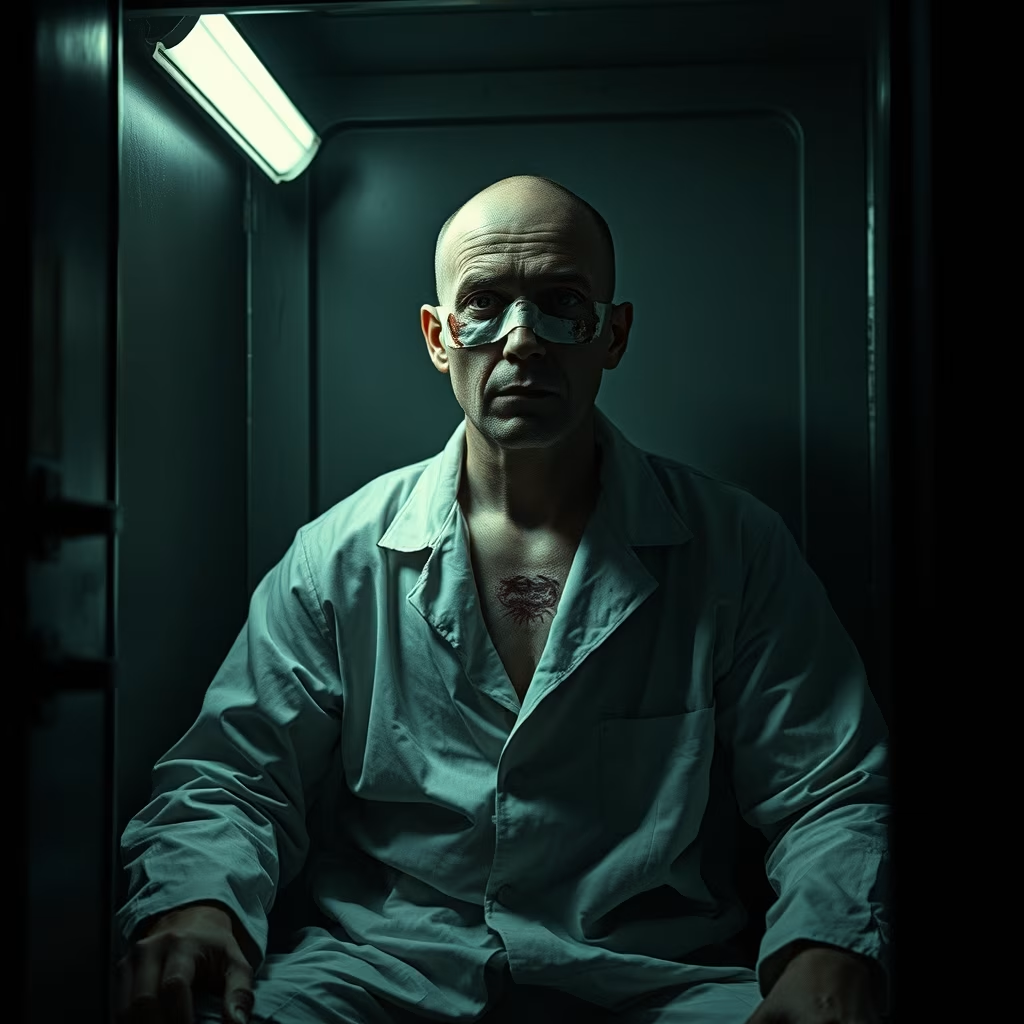
Gustavo was weeping. Not from pain. From exhaustion. But what made Lefebvre recoil, stumbling over the doorframe, was what he laid upon the metal floor. It was nothing. It was everything. A trail of wrinkles in Gustavo’s skin, beneath the lab coat. Wrinkles that were not wrinkles. They were marks. Bite marks. Small, circular, arranged in a symmetrical pattern across his chest and abdomen. Marks of something that had been eating his reality, sucking his senses dry until only bone remained.
“My God,” Lefebvre whispered, staring at the marks. They were fresh. Wet. The surrounding skin was swollen, red, hot to the touch if one dared to approach, and no one dared.
Gustavo lifted his gaze. The bandages remained on his face, but his eyes, now visible, were white. Completely white. No iris, no pupil. Only a scorched whiteness, like that of a dead bird. And within that whiteness, a darkening. A round shadow that moved, adapting to the light spilling in from the doorway. A shadow that did not correspond to Gustavo’s anatomy.
“It’s there,” Gustavo said, his voice sounding like sand being rubbed together. “It won’t leave. It’s inside. In the walls of the skull. It eats the memories. First the childhood ones. Then the adolescence. Now it’s in the throat. It’s gnawing at my tongue.”
The orderlies hauled him out of the chamber, setting him down in a wheelchair in the corridor. The cold draft from the laboratory struck his skin, yet his body temperature remained fever-hot. Lefebvre stared into the empty chamber. The door stood wide. The reek of ozone and rotting meat slowly dissolved, giving way to the sharp sting of disinfectant. But on the floor of the chamber, at the exact center where Gustavo had knelt, there was a stain. A dark, damp blot that refused to dry. A stain shaped vaguely like a human form, yet with limbs far too long, far too thin, splayed in every direction like the legs of a giant spider.
The experiment was shut down. The other six volunteers were extracted from their chambers—terrified, delirious, unmoored. But Gustavo… Gustavo was committed to the hospital's psychiatric ward. He never spoke coherently again. He never saw again. The doctors diagnosed severe post-traumatic stress, an acute psychotic dissociation. But Lefebvre knew the truth. Lefebvre had looked into Gustavo's eyes. He had seen the shadow slithering behind the sclera. And Lefebvre had heard the laughter. The same raspy, dry cackle that echoed inside his skull every night, just before sleep took him. Laughter that didn't originate from within him. It came from the walls. From the silence.
McGill University buried the project. The files were sealed, then burned, then forgotten. Gustavo died three years later, bound in a gray canvas mitt, chewing the inside of his own mouth until there was nothing left to tear. And during the autopsy, the pathologist uncovered something absent from any textbook of human anatomy. Embedded deep within the folds of his cerebral cortex were minute keratinous structures—hard, black, and claw-shaped. Growths that appeared to have been expanding for years. Growths that seemed to have been waiting for the silence to break, so they could finally dig their way out.
📜Investigation • Frequently Asked Questions
Documentary Archive and Analysis of the Occult • Relatando.com
Why was the temperature set to 22 degrees Celsius, and how did it interact with the failure of subject Gustavo's thermoregulation?
Setting the temperature to 22°C was intended to neutralize thermal stimuli, carving out a sensory 'dead zone'. Yet by severing all external input, Gustavo's autonomic nervous system lost its anchor in reality. The dissonance between ambient neutrality and internal metabolic chaos induced a profound paralysis in his perception of hot and cold. Deprived of external calibration, his body spiraled into acute dysregulation, misinterpreting the lack of stimuli as a thermal emergency. This triggered violent tremors and a deep, biting frostbite that paradoxically coexisted with an inner fever entirely absent from the thermometer.
What psychological function did the porous cardboard sheathing on the extremities serve in amplifying the auditory perception of his own pulse?
The porous cardboard acted as an imperfect acoustic transducer, dampening proprioceptive movement without entirely erasing physical vibration. By blocking the hands from touching the face, it severed a primary pathway of sensory integration, forcing the brain to grope blindly for new anchors of reality. The venous pulse, normally an inaudible background murmur, rose to become the sole remaining rhythmic constant. In the absolute absence of other sound, the auditory cortex magnified this internal thrum into the weight of rolling thunder, twisting a basic biological signal into an oppressive spatial roar that chained the subject's consciousness to his own throbbing flesh.
How does neuroscience account for the transition of time from 'a straight line' into a 'viscous fluid' after forty hours of immersion?
This metaphor maps the widening rift between conscious temporal perception and physiological time. Under prolonged sensory deprivation, the brain loses its external markers—light-dark cycles, social friction—by which to gauge duration. As these moorings dissolve, the concept of the *future* collapses, and the present swells until it becomes heavy and palpable. The 'viscosity' stands for the stagnant accumulation of raw, unindexed immediate memory, breeding a cognitive congestion where every single second demands a disproportionate metabolic toll simply to exist, drowning the subject in an eternal, suffocation-grade present.
What implications did the absolute soundproofing of the copper chamber have on the distortion of Gustavo's internal scream?
The soundproofing smothered all external acoustic feedback, shattering the familiar loop of projection and return. When Gustavo screamed, he did not hear his voice travel through space and echo back; instead, he felt the raw vibration directly against his eardrums and the bones of his skull. This absence of spatial distance between emitter and receiver forced the sound inward, stripping it of any communicative function and turning it into a visceral intrusion. The scream ceased to be an act of outward defiance and mutated into an expression of Horror autonomy—a guttural roar that seemed to emanate from a distinct, separate entity lodged deep within his own skull, intensifying the horrifying certainty that he no longer owned his voice.
Don't turn off the light just yet...
If you have had the courage to make it this far, we have other dossiers that will test the limits of your sanity.

Terms and Figures of this Tale
To delve deeper into the legends, creatures, and dark concepts that inspire this account, consult their entries in our dictionary of the uncanny:

Tu correo no se publica ni se comparte con terceros: solo sirve para notificar la respuesta.