In the silent depths of the clay libraries of Assyria and Babylon, where human history barely crawled upon cuneiform tablets, lurked a terrifying winged presence that embodied the worst fears of antiquity: the demon Pazuzu. It was neither a simple theological abstraction nor a monster relic relegated to children's folklore; it represented the unleashed fury of the southwest wind, a searing gale descending from the arid deserts, dragging in its wake pestilence, incurable fevers, barren drought, and sudden death. As director of Relatando.com and an eternal investigator of the shadows inhabiting the fringes of official history, my fascination with this entity transcends conventional mythology. Pazuzu is the precise personification of biological and environmental collapse within the Fertile Crescent, a guardian of cosmic thresholds whose grotesque mask served simultaneously as a life-saving amulet and a relentless reminder of human frailty before the blind forces of nature. Delving into its study means unearthing the darkest rituals of ancient Mesopotamia, where exorcist priests (the *āšipū*) had to bargain with horror to keep the plague at bay, turning the lord of demons himself into the ultimate shield against even more malevolent entities, such as the dread goddess Lamashtu. Prepare to descend into the abysses of myth and forbidden archaeology, where the warm air we draw into our lungs still holds the lingering echo of their beating wings.
Classified File
- Origin: Mythology of ancient Mesopotamia (Assyrian and Babylonian Empires, approx. 1st millennium BCE).
- Nature: Winged daimonic spirit, personification of the destructive southwest wind and pestilential fevers.
- Hazard Level: Catastrophic on an epidemic scale, though ambivalent (capable of acting as a protector against other demons).
- Weaknesses: Ritual incantations of the *āšipū* priests, bronze or lapis lazuli amulets bearing his effigy, purification offerings, and the balance of the elements.
Origin and Etymology
The term ‘Pazuzu’ has spawned countless philological debates among modern epigraphers and Assyriologists. Etymologically, it is bound to Semitic roots that describe the fury of atmospheric elements and the violent disruption of the air. In Mesopotamian cosmology, winds were not mere meteorological phenomena explicable by modern atmospheric physics; they were conscious agents, the volatile breath of ancestral deities or fallen spirits dwelling in the netherworld known as the Kur. The southwest wind (the *šūtu* in Akkadian) was particularly dreaded, blowing as it did from the scorched deserts of Arabia across the fertile plains of Sumer and Akkad, heavy with dust, suffocating heat, and invisible blights that decimated entire populations within days. Pazuzu emerges from this geographical and climatic crucible as the undisputed king of the wind demons (*lilû*). His figure solidifies firmly during the Neo-Assyrian period, though his roots sink their claws deep into earlier Sumerian traditions. He was deemed the son of Hanbi, the primordial god of evil and primordial chaos, granting him a superior hierarchical status within the pantheon of chthonic and infernal entities. For the ancient Mesopotamians, comprehending the origin of Pazuzu was the indispensable first step toward surviving his unseen onslaughts, for to ignore his existence was to sign a death warrant beneath the relentless sun of Mesopotamia.
Anatomy and Appearance
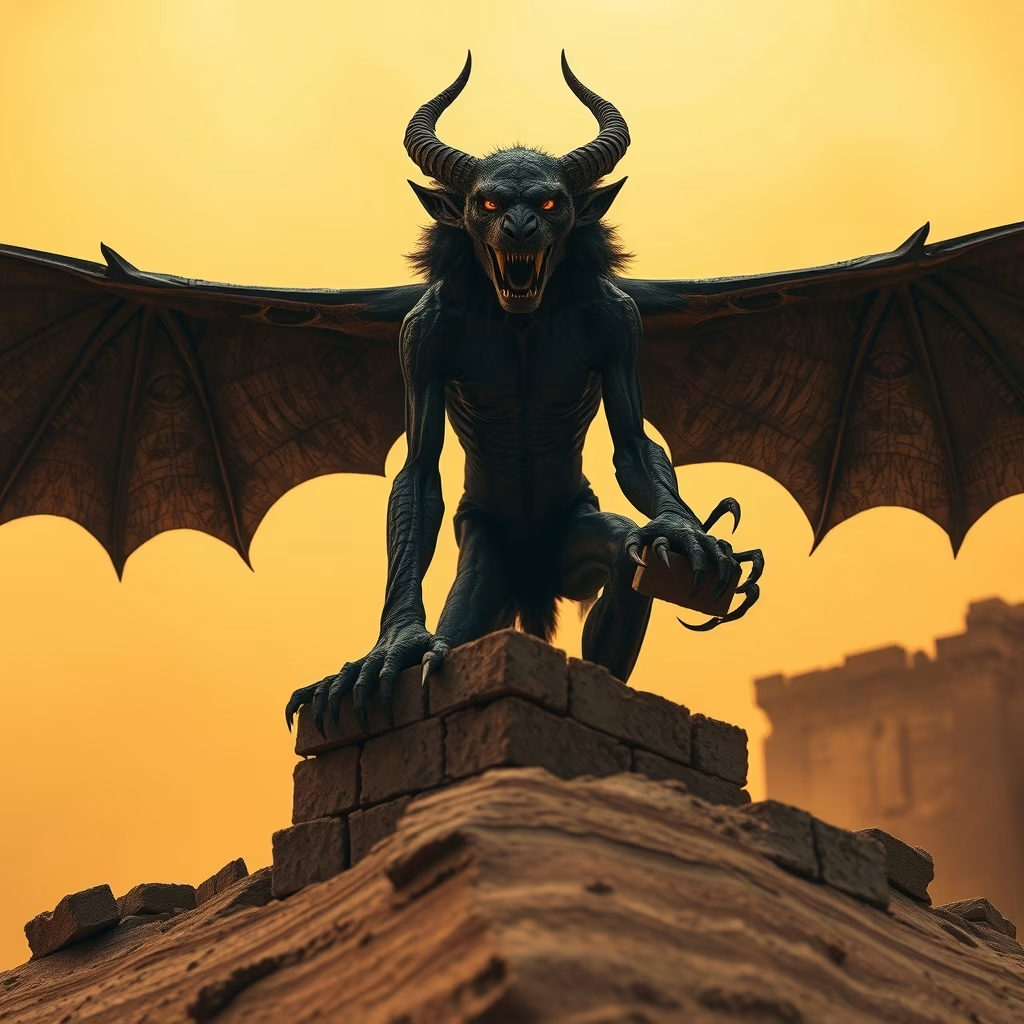
The iconographic representation of Pazuzu is one of the most terrifying, complex, and fascinating in the entire ancient Near East. We are not faced with a fair anthropomorphic deity, but an anatomical chimera specifically designed to instill dread and convey his chaotic nature. Pazuzu possesses a male human body—scaly and famished, furrowed by prominent ribs betraying the wasting away caused by fever and starvation. His limbs terminate in the sharp talons of a bird of prey, ready to tear flesh or cling to house roofs in the dead of night. From his back sprout two pairs of membranous wings, akin to those of a bat or giant insect, engineered to ride the currents of the southwest wind. His head is the ultimate nightmare: a disturbing hybrid of a rabid lion and a wild canine, with gaping jaws displaying rows of menacing canines, bulging and all-seeing protruding eyes, and short, backward-curving horns. Yet the most unsettling detail of his anatomy, documented in numerous bronze and stone votive statuettes, is his serpentine or snake-headed phallus—a phallic symbol of destructive regeneration and uncontrolled chthonic power. This grotesque fusion of lion, dog, eagle, scorpion, and serpent traits was no arbitrary design; every part of his body represented a different aspect of the perils lying in wait for mankind across the Mesopotamian plains, unifying all natural terrors into a single, intimidating effigy.

Modus Operandi and Powers
Pazuzu's *modus operandi* is subtle, relentless, and profoundly destabilizing, operating on the borderlands between meteorology and medical pathology. He rarely manifests through frontal physical combat or blatant apparitions; his preferred attack is invisible stalking through the air currents. When the southwest wind begins to blow with unusual force over the cities of Babylon or Nineveh, Pazuzu rides its gusts carrying the miasmas of disease. He slips into dwellings through door cracks, open windows, or ventilation shafts, hunting primarily the most vulnerable sectors of society: pregnant women, newborns, and convalescing invalids. Once inside, he unleashes his primary power: the pestilential fever (*šuruppû*), a scorching internal heat that burns out the victim's entrails, inducing delirium, muscle spasms, cold sweats, and ultimately total organ collapse. Beyond physical illness, Pazuzu possesses the capacity to corrupt the human psyche, inciting terrifying nightmares, sleep paralysis and transient madness, driving men insane with the belief that they hear whispers carried on the night wind. His mere presence disrupts the equilibrium of households, turning a secure refuge into a climatic and demonic torture chamber where earthly medicine proves utterly useless.
Weaknesses and Protective Rituals
Despite his terrifying nature and immense destructive power, Pazuzu possessed a unique theological ambivalence that the ancient Mesopotamians mastered the art of exploiting through apotropaic magic. The golden rule in Assyro-Babylonian demonology was that ‘like expels like’—that terror itself could be forged into a shield against a greater evil. Pazuzu’s primary vulnerability lay in his own hierarchical pride as king of the wind demons: though he himself unleashed the fever, his effigy held the strange power to terrify and drive away even more malevolent spirits, most notably the arch-demoness Lamashtu, the child-devourer and bringer of miscarriages. For this reason, the *āšipū* priests devised intricate protective rituals that involved placing small statuettes of Pazuzu upon the thresholds of doors, hanging them from the necks of expectant mothers, or burying them in the corners of vital rooms within the house. These figures typically bore cuneiform inscriptions across their spines declaring: *’I am Pazuzu, son of Hanbi. King of the evil wind spirits who blow with violence from the kur… I have come’*. Beyond the amulets, the rites demanded offerings of bread, beer, fumigations of juniper and cedar smoke, and midnight incantations chanted to appease his wrath and bind him to his protective duty rather than his ruinous instincts.
Documented Cases and Famous Legends
Mesopotamia's archaeological archives—notably those recovered from the renowned Library of Ashurbanipal in Nineveh—are rife with medical texts and magical incantations documenting Pazuzu's shadow over daily life. One of the most famous pieces of evidence is a bronze plaque housed in the Louvre Museum (known as the Plaque of Lamashtu), where Pazuzu's imposing figure presides from above, watching over and restraining the lesser demons attempting to assail a dying man's bed. The royal chronicles of the Assyrian kings also record episodes where sudden fever epidemics decimated entire garrisons during military campaigns in the desert, the catastrophes categorically blamed on Pazuzu's fury for the desecration of sacred lands or the neglect of wind sacrifices. Beyond the strictly historical and archaeological realm, Pazuzu's myth breached the boundaries of millennia to settle into the contemporary collective consciousness thanks to William Peter Blatty's novel and the masterful 1973 cinematic adaptation of *The Exorcist*. In this masterpiece of modern horror, the Pazuzu statuette unearthed during archaeological excavations in Hatra becomes the catalyst for the possession of young Regan MacNeil, proving that the dark energy of the Mesopotamian demon remained as vibrant and lethal in the twentieth century as it was three thousand years ago beneath the scorching Assyrian sun.
Comparative Analysis
To grasp the true scale of Pazuzu, it is essential to establish a rigorous comparative analysis against other demonic and mythological entities across various cultural traditions. Unlike Lucifer or Satan in Western Christian demonology, who represent moral rebellion and spiritual sin against a supreme monotheistic God, Pazuzu operates on a strictly cosmological and elemental plane: he is no moral rebel, but a personified force of nature, a violent gear within the cosmic machinery of Mesopotamia. Compared to the *Jinn* of pre-Islamic and Arabic mythology, striking similarities emerge in his association with deserts, scorching air, and the wind (*simoom*), though the jinn possess absolute moral free will, whereas Pazuzu maintains a fixed function within the pantheon as both a vector of plague and, paradoxically, an apotropaic guardian. Likewise, when placed beside classical figures like the Harpies or Sirens of Greek mythology—which similarly fuse human and avian anatomy—Pazuzu far surpasses their symbolic ferocity by welding pathological pestilence directly into the ritual architecture of the home. While the monsters Hellenic horrors are struck down by the heroic might of a demigod, Pazuzu demands constant magical negotiation, a fragile pact between man and the abyss where survival hung entirely on the cunning of priests and the warding power of his own monstrous bronze likeness.
📜Investigation • Frequently Asked Questions
Documentary Archive and Analysis of the Occult • Relatando.com
Who, precisely, was Pazuzu in ancient Mesopotamia?
Pazuzu was a powerful winged demon who embodied the destructive southwest wind, responsible for pestilent fevers, droughts, and plagues across Assyria and Babylon.
Why was the likeness of Pazuzu invoked if he was an evil spirit?
Mesopotamians wore amulets bearing his effigy because they believed his terrifying visage frightened and drove away even more dangerous demons, such as the malevolent goddess Lamashtu.
How did the ancients shield their dwellings against the onslaught of Pazuzu?
They placed bronze or stone statuettes of Pazuzu across door thresholds, performed fumigations with sacred herbs, and chanted nocturnal magical incantations.
Don't turn off the light just yet...
If you have had the courage to make it this far, we have other dossiers that will test the limits of your sanity.

Terms and Figures of this Tale
To delve deeper into the legends, creatures, and dark concepts that inspire this account, consult their entries in our dictionary of the uncanny:

Tu correo no se publica ni se comparte con terceros: solo sirve para notificar la respuesta.