In the deep recesses of the Indian subcontinent, where ancient legends exhale through the warm monsoon breeze, lurks one of the most terrifying and tragic entities of Asian folklore: the Churel, a vengeful specter born of an obstetric death, roaming shadowed paths to sate an unquenchable hunger for life, revenge, and blood, leaving in its wake a trail of madness and absolute terror that villagers still dread uttering aloud when night falls.
Classified File
- Origin: Mythology of India and Pakistan (Hindu and Muslim Folklore).
- Nature: Vengeful female spirit, demon post mortem.
- Hazard Level: Extreme (Fatal for men and neonates).
- Weaknesses: Iron nails, loose hair, sacred mantra, purifying fire, and spicy spices.
Origin and Etymology
The term ‘Churel’ (also spelled Churail or Churgin) roots its etymology in the Indo‑Iranian tongues, presumably deriving from concepts of impurity and tragic death. In the traditional Indian worldview, death is a sacred passage that demands precise rites to secure the soul's peace. Yet when a woman dies during pregnancy, childbirth, or the post‑natal period of ritual impurity known as the quarantine, her spirit cannot find eternal rest. This violent, sudden, and profoundly unjust death of a mother who leaves behind her dreams and unborn child becomes the perfect catalyst for the curse that turns her into a Churel.
Stories passed down through generations in the rural regions of Bengal, Punjab, and Uttar Pradesh detail how these women, who died under obstetric circumstances, harbor a deep resentment toward the living. Traditional society often stigmatized such deaths as an ill omen or the result of negative karma, further fueling the cycle of pain and spectral transformation. Thus, the Churel becomes the embodiment of the repressed fury of a mother torn from her home too soon, returning from the beyond with a distorted anatomy and a malice that defies all human logic.

Anatomy and Appearance
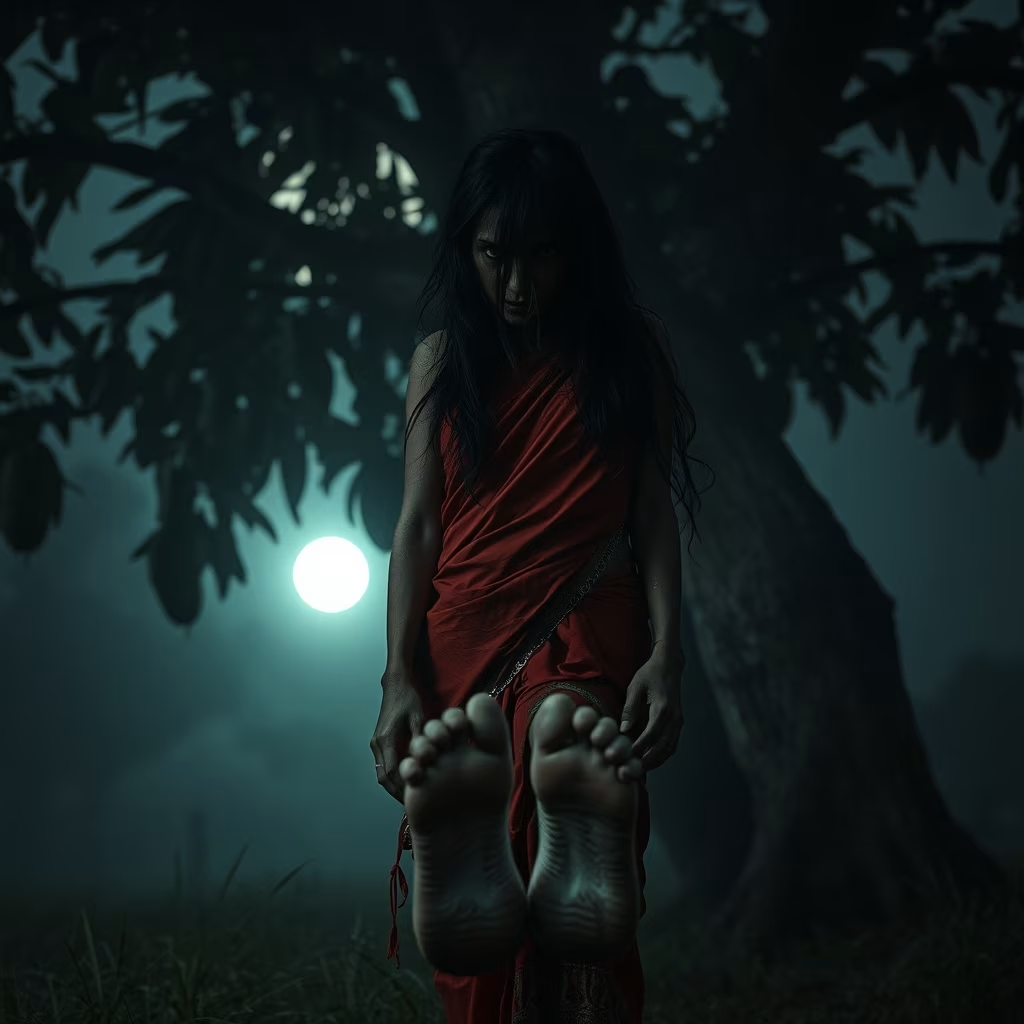
Unlike Western specters that linger in ethereal, translucent guise, the Churel bears a disturbingly ambiguous corporeality. By day it may assume the shape of a woman of staggering beauty, draped in sumptuous traditional garb—a riot‑colored sari woven to lure the unwary into tangled woods or riverbanks. Yet that veneer of allure masks a genuine biological and supernatural nightmare, unveiled in its true form or when it commits its murders beneath the cover of moon‑darkness.
The Churel’s most unmistakable physical trait is its reversed feet, heels thrust forward while the toes point backward. This anatomical inversion is not a mere affectation but an indelible stamp of its unholy, antinatural essence. Moreover, its flesh bears the scars of violent death: pallid, ash‑gray skin; sunken eyes that flicker with a famished gleam; long, tangled hair that drapes over its face; and razor‑sharp claws where nails should be. Its jaw often hangs disjointed, poised to rend flesh, and it exhales a sharp stench of wet earth, rotting meat, and sour milk.
Modus Operandi and Powers
The Churel’s predatory behavior is driven by a twin compulsion: a mortal envy of the living and a desperate, unfulfilled urge to nurse a child. Phantom who never was born, or who perished with her. It typically lurks at solitary crossroads, in dense forests, cremation fields, and abandoned orchards, awaiting the passage of young, unsuspecting men. It wields its illusory allure to seduce its prey, drawing them into the thick underbrush with sweet voices or feigned wails that mimic a helpless infant.
Once the victim is isolated and ensnared in its illusory trap, the Churel sheds its façade, revealing the grotesque silhouette of inverted feet and unleashing its terrible, otherworldly powers. Among its most dreaded abilities is the power to freeze a soul with a single glance, to warp the very sense of space until paths stretch into endless labyrinths, and to leave travelers utterly disoriented. Its physical assault is relentless: it leaps onto the victim’s back, drives its claws deep, and drains the life‑force, blood, and breath from the body. Men who survive an encounter with a Churel seldom emerge unchanged; most are left crippled by an incurable madness, muttering about unspeakable horrors and the sight of feet turned backward.
Weaknesses and Protective Rituals
Despite its fearsome destructive power, the Churel is not invulnerable, and Indian folklore has, over centuries, amassed a meticulous arsenal of methods to repel, neutralize, or destroy the creature. One of the most effective safeguards is the use of sharp objects forged from pure iron, a metal loathed by the malevolent spirits of the region. Driving iron nails into door thresholds or wearing amulets of the same metal can temporarily bar its entry into a home.
Likewise, the local shamans—known as ojhas or tantriks—chant precise sacred mantras and wield purifying fire in nocturnal rites to banish the spirit. It is believed that consuming or smearing extremely hot spices, such as ground red chilies and turmeric, around a dwelling irritates the Churel’s hyper‑sensitive senses, forcing it to flee in terror. Another traditional safeguard is to scrutinize the feet of any unknown woman who approaches a village after dark; if her feet are reversed, an alarm spreads instantly, rallying the community to its defense.
Documented Cases and Famous Legends
In the oral‑tradition chronicles of Punjab and West Bengal, chilling accounts of Churel encounters abound. One of the most famed myths tells of a wealthy landowner who, ignoring the elders’ warnings, resolved to cross an abandoned mango orchard at midnight. There he met a dazzling woman cradling a bundle that resembled an infant. Enraptured by her beauty, he approached recklessly, only to realize in horror that the woman’s feet were turned backward. The landowner escaped by hurling his turban to the ground, a distraction that, according to the Legend, forces the Churel to recount each thread before the chase may continue.
Another account preserved in the British folkloric archives of the colonial era in India describes the panic that erupted at a military camp on Delhi’s outskirts, where several soldiers vanished mysteriously after patrolling the perimeter. The sentries reported hearing whispers in the darkness and hollow laughter emanating from the trees, accompanied by footprints in the earth that defied human anatomy. Though colonial authorities blamed the disappearances on desertion or wild‑animal attacks, the locals instantly recognized the relentless vengeance of a Churel.
Comparative Analysis
When one surveys global comparative mythology, it is striking to see how the Churel archetype finds surprising parallels in other cultures, each bearing its own unique nuances. In Southeast Asia, for instance, the figure of the Pontianak or Kuntilanak appears—a malevolent specter also born of a woman’s death in childbirth. Like the Churel, the Pontianak seeks vengeance against men and displays a sanguinary nature, yet it differs in that it usually manifests in banana trees and emits a sharp wail akin to a nocturnal bird, typically lacking the iconic reversed‑feet trait that defines the myth Indian.
If we cross the ocean into Latin American folklore, we encounter the famed La Llorona, a wandering spirit who likewise lost her children and roams the riverbanks, weeping eternally. Yet, whereas the Llorona It is a figure of profound sorrow, lament, and moral warning toward disobedient children; the Churel is a purely predatory, aggressive, demonic entity that actively seeks the physical and mental ruin of men. This distinction highlights how the shared tragedy of maternal death is reshaped through cultural lenses into creatures with wholly divergent purposes and natures.
📜Investigation • Frequently Asked Questions
Documentary Archive and Analysis of the Occult • Relatando.com
What, exactly, is a Churel in Indian mythology?
It is a vengeful, demonic spirit that is birthed when a woman dies during pregnancy, in childbirth, or in the post‑natal confinement period.
How can one identify a Churel?
Its most distinctive and terrifying trait is its inverted feet—heels thrust forward, toes pointing backward—along with its ability to shapeshift.
What are this entity’s principal weaknesses?
The Churel harbors a deep dread of pure iron, nails, purifying fire, sacred mantras, and intensely hot spices such as red chili.
Do not extinguish the light yet...
If you have had the courage to make it this far, we have other dossiers that will test the limits of your sanity.

Terms and Figures of this Tale
To delve deeper into the legends, creatures, and dark concepts that inspire this account, consult their entries in our dictionary of the uncanny:



Tu correo no se publica ni se comparte con terceros: solo sirve para notificar la respuesta.