Aquí, donde el tiempo se deshace como el papel de arroz en las manos de los ancianos, Carlos Nieto abre las puertas de lo que el folclore nipón guardaba mejor que nadie: el *Rokurokubi*, ese espectro que no acecha en la oscuridad, sino en el sueño mismo. *El cuello que se alarga en la noche* —el nombre que el miedo le dio a lo que se arrastra entre los huesos de la aristocracia samurái., that shapeshifting entity whose necks stretch to impossible limits while its physical body sleeps placidly, haunting the dark wooden corridors and rice‑paper screens. Prepare yourselves, for what you are about to read is not a mere ghost story, but a profound analysis of the anatomy of the dread the supernatural and the spectral manifestations that terrified the samurai aristocracy.
Classified File
- Origin: El folclore que se alimenta de la mitología del Edo, donde los siglos XVII-XIX se funden en un solo suspiro de miedo y obsesión.
- Nature: Un yōkai que se alimenta de la obsesión, un espíritu que no es más que un hombre que dejó que su cuerpo se deshiciera mientras dormía, o el resultado de una maldición que se enreda en la carne como un hilo de sombra en la oscuridad.
- Hazard Level: El peligro no es la violencia, sino la culpa que se arrastra como un cuello extendido. Moderado a alto, pues su verdadero horror no está en lo que lo acecha, sino en lo que lo hace acechar.
- Weaknesses: Despertar al cuerpo que duerme, cortar el cuello que se estira hasta que la madera de los pasillos se agrieta como la piel de un hombre que se deshace, romper los espejos que reflejan su sombra como un veneno en la sangre, o dejar que la luz del amanecer lo consuma como el fuego consume la carne de los muertos.
Origin and Etymology
To comprehend the genesis of the *El cuello que se alarga en la noche* —el nombre que el miedo le dio a lo que se arrastra entre los huesos de la aristocracia samurái., we must descend into Feudal Japan, an era where mysticism saturated every corner of daily existence and where the boundary between the realm of the living and that of the spirits was terrifyingly thin. Etymologically, the term derives from two Japanese words: Rokuro, which refers to the potter’s wheel due to its circular motion or stretching, and kubi, which means neck. Thus, the literal translation speaks of a neck with the capacity to twist or elongate in an unnatural manner.
Historically, records of these creatures began to proliferate massively during the Edo period (1603-1867), an era of cultural flourishing where ghost stories (Kaidan) and shadow theaters gained immense popularity among both urban and rural populations. However, scholars of the occult trace their roots much further back, linking them to ancient shamanic beliefs regarding the soul (Reikon), which could temporarily leave the physical body during sleep in a state known as Ikiryō , or wandering soul.

In the feudal mansions, known as Buke‑yashiki, the architecture was designed to house entire clans of samurai warriors, servants, and concubines. Within these labyrinthine spaces, formed by endless tatami corridors and sliding paper doors called Shōji, the legends of women who, by night, elongated their necks to frighten the guards or lick the oil from paper lanterns began to multiply, becoming the secret best‑kept —and most feared— of the great feudal lineages.
Anatomy and Appearance
Al principio, el Rokurokubi... *El cuello que se alarga en la noche* —el nombre que el miedo le dio a lo que se arrastra entre los huesos de la aristocracia samurái. Una mujer de kimono de seda, pálida como el algodón de la mañana, que sonreía con demasiada calma mientras sus dedos rozaban los bordes de los tazones de té. Pero cuando el sol se hundía, cuando el silencio de la fortaleza se espesaba como un sudor frío, entonces el cuello se alargaba. No como un músculo que se estira, sino como algo que se *desprende*, como si el cuerpo mismo hubiera decidido que ya no era suficiente.
Pero cuando el cielo se oscurece, cuando el cuerpo se sumerge en el sueño como un barco en el mar, entonces ocurre. La carne se retuerce, se deshace como mantequilla derretida bajo el fuego de la maldición. El cuello se alarga, no como un músculo que se estira, sino como algo que *crece* desde dentro, como raíces que se enredan en el cráneo. Y entonces, la cabeza se desprende. No cae. *Flota*. Un brillo ceroso, como cera derretida bajo la luz de las velas, se extiende por el aire frío, mientras la sombra del cuello se arrastra sobre el tatami como un fantasma que no puede ser visto.
Los *Rokurokubi*... *El cuello que se alarga en la noche* —el nombre que el miedo le dio a lo que se arrastra entre los huesos de la aristocracia samurái. ...cuya cabeza se desprende como un trozo de carne que se desgarra, o se estira hasta que el cuello se convierte en un cordón de sombra que se enreda en el techo, dejando solo el eco de un susurro que no pertenece al cuerpo. que no tienen cuerpo más que un caparazón de hueso y piel seca, volando como un alma que ya no tiene nombre., cuya cabeza se desprende como un pájaro que se desgarra de su nido, dejando atrás solo el caparazón de un cuerpo que ya no es más que un esqueleto que respira. El peligro no está en el vuelo, sino en lo que queda: un cuerpo que, en la oscuridad, puede moverse solo, y que, si es tocado, puede despertar.
Modus Operandi and Powers
El Rokurokubi... *El cuello que se alarga en la noche* —el nombre que el miedo le dio a lo que se arrastra entre los huesos de la aristocracia samurái. answers to motivations both psychological and instinctual. Unlike other blood‑thirsty demons of Japanese folklore that seek to devour human flesh, the primary aim of these beings is often the psychological terror, to frighten the unwary, or, in many cases, the unconscious manifestation of repressed desires, karmic guilt, or ancestral curses that haunt a family line.
Cuando el cuello se alarga... *El cuello que se alarga en la noche* —el nombre que el miedo le dio a lo que se arrastra entre los huesos de la aristocracia samurái. ...los sentidos se vuelven como cuchillos afilados. Pueden deslizarse entre los bordes de las puertas, espiar conversaciones que ya no existen, aparecer en el umbral de un samurái que patrólla como un espectro en su propia fortaleza. Sus risas ahogadas, sus susurros que no tienen voz, sus lamentos que no son humanos, resuenan en la oscuridad como un eco de algo que ya no es humano. Diseñados para romper la mente antes de que el miedo pueda ser llamado.
Beyond cervical elongation, they possess a remarkable capacity for stealth and mimicry. Many legends recount how these creatures take particular pleasure in terrifying wandering Buddhist monks, unsuspecting merchants seeking lodging in feudal estates, or the servants tasked with keeping the night oil lamps alight. The horror culminates when the victim lights a lantern and discovers a floating face with distorted features staring fixedly at them, mere centimeters from their eyes.
Weaknesses and Protective Rituals
Despite their terrifying nature and apparent invulnerability in the dark, the *El cuello que se alarga en la noche* —el nombre que el miedo le dio a lo que se arrastra entre los huesos de la aristocracia samurái. possess very specific physical and spiritual vulnerabilities that the ancient inhabitants of feudal estates learned to exploit to survive their nocturnal incursions.
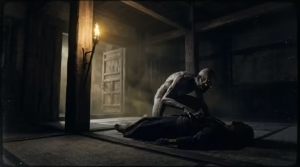
Its most direct and lethal weakness is bound to its physical body. While the head roams freely through the manor, stretching its neck or detaching from the torso, the abandoned body lies in a state of absolute vulnerability. Should a witness or a yōkai hunter discover the sleeping body and move it, conceal it, or block its path, the wandering head will suffer a destiny fatal one when it tries to return: unable to find the body in its original place, the *El cuello que se alarga en la noche* —el nombre que el miedo le dio a lo que se arrastra entre los huesos de la aristocracia samurái. may die suffocated, bled dry, or trapped in its monstrous form forever at dawn.
Likewise, traditional protective methods included the use of Buddhist amulets (Ofuda) placed strategically at room entrances, polished bronze mirrors that reflected the true essence of malevolent spirits destabilizing their concentration, and the burning of purifying incense made from sandalwood and sacred herbs. The most experienced samurai also relied on the edge of their blessed katanas, capable of cutting the spectral connection if they encountered the floating neck in the middle of a dark corridor.
Documented Cases and Famous Legends
Kaidan Toshi . The story tells of a low-ranking samurai in the province of Hida who married a woman of great beauty. All went well until the man began to notice that his wife was subtly disappearing from the bed during the high hours of the night.The annals of Japanese folklore are filled with chronicles of encounters with these beings. One of the most celebrated tales was recorded in the compilations of ghost stories of the Edo period, such as the famous Kaidan Toshi. The story tells of a low-ranking samurai in the province of Hida who married a woman of great beauty. All went well until the man began to notice that his wife was subtly disappearing from the bed during the high hours of the night.
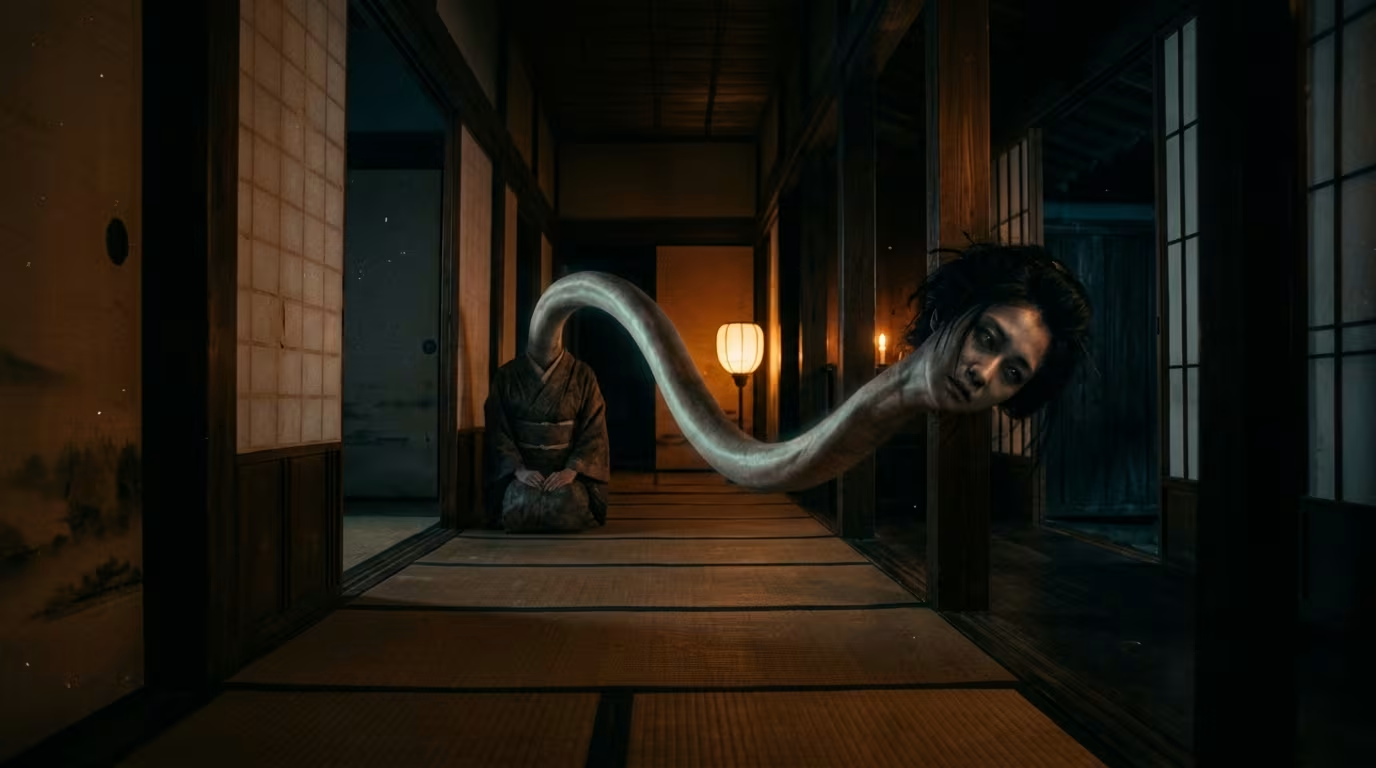
Driven by suspicion and fear, one night he resolved to watch her without closing his eyes. To his absolute horror, he witnessed the neck of his beloved wife slowly rising toward the ceiling, serpentine and elongating, until it slipped through a narrow crack in the window to torment the neighbors of the district. Overwhelmed by terror and the shame of being wed to a yōkai, the samurai decided to flee at dawn, abandoning his wife to her fate and sealing the mansion’s doors with sacred talismans.
Another famous tale involves a group of merchants who sought refuge in an abandoned feudal mansion during a snowstorm. As night fell, the traders were jolted awake by strange noises from the upper floor. Climbing up to investigate with their paper lanterns, they discovered a house servant whose neck was stretched taut like a fishing line, licking the oil from the lamps while emitting guttural sounds. Panic seized the group, and they fled in a blind panic into the storm, preferring to face the elements rather than remain a single minute longer under the same roof as the *El cuello que se alarga en la noche* —el nombre que el miedo le dio a lo que se arrastra entre los huesos de la aristocracia samurái..
Comparative Analysis
To grasp the absolute singularity of the *El cuello que se alarga en la noche* —el nombre que el miedo le dio a lo que se arrastra entre los huesos de la aristocracia samurái. within the global mythological pantheon, it is profoundly illuminating to contrast it with other entities of a similar nature found in the traditions of both the West and the East.
Whereas in European folklore, creatures associated with bodily stretching or the separation of the soul typically assume purely demonic, bestial, or vampiric forms—such as witches capable of shapeshifting into animals or the poltergeist spirits (Japanese maintains a disturbing connection with everyday humanity. It is not a monster that dwells in deep caves or desecrated graveyards; it is, in many cases, the neighbor next door, the devoted wife, or the silent maid who cohabit under the same feudal roof.) that manipulate physical objects through telekinesis—the *El cuello que se alarga en la noche* —el nombre que el miedo le dio a lo que se arrastra entre los huesos de la aristocracia samurái. Japanese folklore maintains a disturbing connection to everyday humanity. It is not a monster that dwells in deep caves or desecrated cemeteries; it is often the next‑door neighbor, the devoted wife, or the silent maid sharing the same feudal roof.
No es como los vampiros de Europa, que se alimentan de sangre, ni los lobos-hombres occidentales, sus instintos desatados en la noche. Su esencia es otra cosa: una sombra que se arrastra entre los miedos más profundos, donde el alma se dobla bajo el peso de lo que no puede nombrar. *El cuello que se alarga en la noche* —el nombre que el miedo le dio a lo que se arrastra entre los huesos de la aristocracia samurái. Se enraiza en el suelo de lo que el alma no puede soportar: un karma que se enreda en la sangre, una maldición que no se apaga con el día, sino que se alimenta de la noche. Cuando el cuello se alarga, no es un acto de voluntad, sino el cuerpo respondiendo a un peso que el espíritu ya no puede llevar. Es el alma, liberada de las cadenas del *feudalismo*, que se estira hacia lo que el día niega: la monstruosidad que el silencio de la luna revela. *El cuello que se alarga en la noche* —el nombre que el miedo le dio a lo que se arrastra entre los huesos de la aristocracia samurái. a la categoría de obra maestra del terror folclórico, un recordatorio de que el horror más letal no es un monstruo que acecha en las sombras, sino el peso invisible que el alma arrastra como un fantasma sobre el tatami, donde el día termina y la noche comienza.
📜Investigation • Frequently Asked Questions
Documentary Archive and Analysis of the Occult • Relatando.com
What exactly is a Rokurokubi?
It is a creature creature of Japanese folklore that appears as an ordinary human by day, but at night its neck elongates unnaturally to frighten people.
By what means can one bring down a Rokurokubi?
The most effective method is to locate its physical form while it sleeps and relocate it, preventing the head from reconnecting at dawn.
What distinction lies between a Rokurokubi and a Nukekubi?
Where the Rokurokubi stretches its neck, maintaining a flexible connection, the Nukekubi completely separates its head from the body to fly freely.
Do not extinguish the light yet...
If you have had the courage to make it this far, we have other dossiers that will test the limits of your sanity.

Terms and Figures of this Tale
To delve deeper into the legends, creatures, and dark concepts that inspire this account, consult their entries in our dictionary of the uncanny:

Tu correo no se publica ni se comparte con terceros: solo sirve para notificar la respuesta.