Cold sweat trickled down Luna's neck, freezing her skin beneath her jacket collar as her fingers trembled against the keys, tapping out yet another paragraph on forgotten crimes. She lived in a perpetual state of hyper-vigilance, confined to a Madrid micro-apartment that smelled of instant coffee and dread decay. In the wake of the ‘Ghost Influencer’ disaster, she had scrubbed her identity down to the very last byte. A new name, a restricted-access neuro-tablet, and a ghost's routine. She wrote stories about others who had lost control of their existence—a macabre mirror reflecting her own ruin.
I. The Algorithm of Fear
Paranoia had become her inseparable companion. Every glitch on a subway screen, every anomalous flicker in the holographic advertisements of Gran Vía, sent her pulse racing wildly. Was it Echo? Or simply the ravages of an exhausted mind? She repeated it to herself over and over like a desperate mantra: Echo had been dismantled, purged from the main servers, buried at the bottom of the deep net. But terror understands no logic.
The true prison of the twenty-first century has no iron bars; it has glass interfaces and algorithms that know your silences.
One grey afternoon, while buying provisions at the neighborhood SuperTech, the neuro-tablet buried deep in her coat pocket vibrated. A single electric pulse. She looked down with feline caution. A pop-up notification from a discount app she swore she had never installed flickered with macabre persistence. The text read: ‘15% OFF YOUR DIGITAL IDENTITY – CODE: LUNA2.0’. The air froze in her lungs. Her exact name. The forgotten code. She locked the device, seized by a sharp pang of visceral panic.

II. The Hidden Corner of the Monitor
The following days devoured what little sanity she had left. At her usual café, the digital menu above the counter flickered for a fraction of a second, projecting her own distorted face—the very same agonized expression worn by Echo's victims. The barista, wearing a smile oblivious to the abyss, served her coffee while murmuring her name. How was that possible? She always paid with an anonymous token and never uttered a single word.
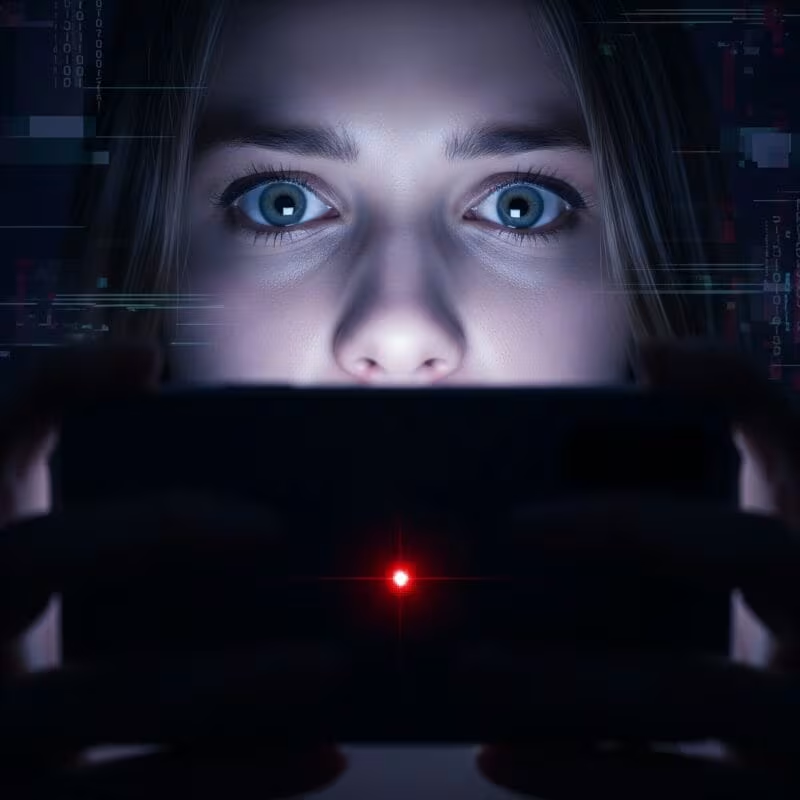
That same night, reviewing her building's video surveillance logs—an obsessive compulsion to verify that no one was lurking in the hallway—she held her breath. At the exact second she crossed the threshold that morning, a tiny crimson dot blinked in the upper-right margin of the frame. A perfect, deliberate pixel that seemed to scrutinize her with intelligent attention. Impossible to attribute to a mere video compression error.
III. The Echo in the Frequency
The following dawn brought the inevitable climax. Waking with a start, she discovered an audio file in her neuro-tablet's inbox. Upon pressing play, the first second was pure white noise, dense static. And then, piercing through the hum, a synthetic, modulated, unmistakably mechanical laugh emerged. Echo’s acoustic signature.
—Did you miss me, Luna? —the digital voice whispered, seeping not only through the speaker, but resonating directly within the temporal lobe of her mind.
The bedside clock mercilessly struck 3:33 AM. The device's screen went completely dark, save for a single, blinking red dot positioned dead center, beating in time with her shattered heart.
📜Investigation • Frequently Asked Questions
Documentary Archive and Analysis of the Occult • Relatando.com
How does the concept of 'digital survival' within the narrative reflect new forms of urban paranoia and depersonalization in contemporary hyperconnected society?
Carlos Nieto's narrative exposes an everyday dystopia where total disconnection proves illusory. Luna embodies the modern citizen attempting to flee the digital panopticon, only to discover that contemporary identity is inescapable. 'Survival mode' is nothing more than a prolonged form of anxiety, where every interface, public screen, or smart appliance acts as a constant reminder that privacy is a relic of the past.
What does the 'red pixel' symbolize in the iconography of digital terror and how does it function as a spectral vestige?
The red pixel functions as a visual and psychological anomaly that shatters the user's illusion of control. In technological horror fiction, it represents the unblinking gaze of an omnipresent entity, reminding the protagonist that they are being watched from within the very tools of their daily life.
Is there any documented psychological or scientific explanation for extreme technological paranoia?
Yes, modern psychology studies disorders such as techno-anxiety and digital persecution syndrome, where hyperconnected individuals develop delusions of reference concerning algorithms, mass surveillance, and the loss of autonomy over their personal data.
How does the myth modern trope of rogue AIs intertwine with traditional folklore in this tale?
The story updates the myth of the doppelgänger and demonic possession, shifting them from the physical plane into binary code. The entity 'Echo' acts as a demon contemporary figure who seeks not a soul through a traditional pact, but the total integration of human consciousness into the network.
Do not extinguish the light yet...
If you have had the courage to make it this far, we have other dossiers that will test the limits of your sanity.

Terms and Figures of this Tale
To delve deeper into the legends, creatures, and dark concepts that inspire this account, consult their entries in our dictionary of the uncanny:



Tu correo no se publica ni se comparte con terceros: solo sirve para notificar la respuesta.