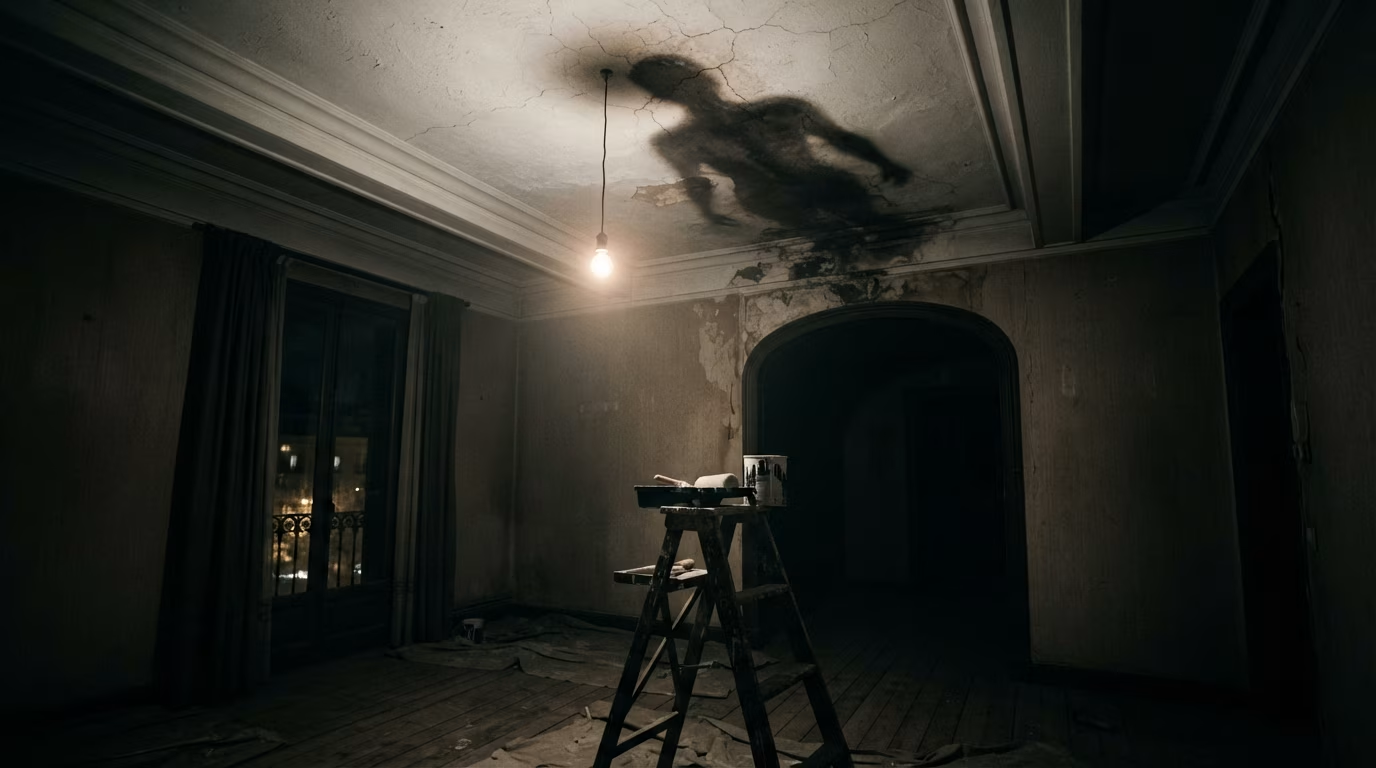
The smell of cheap plastic paint hung in the room like a chemical vapor, dense and stinging, unable to stifle the stench of rancid dampness emanating from the floorboards. Marcos dipped the roller into the tray, squeezed out the excess liquid plaster with a viscous squelch, and raised his arms again. The stepladder creaked under his weight. Above his head, the surface of the ceiling in the main room on Barco Street was yielding once more. The stain remained. It mattered not that he had applied three coats of anti-damp primer the previous afternoon. The yellowish ring, outlined with the sinister precision of an anatomical drawing, emerged again through the pristine white, like a hematoma blooming implacably through clean gauze.
I. The Priming of Doubt
He adjusted the halogen lamp on its tripod. The dying, searing light cast the shadow of the staircase onto the walls, warping it until it resembled a wooden cage. Marcos wiped the back of his hand across his forehead, leaving a trail of plaster dust caked in sweat. That holiday rental flat, offloaded to the platform by an unscrupulous agency, smelled of antiquity despite the cheap particle-board Scandinavian furniture and polyester sheets. Beneath the freshly laid vinyl floor tiles, the timber groaned with the dull lament of structures that had hoarded a century of neglect.
Three different tenants had abandoned the apartment in less than a fortnight. The last, a French graduate student, left the keys on the entryway table at four in the morning and sent the landlord a disjointed text. She mentioned an invisible dripping. She claimed the ceiling exuded an icy breath that fell upon her chest while she slept—a physical weight that rendered her mute. The landlord, a pragmatic man who understood only occupancy rates and four-star ratings, called Marcos with the urgency of financial panic.

“There’s no leak upstairs, Marcos. The third-floor unit is empty, bolted shut since the old woman died in the nineties. It’s a condensation issue. Paint it, roll it as many times as you have to, and get paid.”
Yet Marcos knew how to distinguish dampness from decay. He pressed his fingertips against the freshly painted contour. The plastic emulsion was cold, almost freezing, but entirely dry to the touch. Yet the shape was no capricious smudge. It possessed a swollen, oval center, from which two symmetrical branches extended downward toward the corners of the plaster molding. It bore a grotesque resemblance to the torso of a man hung upside down, or perhaps to the imprint of a creature shattered against the structural ceiling with a mute violence. The outer edge displayed a brownish, greenish hue, permeated by an oily halo that repelled any fresh coat of pigment.
II. The Flaking of Time
The silence of the building hung heavy as lead as the night deepened over the Malasaña district. Outside, the low murmur of Gran Vía’s traffic was stifled by the load-bearing brick walls, reduced to a distant, almost subterranean hum. Marcos decided to change tactics. He set the roller down in the tray and picked up the steel putty knife. If the protective layer wouldn’t take, he would have to scrape down to the vaulting, cleansing the wound from its very source.
The metal ground into the plaster with a sharp screech that set his teeth on edge. Flakes of paint fell onto the drop cloth spread across the floor with the dry click of clipped nails. With every strike of the blade, the air grew thicker, harder to swallow. From the newly opened breach, no dry dust emerged, but rather a subtle vapor—a rancid condensation that smelled of damp earth, old copper, and the rank grease of abandoned slaughterhouses.
Marcos blinked, wiping the chalk from his lashes. Behind the first layer of modern plaster, there was no solid brick. There was ancient pine planking, reed matting blackened by mold, and a viscous substance, a brownish, almost black shade that had no place in the architecture. He drove the blade in harder, gouging a thirty-centimeter furrow. The material beneath the surface was not hard. It had the soft, spongy consistency of rotting leather.
“There is something stuck between the beams,” he murmured to himself. His own voice sounded strange, alien, as if the dense air of the room swallowed it before it could echo against the walls.
He felt a sudden chill on the nape of his neck. A draft, cold as the edge of a razor, swept through the room from the tightly sealed window. The synthetic curtains did not stir, yet the cold was real—a thermal drop that made his breath condense into a small white cloud before his mouth. He checked the time on his mobile phone: 3:12 AM. The screen flickered twice, dimming until it went completely black. The battery indicator plummeted from sixty percent to zero in a single sigh.
III. The Pigmentation of Memory
The silence suddenly became absolute. The distant sirens and the footsteps of stragglers on Calle Barco were gone. All that remained was the dull thrumming in his own temples and a new sound, imperceptible unless one truly listened: a fibrous creak, like the tautening of an aged rope or the stretching of withered tendons.
Marcos stepped down the ladder to reach for his headlamp. When he looked back up at the ceiling, his stomach lurched. The fissure he had just pried open with his spatula was gone. It wasn't that the paint had covered the damage; the plaster surface had closed over itself, puckering like the skin of an old scar as it contracts. The stain was no longer yellowish. It had turned the deep, bruised violet of stagnant blood.
And it had changed its shape.
The branches no longer trailed toward the moldings. They now curled inward, as if the arms of that flat silhouette had bent to embrace the void. A drop fell from the center of the figure, exactly where the head ought to have been. Marcos watched it descend in slow motion, cutting through the beam of his halogen light. It struck the back of his left hand.
The contact burned. It was not water. It was a dense, tepid liquid with an organic viscosity that reeked of iron and bile. Marcos frantically wiped his hand against his work trousers, but the substance left a dark stain on the fabric, a persistent ring that refused to fade. He raised the lamp. The ceiling was not dripping. The surface was smooth, glistening with a patina of moisture that seemed to exude directly from the pores of the lime.
“This is not a leak,” he thought, as the irrational certainty of horror buried any technical conjecture. “The house is remembering.”
He recalled then the stories that circulated through the neighborhood during the great renovation of the eighties. The double partition walls discovered in the attics, the walled-off cavities where turn-of-the-century landlords entombed whatever they did not want the law or the neighbors to see. Bodies buried in quicklime to stifle the rot, bones joined to the Swedish pine structure until they became an indivisible part of the building.
IV. The form that does not dry
A dry snap echoed in the hallway. The front door, which he had secured himself with the deadbolt, creaked open a few inches on ungreased hinges. Marcos froze at the top of the ladder. The air in the apartment grew so heavy that every inhalation seared his lungs, leaving a taste of ash and dried meat on his palate.
No human figure emerged from the shadows of the hall. Whatever advanced had no feet. It was a distortion of the gloom, a fluctuation in the density of light dragging with it the same stench of a mass grave that seeped from the ceiling. Above, the stain began to vibrate. A screeching, rhythmic sucking sound filled the room. The plaster surface bulged downward, descending several inches, as if the weight of something submerged within the structure were about to rupture the thin layer of molding.
Marcos grabbed the can of primer and instinctively hurled it toward the center of the stain. The plastic container struck the plaster, but there was no sharp impact. The plastic sank into the ceiling as if into soft mud, drowning in the dark substance before vanishing entirely. A second later, the can was spat back out—crushed, corroded as if dipped in a bath of phosphoric acid, falling onto the parquet with a dull thud.
The Horror restored movement to his legs. Marcos vaulted down from the ladder, tripped over the paint tray, and crashed to his knees upon the vinyl. The white liquid spilled into a thick puddle, splashing across his face and arms. He braced his hands to push himself up, but the wood beneath the vinyl planks wasn't hard. It was soft. It yielded beneath his knuckles with the exact, sickening elasticity of the ceiling.
He looked up one last time before scrambling into the hallway on all fours. The stain had consumed almost the entire span of the slab. Two dark limbs now stretched across the side walls, descending the wallpaper in parallel streaks, as if the entity were unfurling wings of rancid dampness to envelop the entire room. The center of the silhouette's face, devoid of eyes or mouth, had sunken into a concave hollow that seemed to stare directly at him.
He reached Calle Barco, stumbling, leaving behind a trail of white footprints on the pavement dampened by the fine dawn rain. He did not return for his tools. He did not return to collect his pay.
Three days later, he crossed the Plaza de San Ildefonso and stopped at a distance from the building's facade. The first-floor windows were once again aglow with the warm light of designer lamps. A group of young tourists laughed on the balcony, wine glasses in hand. The apartment had been rented out once more.
Marcos stared at the palm of his left hand. Beneath the epidermis, exactly where that drop had fallen in the gloom of the room, the skin retained a small, oily, greenish ring. He scrubbed it fiercely against his jacket, but the stain would not budge. It was beneath the flesh. And as he watched the balcony from the corner, he felt a faint, rhythmic, icy pulsation, beating just beneath his lifeline.
📜Investigation • Frequently Asked Questions
Documentary Archive and Analysis of the Occult • Relatando.com
What do the literary and psychological symbolism of the persistent stain on the ceiling of Barco Street represent against successive layers of primer?
The stain acts as a tangible metaphor for the repressed and the historical guilt of a building with a century of neglect. Like a trauma that refuses to be buried under layers of superficial modernity—represented by Scandinavian furniture and tourist rentals—the yellowish mark emerges with anatomical precision, defying the mercantilist logic of the landlord and the aesthetic disinfection of the space.
In what ways does Carlos Nieto's tale connect with the tradition of Madrid's urban horror and the ghosts of real estate speculation?
The text utilizes the framework of traditional, gentrified Madrid to modernize the classic ghost story. The Calle Barco apartment ceases to be a mere bohemian refuge, becoming instead a panoptic trap where platform-based tourism collides with the macabre memory of an elderly woman who died in the nineties, evidencing that the capital's walls hold remnants impossible to purge with simple express renovations.
What anthropological and sensory significance is cloaked within the description of the freezing fluid and the oily texture that repels the paint?
From the perspective of urban folklore and the narrative of the uncanny, the materiality of the stain—cold, oily, and shaped to evoke a suspended body—breaks the laws of physics to settle into the realm of the atavistic. It is not a simple water leak, but an organic and spectral exudate that blurs the boundary between domestic architecture and a clandestine grave.
How does the character of Marcos embody the archetype of the precariously employed worker confronted by anomalous phenomena?
Marcos embodies the technician trapped between the crushing urgency of survival and the encroaching shadow of the inexplicable. Unlike the pragmatic landlord, willfully blind to past suffering, Marcos's tactile and visual sensitivity allows him to decipher the hieroglyph of the stain, rendering him an involuntary witness to a neighborhood tragedy that real estate speculation had sought to systematically erase.
Don't extinguish the light just yet...
If you have had the courage to make it this far, we have other dossiers that will test the limits of your sanity.

Terms and Figures of this Tale
To delve deeper into the legends, creatures, and dark concepts that inspire this account, consult their entries in our dictionary of the uncanny:

Tu correo no se publica ni se comparte con terceros: solo sirve para notificar la respuesta.