I. Etymology, Folk Roots, and Oral Tradition
In the twilight of hermetic knowledge and the historiography of superstition, the term Wedjat —which in the ancient Egyptian tongue signifies 'that which is whole or sound'—underwent a grim metamorphosis as it crossed the thresholds of nineteenth-century European folklore. What began in the pharaonic dynasties as a prophylactic hieroglyph, consecrated to the restoration of flesh and the protection of the departed from the machinations of Set, mutated slowly within modern demonological treatises to cement the figure that heterodoxy calls the Eye of Horus paranormal.
This mythological deviation was not born of ancient folk piety, but from the fissure opened by nineteenth-century Egyptomania and parlor spiritualism. Along the banks of the Nile, fellahin legends already spoke of the Ayn al-Sharr (the baleful eye) that haunted violated tombs, but it was within the theosophical lodges of London, Paris, and Madrid that the concept acquired its independent spectral entity. The oral tradition of antiquarians and mummy-looters settled in Alexandria held that certain consecration formulas were not intended to protect the deceased, but to project a bodiless, vigilant intelligence, a metaphysical sentinel capable of shedding its lithic or papyrus vessel to manifest in the physical plane of the living.
Unlike the static amulet carved from lapis lazuli or its counterfeit, the Paranormal Eye of Horus is defined in heterodox files as a manifestation of incorporeal ocularity. It is not an object one possesses, but a presence that possesses the space. Throughout the southern provinces of Spain and the ports of the Levant, clandestine chronicles from the late 19th century refer to the 'Yellow Gaze' or the 'Eye of the Withered Falcon,' attributing its sighting to the precursor of catatonia or the sudden ruin of a bloodline. The folkloric root thus braids the myth of the mythological eye’s mystical amputation with the universal belief in the evil eye, transmuting a divine attribute into a liminal parasite.

«The primitive Wedjat healed the flesh of the gods; the shadow torn from it by the necromancers of the last century does not seek to heal, but to scrutinize the fissures of the human soul until the observer becomes the observed.»
The geographical dispersion of this phenomenon follows the illicit antiquities trade routes. From Victorian-era cabinets of curiosities to the ancestral manor houses of Castile, the pattern repeats: the acquisition of a desecrated object acts as a catalyst, compelling the outline of the sacred eye to abandon inert matter and begin gravitating through the rooms inhabited by the profaner.
II. Morphology, Signs, and Phenomenology
Descriptions contained within the records of the Society for Psychical Research and in the research notebooks of independent occultists converge in attributing to this entity an appearance that defies conventional optics. The Paranormal Eye of Horus does not manifest as a severed biological organ, but as a structure of cold light and smoky density, suspended at an invariable height of two to two-and-a-half meters above the floor, devoid of any face, head, or torso to sustain it.
Its morphology retains the iconic traces of the Egyptian symbol, yet hypertrophied by an aberrant geometry. The pupil, dizzying and vertical like that of a nocturnal bird of prey or a pit viper, emits a coppery or bluish gleam. Surrounding the iris, the sclera reveals a texture akin to fire-fractured marble. The prolonged line of the lower eyelid and the stylized tear—which in classical iconography represent the marks of the cult falcon—manifest in the apparition As filaments of dense shadow that seem to fluctuate in the air, dripping an ethereal substance that dissipates before touching the floorboards.
Prior to the visual manifestation of the entity, the environment undergoes a series of severe microclimatic anomalies that witnesses have invariably described as unbearable:
First, there occurs a sudden and violent thermal drop. Thermometers in the affected rooms record falls of up to fifteen degrees within seconds, accompanied by the formation of ash-colored frost on the frames of mirrors and glass surfaces. This alteration is followed by the symptom of the abyssal silence: an absolute voiding of ambient noise where the witness's own heartbeat and the rush of blood through their ears become deafeningly loud. Domestic animals, especially dogs and cats, descend into states of frantic panic or catatonia minutes before the manifestation.
The olfactory phenomenology is equally distinct. The air grows saturated with a dual, contradictory stench: the sharp, stinging clarity of ozone triggered by an electrical discharge interlaced with the cloying, acrid effluvia of Judean bitumen, rancid myrrh, and the corrupted matter of mummification. When the Eye manifests in the gloom of a room, electric light fails; the incandescent filaments within the bulbs fracture without a sound, and candlelight suffers a cowardly dimming, shifting into a bruised violet hue unable to penetrate the corners.
III. Period Chronicles and Testimonial Cases
Among the dusty dossiers preserved within the crime archives of Restoration-era Spain, the file concerning the Alvear family estate in Toledo stands out, dated to the bitter winter of 1898. The diplomat and amateur archaeologist Don Gonzalo de Alvear had returned from an expedition to the Giza plateau, bringing with him a fragment of limestone stele carved with a low-relief of the Eye of Horus. The scholar’s personal journals, recovered after his tragic confinement in the Santa Isabel asylum, record the genesis of the phenomenon in a trembling hand.
Alvear writes in the entry for November 14, 1898:
“It is not the relief itself that I behold on my study wall, but a fissure in the fabric of the air. Last night, after the lamp was extinguished, the figure etched into the stone did not vanish into darkness. It detached itself from the limestone with a snap like the tearing of dry parchment. It now hovers above the shelf of classified volumes. It does not blink. Its golden iris does not reflect the faint light filtering in from the street; rather, it devours it. I feel an unbearable pressure on the nape of my neck, as if a physical weight were forcing me to bow my head before its presence.”
The Toledo case concluded three weeks later, when the servants found Don Gonzalo huddled in the darkest corner of the cellar. His corneas were severely scorched from exposure to an unknown radioactive or luminous source, and his lips murmured incessant litanies in an extinct Coptic dialect. The limestone stele had become entirely smooth, as if the original carving had been erased by the searing heat of a blowtorch.
A second testimony, documented with notarial rigor, transports us to the port of Liverpool in July 1912. The brigantine Isis Queen, tasked with the transport of antiquities and cochineal dye, docked three days behind schedule, half its crew plunged into a state of catatonic trauma. Captain Arthur Pendelton’s logbook details how, after taking aboard three sarcophagi from the Memphis excavations, an "ocular vision of blue fire" began to manifest on the bridge every midnight.
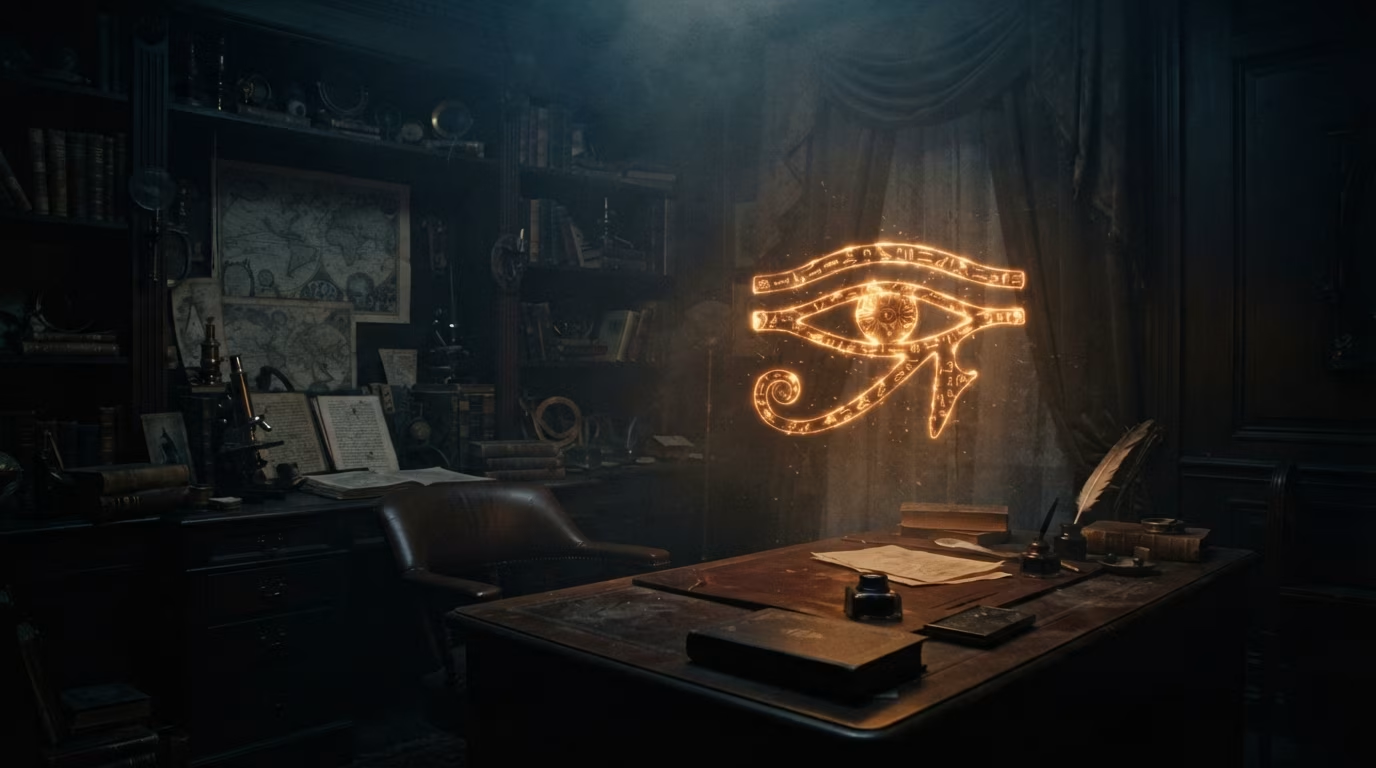
Pendelton noted in the vessel’s official ledger that the phenomenon lacked a physical form, yet it projected a will to psychological domination about the helmsman on watch. Two sailors threw themselves overboard after claiming the Eye demanded—in a soundless voice that resonated directly within their parietal bones—that they open the holds and cast the grain cargo into the sea as a purifying sacrifice. Subsequent investigation by port authorities classified the incident under the label of "mass hysteria brought on by hold gas emanations," yet medical reports confirmed the survivors exhibited irreversible pupil dilation and an identical dissolution of the sense of time.
IV. The Anatomy of Fear: Psychological and Symbolic Dimension
To grasp the psychic devastation wrought by this phenomenon's intrusion into the human mind, one must turn to the structures of the collective unconscious as defined by depth psychology. The Paranormal Eye of Horus does not terrorize through the threat of imminent physical violence—as an anthropomorphic entity or a beast of earthly folklore might—but rather by reactivating the archetype of the Absolute and Inescapable Vigilance.
The human psyche is built upon the premise of an inner sanctuary: the faith that our thoughts, guilts, and secrets remain sheltered behind the ramparts of consciousness. The manifestation of this entity shatters that primary defense. The observer of the anomaly does not feel they are witnessing a specter, but rather that they are being ontologically stripped bare by a superior intelligence, cold and indifferent, judging without mercy. It is cosmic horror in its purest state: the realization that humanity is not the center of Creation, but merely a specimen beneath the lens of immemorial entities.
From the perspective of clinical parapsychology, sighting the Eye immediately triggers the acute phase of sleep paralysis outside of a resting state. The subject remains fully conscious, yet their motor system is locked by a neurobiological response to an apex predator that defies categorization. The mind attempts to assimilate the Eye’s geometry by projecting known patterns, but the sheer incompatibility of its spatial form triggers a cognitive dissonance that frequently results in secondary hallucinations, dissociative fugue, or reactive psychosis.
The symbol of the eye, which in civilization represents the light of reason, conscience, and divine justice, is violently inverted in this manifestation. It becomes the archetypal shadow of omnipresence: the eye that never closes, the gaze that devours spiritual intimacy and reduces the individual to a mere transparent husk. Whoever has remained under the fixation of the Paranormal Eye of Horus no longer experiences solitude as a space of peace, but as the terrifying suspicion that the darkness of the bedroom is pregnant with invisible eyelids about to open.
📜Investigation • Frequently Asked Questions
Documentary Archive and Analysis of the Occult • Relatando.com
How did the original concept of the Egyptian Wedjat transform into the heterodox figure of the Paranormal Eye of Horus?
The Wedjat transitioned from being a prophylactic hieroglyph of healing and protection against Set during the Pharaonic dynasties to a spectral entity during the nineteenth century. Driven by nineteenth-century Egyptomania, parlor spiritualism, and European theosophical lodges, the folklore twisted: occultists reinterpreted the consecration formulas not as shelter for the deceased, but as the projection of a vigilant, incorporeal intelligence capable of manifesting on the physical plane.
What fundamental difference exists between the traditional lapis lazuli amulet and the presence manifested in the clandestine chronicles?
Unlike the sculpted amulet held as an inert trinket, the Paranormal Eye of Horus defines itself as a presence that possesses space. 19th-century chronicles from Southern Spain and the Levant referred to it as the 'Yellow Gaze' or the 'Eye of the Withered Hawk,' linking its sighting to catatonia and the ruin of bloodlines. The shadow torn forth by necromancers does not seek to heal; it exists to scrutinize the fissures of the soul.
In what way did geographical dispersion and the antiquities trade facilitate the spread of this occult phenomenon?
Its spread followed the illicit routes of the clandestine antiquities trade. From Victorian cabinets of curiosity to the ancestral manors of Castile, the pattern proved that acquiring a profaned object acts as a catalyst. This allows the outline of the sacred eye to abandon inert matter—such as papyri or reliefs—and begin to gravitate, actively keeping watch over the rooms inhabited by the desecrator.
What role did fellah legends and the proceedings of the Society for Psychical Research play in documenting this anomaly?
Fellahin legends of the Nile warned early on of the Ayn al-Sharr (the baleful eye) found in violated tombs, providing the oral seed. Later, this trail was rigorously investigated and recorded in the proceedings of the Society for Psychical Research and the notebooks of occultists, who attempted to map a phenomenology where the human observer inexorably ends up becoming the object observed by this metaphysical gaze.
Do not extinguish the light yet...
If you have had the courage to make it this far, we have other dossiers that will test the limits of your sanity.

Terms and Figures of this Tale
To delve deeper into the legends, creatures, and dark concepts that inspire this account, consult their entries in our dictionary of the uncanny:

Tu correo no se publica ni se comparte con terceros: solo sirve para notificar la respuesta.