Introduction: The Threshold of Mystery
Within parapsychology there exist accounts that defy simplistic explanations and descend into the territory of genuine nightmare. When we place ourselves in the rural England of the mid-twentieth century, among red-brick houses and symmetrical gardens, it is difficult to imagine that in such an anodyne setting one of the —which are usually bound to a geographic location— the Dybbuk is bound to a person. It is a form of 'personalized' possession that challenges the notion of evil as an external force, reminding us that the deepest horror sometimes springs from our unfinished humanity and the debts we leave unpaid upon death. most merciless, best-documented, and deeply unsettling of modern history could take root. Welcome, dear listeners and readers, to the definitive chronicle of the —which are usually bound to a geographic location— the Dybbuk is bound to a person. It is a form of 'personalized' possession that challenges the notion of evil as an external force, reminding us that the deepest horror sometimes springs from our unfinished humanity and the debts we leave unpaid upon death. of Black Monk (the Black Monk of Pontefract), a case that redefined the limits of what we understand as a haunted house.
Situated at number 30 East Drive, in the tranquil housing development of Chequerfield Estate in Pontefract, West Yorkshire, this seemingly ordinary dwelling became, from 1966 onward, the epicenter of a violent, physical, and devastating paranormal activity. Unlike the evasive shadows or inaudible whispers that characterize traditional haunted houses, the phenomenon that tormented the Pritchard family manifested with the force of a flesh-and-blood assailant. Fetid odors of decomposition, the levitation of heavy objects, puddles of water of unknown origin seeping from dry ground, and the spine-chilling apparition of a hooded figure dressed in monk's habits dominated the lives of this British family for years. As a researcher of the unknown, I invite you to cross the threshold and delve into the entrails of this phenomenon.
Arcane Origin and Historical Evidence
To grasp the magnitude of the tragedy lived at number 30 East Drive, it is essential to travel back in time and examine the historical substrate upon which the housing development was founded. The town of Pontefract is no stranger to blood or tragedy; during the Middle Ages and the turbulent years of the English Protestant Reformation, the area housed the Priory of St. John, an important Cluniac monastery founded in the eleventh century. The dissolution of the monasteries under the reign of Henry VIII brought with it executions, desecrations, and the violent destruction of monastic life in the region.

The Legend local lore suggests that during the sixteenth century, a Cluniac monk belonging to this milieu was tried, condemned, and hanged upon a nearby gallows—historically known as Gallows Tree— following his conviction for a horrendous crime: the rape and murder of a young girl. The physical structure of 30 East Drive was erected precisely upon the plot adjacent to the ancient execution hill. Although classical parapsychology frequently attributes poltergeists to unconscious telekinetic energy projected by adolescents during moments of emotional stress, the constant presence of a hooded anthropomorphic entity—affectionately nicknamed by the family as ‘Fred’, yet feared as the Black Monk—points toward an infestation of a telluric or residual character tied to the place's blood-soaked past.
When Joe and Jean Pritchard moved into the property in the summer of 1966 with their two children, Philip, fifteen, and Diane, twelve, they knew nothing of the land's macabre history. Yet scarcely a few days passed before the thin layer of reality began to crack.
Manifestations and Nature of the Entity
The phenomenology observed at 30 East Drive far outstrips common paranormal events. The first recorded manifestation occurred during the August 1966 bank holiday, when Philip and his grandmother were left alone in the house. What began as a mysterious white dust falling from the air as a fine drizzle quickly evolved into a cascade of impossible occurrences. Pools of green, viscous water began to materialize on the kitchen floor, defying the laws of physics and local plumbing; when municipal workers came to inspect the pipes, they found no leak whatsoever.
As the days wore on, the entity's strength intensified. Witnesses documented the physical manipulation of heavy objects: massive oak wardrobes that tilted and fell forward without causing structural damage, plants torn from their pots and hurled through the air, and even wall clocks whose pendulums ceased to swing and began to vibrate violently. The sensory descriptions gathered by investigators of the time paint an oppressive picture: abrupt temperature drops of more than ten degrees within seconds, the eruption of an unbearable stench of rotting flesh and excrement, and the constant creaking of the stair boards as if someone of great weight were slowly ascending toward the upper rooms.
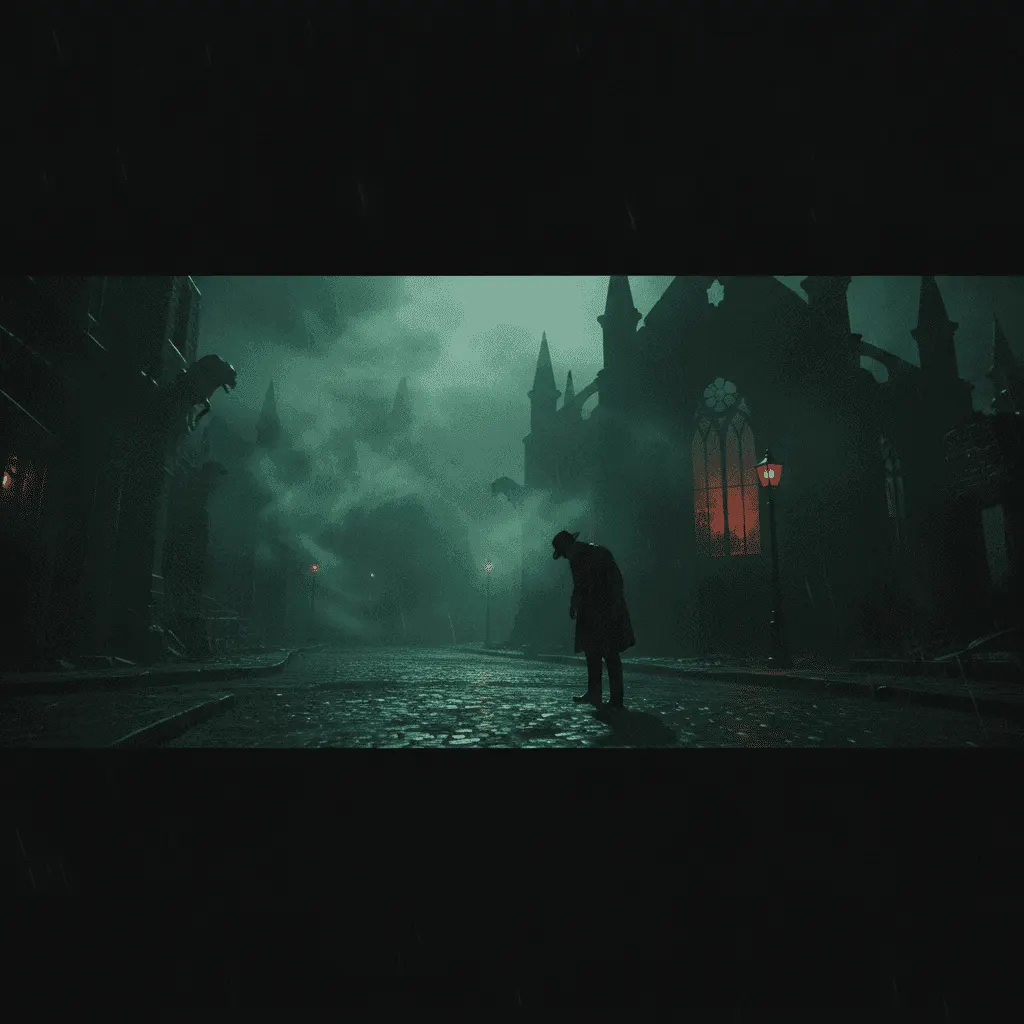
Unlike other poltergeists where the energy is purely invisible, the Black Monk of Pontefract took the step into full materialization. Multiple witnesses, including family members, neighbors, and police officers who came to investigate the calls for help, claimed to have seen a dark silhouette, nearly two meters tall, dressed in a black tunic of medieval cut whose hood concealed a vacant or cadaverous face. The entity's hands, described as pale, desiccated claws, would often show themselves among the folds of the fabric before the figure dissipated into the hot air.
Documented Cases and Notable Encounters
Among the numerous violent episodes suffered by the inhabitants of the house, one stands out for its extreme aggression and cruelty: the assault endured by young Diane Pritchard. The hypothesis that poltergeists use the young as energy catalysts found in Diane an absolute focal point, but the Black Monk did not content himself with feeding on her tension; he made her his primary victim. One particularly dark night, the family was awakened by Diane's deafening screams from her bedroom. Breaking down the door to enter, Joe and Jean witnessed a chilling scene: the girl was being dragged upward along the stairs at a right angle, unconscious, propelled by an invisible force gripping her by the throat. After freeing her from the intangible yoke, the girl bore deep marks of bruised fingers around her throat, a psychological trauma that would accompany her for the rest of her life.
Another incident extensively documented by the British press and by renowned researchers such as Colin Wilson —author of the acclaimed study Poltergeist: The Force of Darkness— involved the attempted exorcism of the property. An Anglican priest came to the house armed with holy water and crucifixes, intent on purifying the dwelling. The moment the cleric began reciting the prayers of deliverance, the crucifixes hung upon the walls turned as one. Seconds later, a Bible lying on the table was flung through the air, striking the priest in the face, while an invisible force tore the liturgical vestments from his body. The priest fled the house in terror, declaring that he was facing something infinitely older and more malevolent than a mere stray spirit.
Even in recent years, following the departure of the Pritchard family and the acquisition of the house by film producer Bil Bungay—who maintained the internal structure almost untouched for investigation paranormal—, dozens of visitors, journalists, and television crews have experienced terror firsthand. Lights that extinguish on their own, objects hurled with surgical precision at the investigators' heads, and physical assaults in the form of deep scratches continue to occur within the small upper-floor room known as ‘Diane's bedroom’.
The Dark Side: A Psychological Analysis
Why does the Black Monk Poltergeist awaken such a deep, atavistic dread in the human psyche? From an analytical and psychological standpoint, this case strikes directly at the fundamental foundations of our sense of safety: the home. The house is the sanctuary where the individual shields himself from outer chaos; when that refuge is desecrated by an unpredictable, omnipotent, and violent entity, the traumatic effect multiplies exponentially.
Furthermore, there is a devastating semantic and symbolic weight bound to the figure of the ‘Black Monk’. The monastic habit evokes sacredness, devotion, and divine protection; yet in this context, that holy iconography is perverted, twisting into an avatar of corruption, depravity, and eternal damnation. The human mind reacts with visceral horror to the desecration of the sacred. The utter impossibility of defending oneself through logic or physical force plunges the victims into a state of learned helplessness, drowning them in absolute existential anguish.
From a parapsychological perspective, the phenomenon oscillates between two fundamental theories: the manifestation of a demonic entity or tulpa fueled by collective hysteria and the historical trauma of the land, or an outburst of recurrent spontaneous psychokinesis (RSPK) sparked by Diane's turbulent puberty, which ultimately tore open a portal to a foreign, hostile consciousness. Whatever the ultimate nature of the phenomenon, the empirical evidence accumulated over the decades proves that the horror experienced in Pontefract was terrifyingly real.
Conclusion: The Echo in the Darkness
When reflecting on the history of 30 East Drive, a chilling cold becomes inevitable. The Black Monk Poltergeist is not a mere urban legend told around a campfire; it is an indelible testament to the cracks that exist in our understanding of reality. The walls of that humble Yorkshire dwelling still hold the memory of violence, the screams of terror, and the unfathomable shadow of that monk who refuses to abandon the land of the living.
As I always tell you on RelatandoCarlos, the border between the natural and the supernatural is ridiculously thin. Perhaps, as you listen to these words in the comfort of your homes, you should pay attention to the small noises, the inexplicable drafts, or the sudden drop in temperature. Because sometimes, when we stare into the darkness of history, the darkness does not merely stare back—it decides to slowly climb the stairs toward our room. Keep the lights on and your mind alert.
📜Investigation • Frequently Asked Questions
Documentary Archive and Analysis of the Occult • Relatando.com
What historical and documentary connection exists between 30 East Drive in Pontefract and the ancient Priory of St. John?
The house's location is no accident on the map of British folklore. The ground upon which the Chequerfield Estate was built borders the ancient domains of the Priory of St. John and the historic medieval execution hill. Oral tradition and local records suggest that the traumatic burden of those years of the Protestant Reformation, compounded by the execution of a Cluniac monk for atrocious crimes, cemented the historical substratum that researchers link directly to the persistence of the entity known as the Black Monk.
How does the manifestation of the Black Monk Poltergeist fundamentally differ from traditional haunted houses?
Unlike the subtle sightings, whispers, or elusive shadows typical of classical parapsychology, the Pritchard family's ordeal stood out for its extreme physical violence and sensory overwhelmingness. The assaults included the levitation of heavy objects, the apparition unexplained pooling of water on dry floors, foul stenches of organic decay, and direct physical attacks against family members, resembling the intrusion of a flesh-and-blood assailant far more than a mere specter.
How does parapsychology address the duality between telekinetic theory and the presence of the entity 'Fred'?
A central debate runs through the investigation of this phenomenon. On one hand, traditional parapsychology tends to explain poltergeists as projections of unconscious psychokinetic energy generated by adolescents under emotional stress. Yet the persistence of a perfectly defined anthropomorphic figure, christened 'Fred' by those afflicted, defies this hypothesis by suggesting the existence of an entity with its own will, self-awareness, and intentionality rooted in the place.
Why is the case of the Black Monk of Pontefract still considered one of the most unsettling dossiers in modern English history?
The case transcends rural anecdote through the accumulation of firsthand testimonies, the prolonged duration of the phenomena over the years, and the inability of conventional science to offer satisfactory answers. The severity of the physical assaults suffered by the Pritchard family and the exhaustive documentation compiled by amateur researchers and experts in the occult have turned 30 East Drive into an inescapable landmark of British documentary horror.
Do not extinguish the light yet...
If you have had the courage to make it this far, we have other dossiers that will test the limits of your sanity.

Terms and Figures of this Tale
To delve deeper into the legends, creatures, and dark concepts that inspire this account, consult their entries in our dictionary of the uncanny:



Tu correo no se publica ni se comparte con terceros: solo sirve para notificar la respuesta.