Cold sweat does not spring from dread the dark nor from the threat of a claw in the gloom; it is born of something infinitely more subtle, of a blink that takes a fraction of a second too long to complete.
I. The Geometry of the Abyss
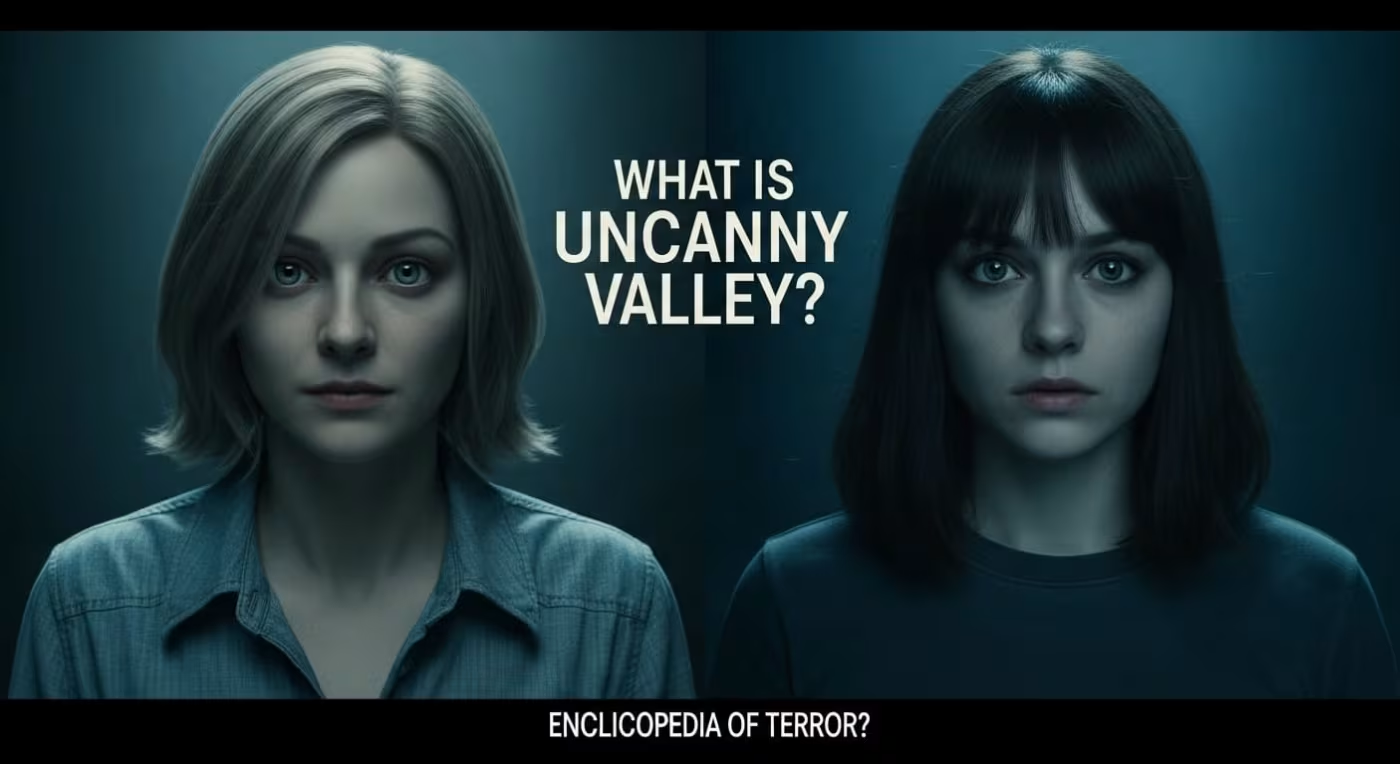
In 1970, Japanese roboticist Masahiro Mori drew a line on paper that would forever change our understanding of horror. He was not speaking of monsters nor of otherworldly ghosts, but of the geometric perfection of imitation. As an inanimate object or artificial creation acquires human traits, our emotional affinity rises—a natural ascent toward empathy. Yet a breaking point occurs. At the threshold where the artifact is nearly identical to us, yet devoid of a soul, the curve plummets abruptly into a cold, vertical abyss: the uncanny valley.
True horror does not reside in the utterly monstrous, but in that which apes our humanity with a flawed, subtle perfection.
This is no mere visual aversion; it is an ancestral alarm wired deep into the architecture of our nervous system. The human brain, an unforgiving predictive machine, detects the grinding dissonance between what it witnesses and what it can comprehend. A smile held too rigidly still, a vocal cadence touched by an algorithmic chill, or an unblinking gaze that harbors no inner history.

II. Roots in the Shadow of Myth
Long before integrated circuits and modern robotics gave shape to hyper-realistic automata, mankind already trembled before its own creations. In the dusty alleys of the Prague ghetto, the Legend of the Golem warned of the dangers of sculpting life from inanimate clay. A corporeal figure, heavy-gaited and hollow-eyed, walking among men yet truly belonging to no mortal lineage.
Nineteenth-century literature captured this very dread with surgical precision. Mary Shelley laid bare the agony of the creature abandoned within its Frankenstein, while E.T.A. Hoffmann plunged us into paranoia with the automaton Olympia in The Sandman. In both instances, terror arises not from explicit violence, but from the unsettling suspicion that what stands before us is watching us from behind a borrowed facade, devoid of any genuine soul.
III. The Everyday Infiltration
Today, the uncanny valley no longer dwells solely within robotics laboratories or the pages of old ghost stories. It slips stealthily into our daily existence through hyper-realistic digital animations, storefront mannequins that seem to track us with glassy eyes, and human behaviors so mechanized they border on clinical falsity. Prolonged exposure to these entities leaves no physical wound; it erodes the sanity, unraveling the mind into paranoia and depersonalization.
In the end, we confront the darkest mirror of our own existence: the grim realization that the boundary separating human from machine, life from inert matter, is so fragile that a single vacant glint in the eye can shatter it forever.
📜Investigation • Frequently Asked Questions
Documentary Archive and Analysis of the Occult • Relatando.com
What origin or documented testimony inspired this theory?
The concept was formally coined in 1970 by Professor Masahiro Mori, stemming from his observations of human emotional responses to industrial robots and prosthetic limbs.
What are the telltale signs or anomalies that precede this phenomenon?
Subtle discrepancies like an asynchronous blink, localized facial rigidity, a complete absence of emotional micro-expressions, and a hollow gaze that remains entirely deaf to the stimuli of the surrounding room.
Is there any documented psychological or scientific explanation?
Evolutionary psychology suggests it is a visceral defense mechanism—an innate aversion wired into our bones to shun corpses, disease carriers, or the severely neurologically impaired.
How do folklore and tradition react to this case?
Echoed through ancient myths of automata, doppelgängers, golems, and soulless artificial constructs, haunting almost every ancient culture upon the face of the earth.
Do not extinguish the light yet...
If you have had the courage to make it this far, we have other dossiers that will test the limits of your sanity.

Terms and Figures of this Tale
To delve deeper into the legends, creatures, and dark concepts that inspire this account, consult their entries in our dictionary of the uncanny:


Tu correo no se publica ni se comparte con terceros: solo sirve para notificar la respuesta.