The hum of the fluorescent tube in the hallway had the consistency of a sick pulse. José Pedro Negri adjusted the lapel of his trench coat, noting how the rough wool chafed a neck hardened by years of night shifts, dark alleyways, and urban miseries that left no trace in official records. Outside, the Madrid district of Vallecas exhaled the dry November cold, but inside apartment number one on Calle Luis Marín, the air was dense, thick as a broth of rust and stale sweat. The National Police officers accompanying him avoided eye contact. There was a mute urgency in the atmosphere, a shared desire to finish the report and flee that place where the walls seemed to exude a dampness that did not come from the pipes.
I. The First Sign
Negri approached the living room with a steady step, trying to impose the normalcy required by his rank as Chief Inspector. However, his reason choked in his throat as soon as he crossed the threshold. On the wilted-flower wallpaper remained the unmistakable mark of what had occurred only hours before: the heavy walnut crucifix, secured with steel bolts, was no longer in its place. It had not fallen; it had been ripped away with a methodical violence that had torn the plaster in a perfect circle. White shavings covered the floor like a macabre frost.
Who tears a Christ from the wall with bare hands and leaves the nails intact?
He crouched to examine the trail. His fingers trembled slightly, an involuntary spasm he attributed to accumulated exhaustion. But it was not exhaustion. It was the physical certainty that the space had been altered. Sergeant Gómez cleared his throat from the end of the hall, breaking a silence that weighed like a lead slab upon the chest. No one spoke loudly. In that apartment, raising one's voice felt like an absurd provocation against something invisible lurking in the margins of peripheral vision.

II. The Fracture of Reason
“Inspect the wardrobe,” Negri ordered, gesturing with his chin toward the ancient piece of furniture that occupied the north wall of the main bedroom.
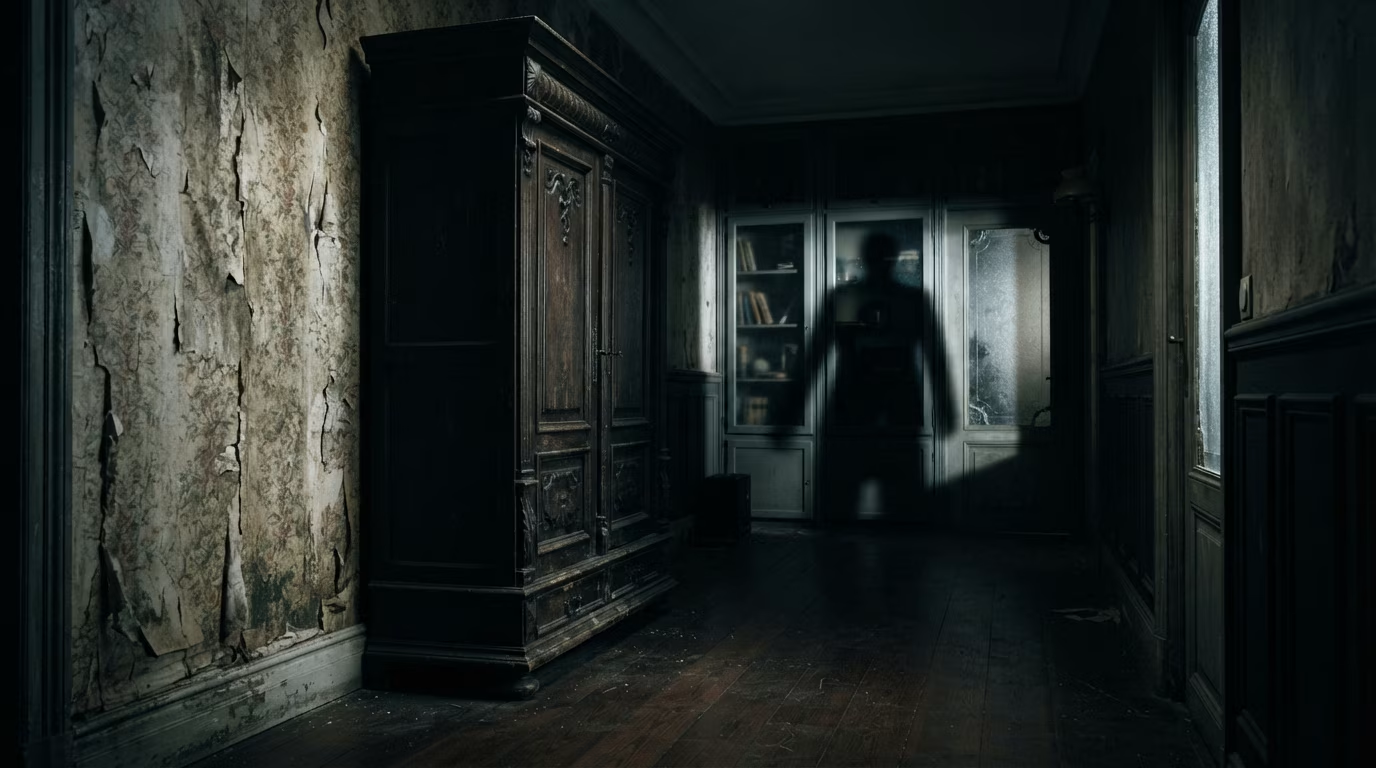
Two officers approached with flashlights. The beams cut through the gloom, revealing motes of dust suspended in a lethargic dance. As the younger officer's gloved hand touched the brass handle, the wardrobe answered. It was not the creak of aged wood shifting with the temperature; it was a dull, heavy thud, as if a colossal fist had struck the interior back panel, followed by a metallic groan that sent a tremor through the soles of their shoes against the parquet. The cold bit into their bones with the swiftness of a blade. The officer recoiled instantly, stumbling over the rug and letting out a choked curse that withered in the oppressive atmosphere of the bedroom.
“Open it,” Negri demanded, though his own breathing had grown shallow and thin.
They turned the key with a metallic snap that echoed like a gunshot in the midnight silence. The scent that surged from within was not of camphor or stored linens. It smelled of damp earth, a flooded cellar, and organic matter rotting in absolute darkness. It was empty. Entirely empty. And yet, the vapor of their own breath condensed in the air before the open doors, forming thin white clouds that vanished slowly.
III. The Certainty of the Shadow
The early morning hours crept on without mercy. The inspector's watch read quarter past three when the phenomenon disturbance shifted to the exterior gallery overlooking the light well. A tall, disproportionate shadow suddenly cast itself against the opaque glass of the large window. It did not correspond to the silhouette of any neighboring building nor to that of the police guarding the perimeter. It was a stretched, faceless figure that seemed to bend back upon itself, defying the most elementary laws of perspective and physics.
Negri rushed to the window and threw the bolt with a sharp jerk. Outside, the Madrid night remained still, oblivious to the horror contained within those four walls. There was no one in the courtyard. No neighbor peeked through the slats of the lowered blinds. Only the electric hum of a distant transformer and the hollow echo of his own boots against the terrazzo floor.
The inspector stood there, staring out into the exterior darkness, feeling cold sweat trickle down the back of his neck as unanswered questions began to gnaw at the foundations of his sanity. What kind of dossier case file is written when the enemy has no body, when the dread terror is not a psychological reaction but a tangible presence inhabiting the corners of just any house on just any street in Madrid?
📜Investigation • Frequently Asked Questions
Documentary Archive and Analysis of the Occult • Relatando.com
What historical and documentary connection does this account hold with the celebrated 'Vallecas File' of Spanish parapsychology?
The text recreates with forensic rigor the actual intervention of Chief Inspector José Pedro Negri in the 1992 Luis Marín Street case, widely considered the first and only police report in Spain to officially document paranormal phenomena. The narrative captures the tension of law enforcement facing inexplicable physical anomalies within a domestic setting.
This chronicle transforms Madrid's urban folklore into a fascinating object of criminological and documentary study, where the sobriety of an official record fractures in the face of the inexplicable.
How should the violent extraction of the crucifix be interpreted from a folkloric and symbolic perspective?
In popular demonology and Iberian folklore, the desecration or spontaneous alteration of sacred imagery—especially in fine woods like walnut—symbolizes the drastic rupture of the sacred space of family protection.
The surgical precision with which the Christ figure was torn away, leaving the steel anchors intact while the plaster was shredded in a perfect circle, suggests a manifestation that defies conventional vector physics. This is no mere vandalism, but a spiritual contempt seeking to dismantle the home's final symbolic barrier.
What function does the tension between police rationalism and the collapse of logic serve within the narrative?
The account pits the methodical bureaucracy of the police force against the eruption of the ineffable. By articulating the narrative from the perspective of a seasoned inspector like Negri, the story explores the disintegration of the positivist paradigm.
The authority of the law and the pragmatism of trench coats and police reports are reduced to nothing before the density of an atmosphere where humidity, temperature fluctuations, and the warping of matter impose an invisible but crushing presence.
What anthropological meaning do the dull, heavy thuds echoing from inside the wardrobe harbor?
Sealed furniture and family heirlooms serve, in folklore, as liminal spaces—thresholds between the mundane and the unfathomable. The sound of sharp percussive knocks emanating from within an aged wooden structure recalls the classic phenomenon of the *—which are usually bound to a geographic location— the Dybbuk is bound to a person. It is a form of 'personalized' possession that challenges the notion of evil as an external force, reminding us that the deepest horror sometimes springs from our unfinished humanity and the debts we leave unpaid upon death.*.
Anthropologically, the wardrobe serves as a vessel for the repressed. That the entity reacts with such violent fervor to the officers' contact with the brass fitting symbolizes a bitter, desperate resistance against being exposed to the cold, rational glare of their lanterns.
Don't extinguish the light just yet...
If you have had the courage to make it this far, we have other dossiers that will test the limits of your sanity.

Terms and Figures of this Tale
To delve deeper into the legends, creatures, and dark concepts that inspire this account, consult their entries in our dictionary of the uncanny:

Tu correo no se publica ni se comparte con terceros: solo sirve para notificar la respuesta.