The cold of Popocatépetl did not creep through the doorframes; it was born directly in the center of the rooms, as if the volcanic stone foundations guarded the frozen memory of an eternal winter.
I. The Forgotten Corner
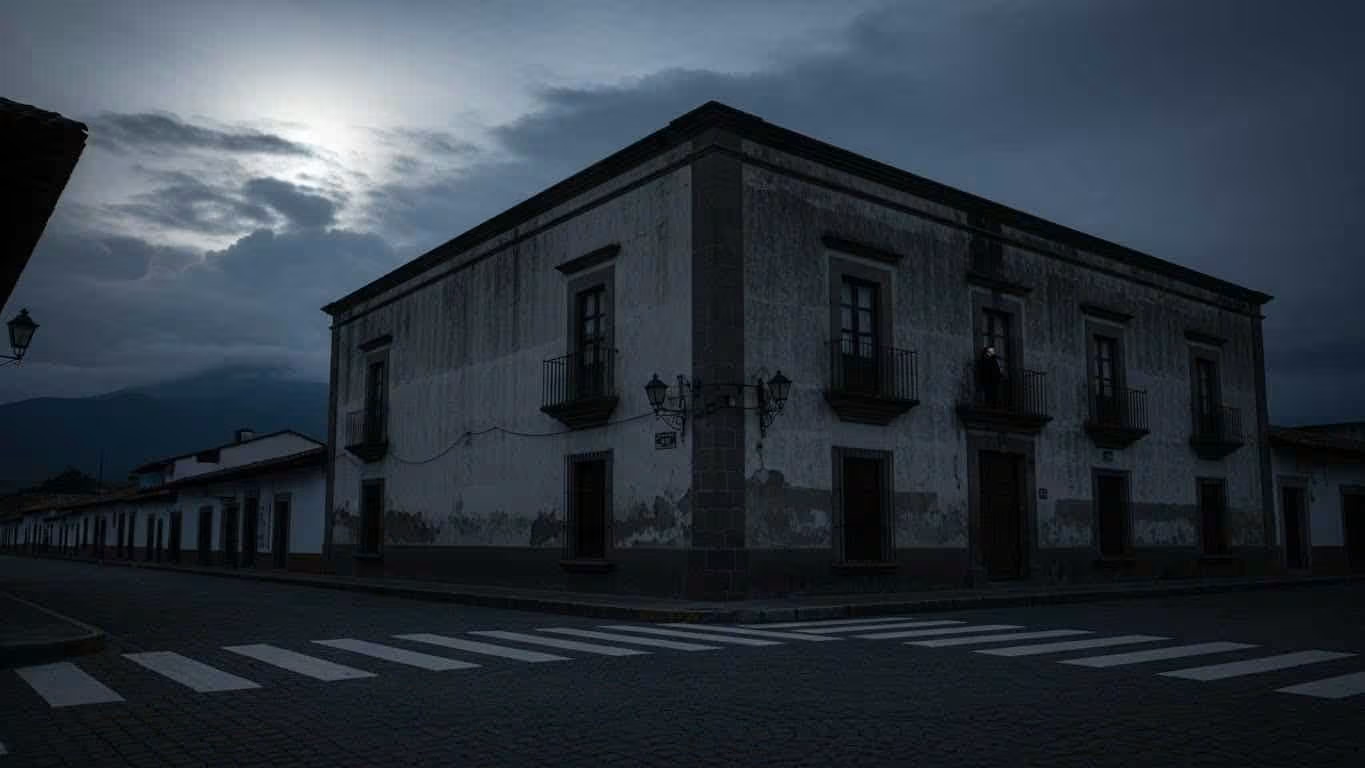
In the village of San Jerónimo, at the foothills of the smoking colossus, there existed a coordinate where logic fractured. The wind did not blow; it wailed with an almost human timbre as it struck the dark walls and narrow windows of that colonial mansion. No one remembered the architect's name or the registry of its cornerstone. Only the oral certainty prevailed—the kind inherited in hushed tones by the hearth: there, flowers never managed to open their buds, and silence was a chimera.
Margarita, the neighborhood baker, swore that the plot held the perpetual mourning of an entire family swallowed by desolation. Don Teófilo, a retired commissioner scarred by ancient winters, claimed to have heard an unclassifiable weeping when crossing the corner at the deepest hour of midnight. The local children turned the dread into a test of courage, running in a pack before the facade, yet none dared to raise their eyes toward the second-floor window, where a static silhouette seemed to keep watch over the square.

Fear is not the absence of light, but the presence of something that feeds upon our own shadows.
And yet, driven by real estate displacement and the urgency of a fresh start, the Ramírez family crossed the threshold. Julián, a novelist determined to fulfill a publishing contract slipping through his fingers; Irene, his wife, of firm temperament yet worn down by the city; and Carolina, a girl with eyes deep as bottomless wells and hair as black as a wolf's maw.
II. In the Gloom
The move transpired under a subtle omen: the forged iron keys refused to turn smoothly. They seemed to gauge the density of those who intended to inhabit the space, jamming in the lock like an organism rejecting a foreign body.
The first night was an oasis of rest. The second, however, brought the first fracture. Irene lay awake, listening to Carolina's rhythmic babbling in her crib. The child was not having ordinary nightmares; she articulated names foreign to the family vocabulary: “Emilia, do not come closer… The shadow is here…”. Irene chalked it up to travel fatigue, to the accumulated dust of old furniture.
Yet by the third day, the house's architecture began to fracture and unfold. At the exact hour when the sun touched the line of the volcanic horizon, Julián's study was cast into absolute darkness. It mattered little how many times he changed the bulbs or inspected the aging wiring; the gloom was punctual, disciplined, and dense.
Carolina, meanwhile, filled sheets of paper with an obsessive stroke. She drew a little girl identical to herself, always holding the hand of a formless smudge that spilled over the margins of the page, desperately seeking to break through into the real world. Irene discovered another anomaly before the washbasin: the bathroom mirror refused to reflect the room in its entirety. A corner was always omitted, a blind angle veiled by a mist that felt like nothing at all.
III. The Seed of Horror
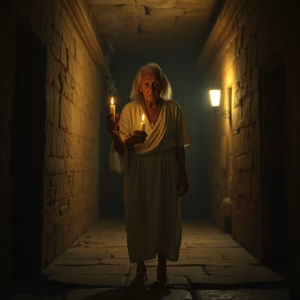
Two weeks of minor fissures in reality were enough to shatter Julián's stubborn skepticism. He crossed the street in search of Doña Maruca, the living memory of San Jerónimo, an old woman whose eyes had watched entire generations pass away.
—That house… —whispered the woman, leaning toward him as though fearful of being overheard by the park's stone walls—. That house does not belong to this town. They brought it here.
Julián frowned in disbelief. —What do you mean, it was brought here?
—They built it over the foundations of an older estate. It belonged to a man named Salas. He had a daughter called Emilia. They said the child spoke to the adobe brick, that the house chewed her words and spat them back in whispers. One night of thick fog, Emilia vanished. The house swallowed her whole.
The warning hung suspended in the cold afternoon air. That very dawn, at precisely three in the morning, Julián awoke with the clinical certainty that someone was staring straight at him. His study was cast in shadow, illuminated solely by the small reading lamp. And then, piercing the mountain silence, he heard it: a chorus of whispers, akin to the beating wings of a thousand night moths. They were not comprehensible words, but a child's lament, deep and wet.
He rose from the bed, his heart hammering against his ribs, and walked toward the darkened study…
📜Investigation • Frequently Asked Questions
Documentary Archive and Analysis of the Occult • Relatando.com
What origin or documented testimony inspired this story?
The narrative draws from legends Mexican colonial traditions regarding grand houses built upon ancient shrines or estates where family crimes remained trapped within the memory of adobe and volcanic stone.
What are the telltale signs or anomalies that precede this phenomenon?
Classic motifs in such tales include inexplicable electrical failures at dusk, objects that fail to reflect properly in mirrors, and children who voice names or presences foreign to their surroundings.
Is there any documented psychological or scientific explanation?
Parapsychology and environmental psychology suggest that ancient structures featuring poor acoustics and thermal insulation can generate low-frequency vibrations capable of inducing sensations of panic and auditory hallucinations.
How do folklore and tradition react to this case?
Popular folklore often warns against the recklessness of inhabiting spaces marked by silenced tragedies, interpreting the isolation of cursed houses as a self-defense mechanism of the village itself.
Don't extinguish the light just yet...
If you have had the courage to make it this far, we have other dossiers that will test the limits of your sanity.
Terms and Figures of this Tale
To delve deeper into the legends, creatures, and dark concepts that inspire this account, consult their entries in our dictionary of the uncanny:

Tu correo no se publica ni se comparte con terceros: solo sirve para notificar la respuesta.