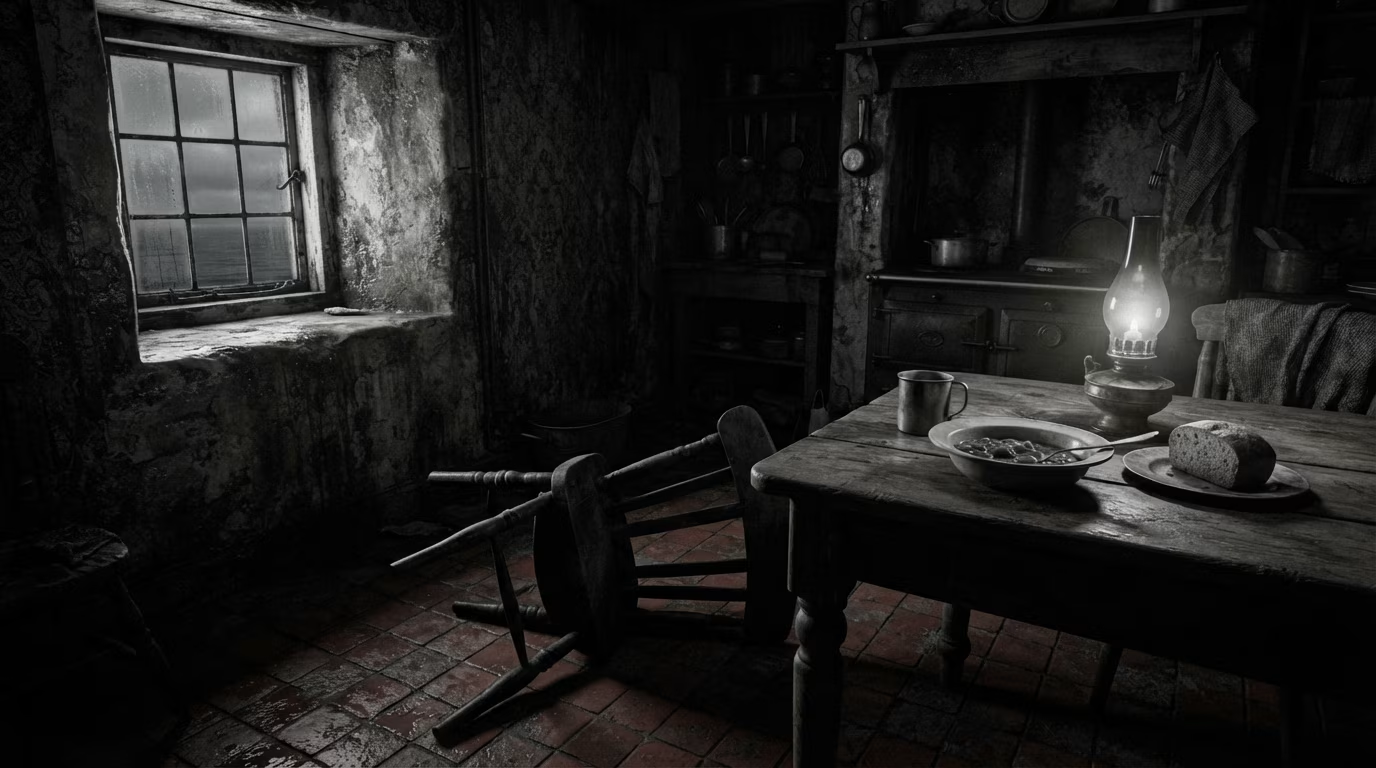
The jug of lamb stew was still lukewarm on the iron stove, giving off a thick steam that mingled with the smell of rancid grease and damp coal. James Ducat, the veteran with the salt-crusted beard who had weathered gales capable of wrenching oak doors clean off their hinges, was not there to taste it. His plate rested on the pine table with the pewter spoon balanced on its rim, as if he had stepped out to answer an urgent call beyond the threshold. But the threshold opened only onto the grey abyss of the Outer Hebrides, onto a North Atlantic that, on that December morning of 1900, stretched smooth and heavy as a sheet of polished lead, devoid of waves, of wind, and of life.
The steamer Hesperus had docked at the eastern pier of Eilean Mòr after three days of delay imposed by the sea mist. On board, Joseph Moore carried in his hands the satchel with fresh provisions and the overdue mail. His first impression upon setting foot on the rock was the absence of the flag on the mast. No greeting from the railing. No silhouette wrapped in yellow oilskins descending the steps carved into the cliff to help with the cargo. The silence had a physical weight, a density of molten lead that crushed the ears and set the teeth on edge with every breath of it.
I. The Fallen Chair in the Kitchen
Moore ascended the cobbled paths with his heart hammering against his ribs in a fevered rhythm. Each step echoed against the basalt stone with an insulting clarity. When he reached the lighthouse's main door, he found it wide open. Not battered down by the fury of a storm, but opened with the deliberation of someone who steps out to gaze at the horizon and forgets to draw the latch. He pushed the heavy timber and the smell struck his palate before he saw anything: a nauseating blend of burnt paraffin oil, the dampness of old cassocks, and the stale sweat of three bodies locked too long within too narrow a perimeter.

In the kitchen, the high-backed chair lay toppled on the red ceramic tiles. It had fallen backward, legs pointing at the vaulted ceiling, revealing a small puddle of cold tea still dripping slowly from the table, keeping time with a metallic, lonely sound: tick, tick, tick. No one picks up a fallen chair if there are hands to do it. No one leaves food steaming while the tea's vapor still forms tiny pearls of condensation on the window glass.
The sea has no memory, Moore. It swallows us and then pretends it never knew our names.
He recalled the sly warning Ducat had tossed at him in the port of Glasgow weeks earlier. But that was not the work of the sea. The sea devours with fury, shatters timbers, tears iron apart, and scatters bones across the abyssal trench. That was something else. It was a surgical void, a methodical subtraction that had left untouched the teacups, the tobacco pipes lined up by the window, and the coats hanging on their pegs, dark and heavy as the pelts of dead animals.
II. The Impossible Pages of the Notebook
On the desk in the watch room, beneath the ashen light that seeped through the thick panes of the Fresnel lens, lay the logbook. Its pages were filled with the angular, polished handwriting of Thomas Marshall, the second assistant. Moore turned the pages with trembling fingers, feeling the paper crackle like dry leaves under a furtive foot. The entries spanned the last four days.
On December sixteenth, Marshall had written of hurricane winds lashing the tower with the force of a thousand demons, forcing the three men to pray huddled on the engine-room floor while waves leapt over the lantern, more than forty meters above sea level. The seventeenth continued the litany of the storm: screams drowned by the roar of water, panes about to burst, the entire structure groaning like the timbers of a ship in agony. The eighteenth brought mention of a persistent weeping that came from the depths of the rock, a sound akin to metal dragging across wet stone.
Moore slammed the book shut. The dust gathered on its edge drifted in the stagnant air, forming tiny constellations beneath the gray light. Outside, in the harbor, the thermometer registered absolute calm. Not a breeze rippled the water's surface. The fishing boats had gone out that very morning without recording any anomaly on the open sea. On the day of the supposed monstrous hurricane, the local fishermen remembered having taken their tea on the decks of their cutters under a sky as clear and blue as the belly of a trout.
Marshall had lied. Or worse still: Marshall had lived in a world that shared neither space nor time with the rest of Scotland.
III. The Descent into the Lower Lighthouse
The tower of Eilean Mòr kept secrets at its base, where the wrought-iron spiral staircase ended, swallowed by the gloom of the oil stores. Down there, the stench of dead fish and salt spray turned the air unbreathable. Moore descended with a kerosene lamp whose flame wavered, stretching into famine-thin tongues that threatened to die at the faintest draught. The walls sweated a viscous liquid that stained the shoulders of his coat.
He found the three men's oilskins hanging on the lower landing. Only two remained. Donald MacArthur's was gone—Donald, the youngest and most superstitious of the sailors, the one who would spend hours staring into the fissures of the cliff, searching the moss for human shapes. With him they had taken the tall wading boots. No one walks the slick cornices of Eilean Mòr without a coat and with the tide at low ebb unless something, from the depths of the breakers, is calling him by name with an urgency that cannot be denied.
Later records spoke of a rogue wave, an unforeseen surge of the sea that swept away three keepers while they were securing a crane on the western landing. A convenient explanation for the offices in Edinburgh, an official report penned in the sterile ink of bureaucracy to pacify widows and close the dossier with a hurried signature.
But Joseph Moore, sitting in the empty kitchen while the stew finished cooling forever, knew that no wave drags a chair from inside without breaking the table, no wave leaves pipes loaded on the windowsill, and above all, no wave is capable of writing lies in a notebook with the trembling handwriting of a man who has seen the sky open to let pass something that has no name on the Admiralty charts.
On the entrance wall, beside the emptied coat rack, someone had carved a series of irregular notches with the tip of a knife. Fifty-two deep notches. And beneath them, a final sentence written in charcoal, so faint it barely grazed the wood: *We are no longer alone in the stone*.
📜Investigation • Frequently Asked Questions
Documentary Archive and Analysis of the Occult • Relatando.com
On what myth or dread reality is this tale based?
It draws inspiration from the real mystery of the disappearance of the Flannan Isles lighthouse keepers in 1900, a historical enigma of absolute isolation.
Are there documented real cases similar to this story?
Yes, the case of the Eilean Mòr lighthouse remains one of the most baffling and unresolved maritime files in the history of the British navy.
What does the ending of the story mean?
It represents the invasion of the unknown into the human psyche, suggesting that the keepers were drawn willingly toward something beyond comprehension.
Do not extinguish the light yet...
If you have had the courage to make it this far, we have other dossiers that will test the limits of your sanity.

Terms and Figures of this Tale
To delve deeper into the legends, creatures, and dark concepts that inspire this account, consult their entries in our dictionary of the uncanny:




Tu correo no se publica ni se comparte con terceros: solo sirve para notificar la respuesta.