En los recovecos más oscuros de la historia clásica, donde la racionalidad del Imperio Romano se quiebra ante el peso de lo insondable, emerge una entidad que aterroriza tanto a los vivos como a los muertos: la Larva y su inseparable manifestación, el espectro esquelético que condena a la locura. Soy Carlos Nieto, y en este exhaustivo recorrido por los abismos de Relatando.com, desentrañaremos una de las legends más aterradoras y menos comprendidas de la antigüedad, un ente incorpóreo diseñado no para arrebatar la vida de un tajo rápido, sino para desquiciar la mente humana hasta arrastrarla al más absoluto y violento delirio.
Classified File
- Origin: Mythology y creencias funerarias de la Antigua Roma.
- Nature: Wandering spirit, threshold larva, or skeletal specter of the damned.
- Hazard Level: Extreme (Induces irreversible dementia and lethal paranoia).
- Weaknesses: Purification rites of the Lemuralia, offerings of black beans, and iron apotropaics.
Origin and Etymology
Para comprender la verdadera dimensión de este Horror ancestral, debemos sumergirnos en la etimología y la cosmovisión de la antigua Roma. La palabra ‘larva’ (en plural, *larvae*) posee una raíz lingüística fascinante y escalofriante. En su sentido más primitivo y etimológico, el término hacía referencia a una máscara grotesca, a un Phantom aterrador o a una sombra sin descanso. A diferencia de los *lares*, que eran los espíritus protectores del hogar y los antepasados benévolos venerados con devoción en el larario, las *larvae* representaban la antítesis absoluta: almas en pena, espectros de individuos que habían sufrido muertes violentas, prematuras, o cuyos ritos funerarios habían sido profanados o ignorados por los suyos. Estos seres no encontraban reposo en el inframundo gobernado por Plutón y Proserpina, por lo que quedaban atrapados en un limbo terrenal, vagando por los cimientos de las domus, las cloacas y los caminos oscuros.
The Romans, profoundly superstitious despite their facade of legal and military pragmatism, held a deep dread of these entities. There was a firm conviction that a *larva* was not merely a restless corpse, but a corrosive force bent on dragging the living down into its own state of spiritual decay. The fusion of this concept with the figure of the skeletal specter—a visual manifestation of stripped bone, grinning skull, and eternal starvation—gave rise to one of the most terrifying legends of the ancient Mediterranean. Priests and augurs warned that to ignore the cult of the dead on designated days of the Roman calendar, such as the Lemuralia in the month of May, meant opening a direct portal to these creatures, allowing them to invade the domestic sanctuary and plant the seeds of mental ruin.

Anatomy and Appearance
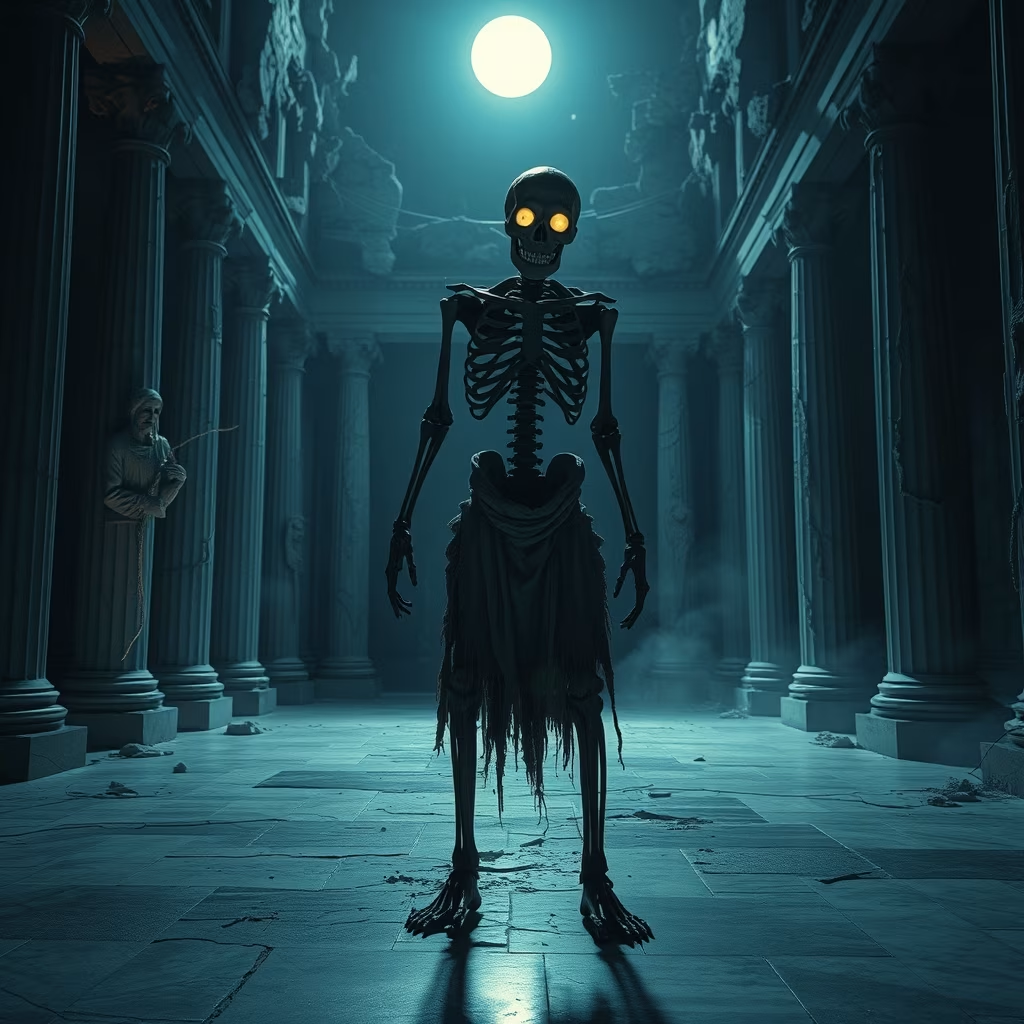
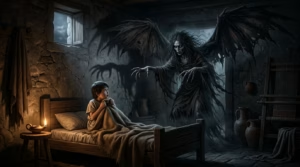
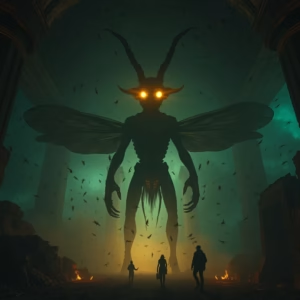
The physical description of the Roman Larva and its skeletal companion defies the laws of biology and dream logic. Fragmentary accounts gathered from senatorial chronicles and curse tablets (*defixiones*) describe the primary *larva* as a translucent mass, possessing a consistency akin to putrid gelatin or a dense, parasitic smoke that clings to walls and ceilings like an invisible spider's web. Yet when this entity chooses to manifest in its most terrifying guise, it assumes the silhouette of a skeletal specter of impossible proportions: exaggeratedly elongated limbs, ribs that resemble empty cages, and a fleshless skull whose eye sockets cradle two points of cold, flickering light, reminiscent of a will-o'-the-wisp fueled by marsh gas.
Este espectro no emite calor; por el contrario, su presencia provoca un descenso drástico e inmediato de la temperatura ambiental, congelando el aliento de quienes osan mirarlo. Viste jirones de una toga romana desgarrada por los siglos, manchada de un lodo negruzco que nunca llega a secarse y que exuda un hedor penetrante a tumba abierta, a carne rancia y a tierra mojada tras una tormenta de verano. Lo más perturbador de su anatomía es su capacidad para alterar la percepción visual de la víctima: el esqueleto parece cambiar de tamaño según se le mire directamente o se intente esquivar con el rabillo del ojo, creando una sensación de vértigo espacial que desorienta por completo el córtex cerebral de quien sufre la apparition.
Modus Operandi and Powers
The *modus operandi* of the Larva and its skeletal specter is a masterpiece of psychological cruelty. They strike with no physical claws, nor do they seek to bleed their prey outright. Their primary weapon is the methodical, progressive induction of madness. The process begins subtly: the chosen victim starts to hear unintelligible whispers in archaic Latin drifting from the corners of the room—voices that speak their name with utter contempt and detail the exact manner of their inevitable demise. These whispers are soon compounded by tactile hallucinations, such as the sensation of unseen insects crawling beneath the skin or currents of freezing air tracing the length of the spine for no discernible reason.
As the nights wear on, the skeletal phantom materializes at the foot of the bed or within the darkened corridors of the home. Its mere presence acts as a magnetic field of quiet despair. The *larva*'s powers include the manipulation of dreams, inducing recurring nightmares wherein the victim is buried alive, devoured by colossal worms, or condemned to witness the ruin of everything they hold dear. This relentless psychic bombardment shatters sleep patterns, precipitating chronic insomnia, acute paranoia, short-term memory loss, and ultimately, total nervous collapse. Unable to distinguish between reality and the entity's macabre projections, the victim invariably loses their reason entirely, ending their days in a state of catatonic mutism or hurling themselves over a precipice in a frantic bid to silence the voices.
Weaknesses and Protective Rituals
Despite the dread they inspire and their apparent incorporeal invulnerability, the Romans discovered through bitter experience and anguish that the Larva and its skeletal specter are not invincible. Very stringent traditional methods exist to keep them at bay or banish them from the hearth. The first line of defense lay in the strict observance of the **Lemuralia**, held on the 9th, 11th, and 13th of May. During these hallowed nights, the *pater familias* was required to rise at midnight, walk barefoot through the house making a specific finger-gesture to ward off spirits (touching the thumb to the middle finger), and cast black beans (*fabae*) over his shoulders nine times while repeating an expulsion formula: «With these beans I redeem myself and mine». It was believed the *larvae* would occupy themselves counting the beans, forgetting their original grim purpose until dawn broke.
Another fundamental weakness lies in the use of apotropaic amulets fashioned from **pure iron** and phallic elements (such as the Roman *fascinum*), alongside metals and symbols ancient sorcery deemed repulsive to the chaotic entities of the underworld. Likewise, the ritual burning of pungent aromatic resins—such as frankincense mixed with sulfur and rue—created an olfactory and energetic barrier that prevented the specter from crossing the threshold of blessed doors and windows. Sea salt, consecrated at domestic altars, was also scattered across the foundations to block the passage of any ectoplasmic residue seeping up from the earth.
Documented Cases and Famous Legends
The annals of Rome's occult history are peppered with references to houses cursed by these visitations. One of the most celebrated accounts reaches us through the epistles of Pliny the Younger, who documented the terrifying tale of a vast and spacious house in Athens—a city under Roman cultural and administrative rule—which stood cursed and uninhabited on account of an unbearable specter. A philosopher named Athenodorus, ignoring warnings regarding the property's suspiciously low rent, resolved to lease it. As night fell, while writing by candlelight, he began to hear the metallic echo of chains and the dragging of skeletal feet. Unflinching, the philosopher continued his work until the apparition—a gaunt, shackled old man—revealed itself to him and pointed to an exact spot in the inner courtyard.
Athenodorus marked the spot and, the following day, instructed the magistrates to dig in that corner. They unearthed the skeletal remains of a man wrapped in chains, whose bones had been clandestinely interred without the proper funerary rites. Once the remains were exhumed and solemnly laid to rest with the honors owed by the city, the specter never manifested again, and the house reclaimed its peace. For centuries, this historical case served as the archetypal proof that *larvae* and skeletal phantoms are nothing more than souls anchored to the physical plane by a debt owed to justice or ritual, and that truth, however tragic, remains the sole key to breaking their curse.
Comparative Analysis
When analyzing the Roman Larva and its skeletal specter within the vast tapestry of demonology and comparative cryptozoology, it is crucial to establish vital distinctions from similar entities across different cultures to avoid taxonomic confusion. There is a frequent tendency to conflate the Roman *larva* with the modern concept of **—which are usually bound to a geographic location— the Dybbuk is bound to a person. It is a form of 'personalized' possession that challenges the notion of evil as an external force, reminding us that the deepest horror sometimes springs from our unfinished humanity and the debts we leave unpaid upon death.** or with Eastern vengeful spirits, such as the Japanese *Onryō*. However, profound structural divergences exist.
Whereas a poltergeist is commonly associated with involuntary psychokinesis generated by a living adolescent undergoing puberty, the Roman Larva is a purely necrotic construct—a post-mortem remnant strictly bound to Roman funerary law and ritual abandonment. On the other hand, when compared to Celtic *banshees*, which act as heralds of impending death through their wails, the Roman skeletal specter does not merely announce the end: its purpose is active, parasitic, and destructive, seeking to disintegrate the victim's mind before their heart ceases to beat. Likewise, it differs from the zombies or living dead of modern popular culture; the *larva* possesses no physical body of putrid flesh wandering about to consume brains, but instead operates upon the borderland between residual energy, induced hallucination, and subtle mental possession, turning the human psyche into its own private killing floor.
📜Investigation • Frequently Asked Questions
Documentary Archive and Analysis of the Occult • Relatando.com
¿Cuál es la diferencia teológica y funcional entre los Lares protectores y las Larvae en la cosmovisión funeraria de la Antigua Roma?
While the *lares* represented domesticity, order, and the benevolent protection of ancestors integrated into the family lineage through continuous worship, the *larvae* symbolized a total rupture with the Roman cosmos. They were the pariahs of the underworld—souls bereft of rites or stained by violent deaths who, finding no rest beneath Pluto's domain, returned as a corrosive force destined to subvert the domestic order.
¿De qué manera el concepto etimológico de la 'máscara grotesca' (*larva*) se vincula con la manifestación psicológica del terror en las víctimas?
At the philological root of the term, the *larva* embodied a duality between the theatrical mask and the terrifying specter. This performative condition explains its modus operandi: it sought not immediate physical destruction, but to act upon the human psyche as an illusory mask that fractures rationality, casting skeletal visions that drag the individual down into delirium and lethal paranoia.
¿Qué implicaciones tenían las festividades de las Lemuralia dentro del calendario romano para contener la amenaza de estos espectros esqueléticos?
Observed in May, the Lemuralia constituted a ritual of purification and appeasement of a strictly private and nocturnal nature. The head of the household (*pater familias*) was required to actively banish the shadows by casting black beans—an element carrying deep chthonic and funerary connotations—and employing bronze and iron sorceries to seal the threshold of the home, thereby preventing the madness of the *larvae* from defiling the *domus*.
¿Por qué el folclore romano asociaba a estas entidades específicamente con la descomposición espiritual y la demencia irreversible?
To the Roman mindset, premature or desecrated death denied the individual integration into Hades' natural cycle, condemning them to an eternal starvation. This inability to transcend transformed the entity into a parasitic echo which, lacking a vital substance of its own, fed upon the living host's mental stability, corroding their thoughts until they mirrored its own state of spiritual decay.
Don't put out the light just yet...
If you have had the courage to make it this far, we have other dossiers that will test the limits of your sanity.

Terms and Figures of this Tale
To delve deeper into the legends, creatures, and dark concepts that inspire this account, consult their entries in our dictionary of the uncanny:


Tu correo no se publica ni se comparte con terceros: solo sirve para notificar la respuesta.