In the mist-shrouded, relentless wind-lashed reaches of the Orkney archipelago, where the boundary between the raging sea and barren earth blurs into the northern gloom, lurks one of the most abject, terrifying, and repulsive entities in all of European folklore: the Nuckelavee. As an investigator of mystery and a scholar of the darkest corners of human psychology and comparative mythology, this chronicler has spent years dissecting the Legend of this horrific equine and rider hybrid. We are not dealing with a mere Phantom or a mischievous goblin of fairy tales; the Nuckelavee is the very personification of pestilence, sudden death, sterile drought, and the unbridled fury of the marine elements. Its mere mention, whispered in dread beside the hearth on the coldest nights of the Scottish winter, was enough to freeze the blood of the ancient inhabitants of these northern islands. Accompany me on this journey through the abysses of myth, where raw, flayed flesh gleams under the moonlight and the air corrupts with the stench of decomposition.
Classified File
- Origin: Orkney Islands mythology and Scottish / Norse folkloric tradition.
- Nature: demon marine and terrestrial hybrid, malevolent spirit of pestilence and destruction.
- Hazard Level: Extreme / Lethal. Capable of decimating entire crops, sickening livestock, and inflicting violent deaths.
- Weaknesses: Running or fresh water (rivers and springs), purifying fire, seasonal fresh air, and the protection of ebbing tides.
Origin and Etymology
To grasp the true scale of the Nuckelavee, we must plunge into the cultural crucible that forged the Orkney Islands. Situated north of mainland Scotland, these lands stood for centuries as a bastion of Norse culture before passing to the Scottish crown. This cultural duality left an indelible scar upon their mythology. The term 'Nuckelavee' derives, according to linguists and ethnologists, from Old Norse njuggur, associated with a water spirit or sea demon, which in turn links back to the dreaded Nokk or Neck Scandinavian. Yet, as the centuries waned, the name evolved within the local Orkney dialect into constructions signifying 'the devil of the sea' (Old Nick of the sea). Unlike other water spirits of a peaceful or mildly mischievous nature, the Nuckelavee absorbed the unvarnished brutality of an unforgiving geography, where survival hung upon both fishing and tillage, and where a failed harvest or sudden plague spelled a death sentence for an entire community.
The ancient farmers and fishermen of Orkney did not view the Nuckelavee as a mere metaphor for natural ills, but as a corporeal, active entity that dwelt in the ocean depths during the temperate months, only to emerge onto solid ground and sow absolute chaos. In chronicles compiled by nineteenth-century folklorists such as Walter Traill Dennison, it is detailed how the Nuckelavee was considered the most malignant of all monsters of Scottish mythology. No negotiation was possible with it; its primary purpose was the annihilation of human and animal life. Its very etymology evokes a primordial terror, a constant reminder that the forces dominating the natural world are indifferent to human morality and profoundly hostile toward our fragile existence.

Anatomy and Appearance
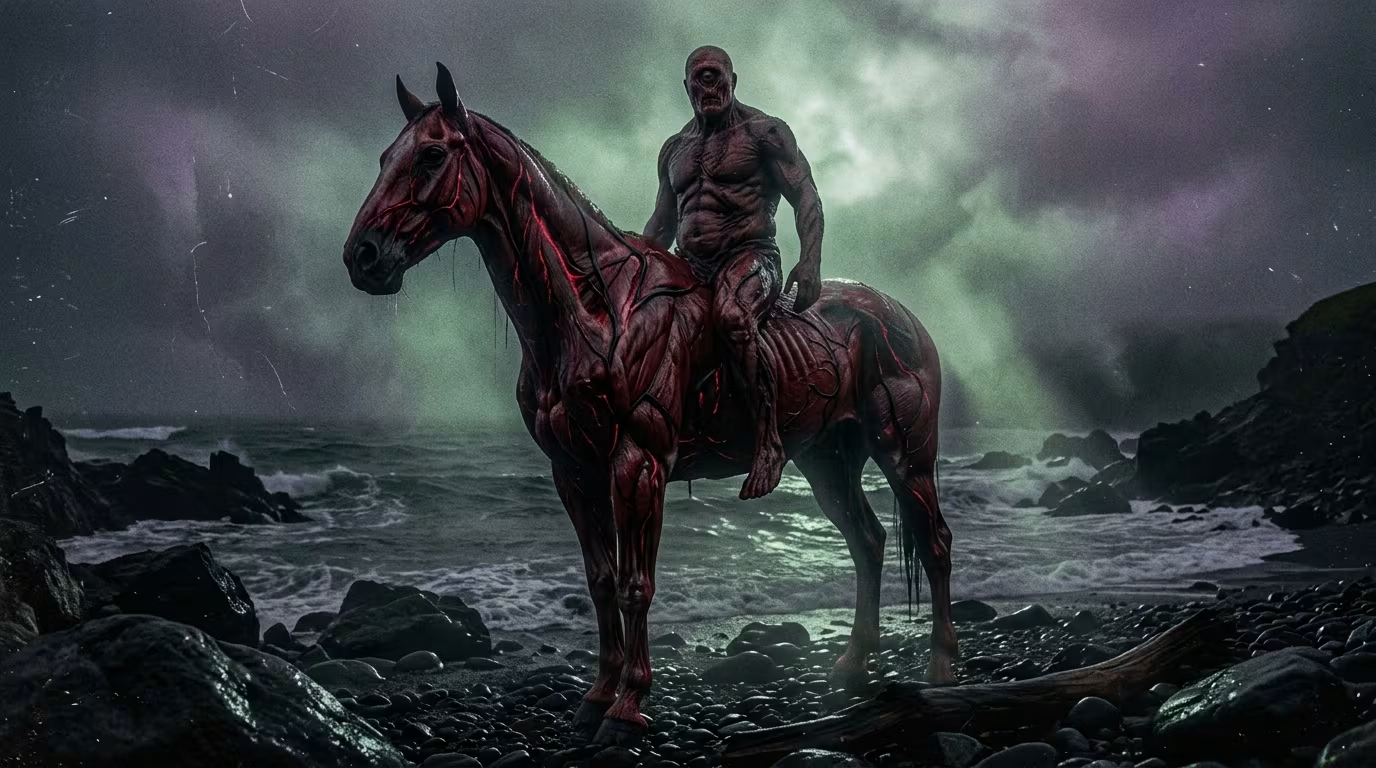
The physical guise of the Nuckelavee stands, without question, as one of the most grotesque nightmares ever spawned by the human mind—an exercise in anatomical horror that spits in the face of biology and reason. The entity manifests as a monstrous amalgamation of horse and human rider, marred by a fundamental abomination: it is utterly devoid of skin. Those who, according to the blood-chilling lore, crossed its path and lived to whisper the tale, describe the beast's musculature as entirely bare, exposed to the elements in a dark, bruised, blood-crimson hue. Thick, black, pulsing veins writhe like independent serpents across its flayed carcass, while a yellowish, viscous ichor constantly weeps and drips from the raw meat, poisoning every inch of earth it treads.
The rider, seemingly fused to the equine spine in a manner defying surgical logic, boasts grotesque proportions. Its human torso is monstrously oversized, dwarfing withered, stunted legs that sink directly into the horse's flesh, rendering dismount an impossibility. Its head is huge, lolling from side to side in an involuntary, spasmodic twitch, anchored by a single, cyclopean eye burning with an incandescent, demonic fury. Most disturbing of all is the utter lack of lips or nose; the mouth stretches in a wide, obscene gash from ear to ear, baring a row of razor-sharp teeth that exhale a pestilential stench, withering grass and rotting crops in its wake. The rider’s hands are enormous, dangling near the dirt on unnaturally long arms, cementing the impression of an ancient beast engineered solely for wreckage and slaughter.
Modus Operandi and Powers
The Nuckelavee does not operate under the cloak of subtlety; its modus operandi is total devastation and psychological terror collective. When this spawn rises from the ocean depths, its presence instantly warps the ecological and atmospheric balance of the region. Its venomous breath is said to be the source of the 'mortality,' a fulminant plague that ravaged the cattle and sheep of Orkney, striking the beasts down in agonizing convulsions within minutes. Likewise, grain harvests withered and blackened in a single night whenever the Nuckelavee rode close to the tilled fields, plunging the island communities into devastating famines.
Among its most terrifying attributes is an unnatural speed across solid ground, belying its grotesque anatomy. It can outpace and outrun the finest stallion bred by man. Yet, its most dreaded weapon remains the curse of airborne rot: the mere stench exhaled from its flayed hide is enough to sicken mortals unto death, sparking delirious fevers, hemorrhages, and a slow, agonizing expiration. Moreover, the Nuckelavee possesses the sheer physical might to shatter drystone walls and drag entire homesteads down into the surf. Its wrath swells highest through the dead of winter and on moonless nights, when it stalks the lonely tracks, hunting for some unfortunate wanderer to trample, tear apart with massive hands, and drag down into the abyssal deep.
Weaknesses and Protective Rituals
Despite being an almost invulnerable demonic force on its own turf, Orkney folklore has preserved certain slivers of hope through the Nuckelavee's weaknesses and traditional methods of defense. The most celebrated and absolute weakness of this monster hybrid is running water and, very specifically, freshwater rivers, streams, and springs. The Nuckelavee, being a creature bound to the saltwater of the deep sea and corrupted earth, is incapable of crossing a running watercourse. If a person pursued by this spawn manages to cross a stream, the monster will be forced to stop dead on the opposite bank, as the freshwater acts as an impenetrable mystical barrier that burns and repels its exposed flesh.
Another vital bulwark against the Nuckelavee is the use of purifying fire and the thick, acrid smoke of burning kelp, invoked during communal warding rites on the pivotal nights of the solstice. The ancient islanders also found that the fiend holds a deep abhorrence for fresh air and the tang of tempered metal. Local lore notes that the sole season the Nuckelavee retreats back into the ocean depths is during the swiftest weeks of summer, when direct sunlight and the clean sweep of the fields sap its resilience. Yet, trusting in this seasonal truce was a fatal mistake; village elders continually urged bolting doors, locking horses within blessed stables, and hanging iron talismans above thresholds year-round.
Documented Cases and Famous Legends
The most celebrated and well-documented account within the folkloric chronicles of the Orkney Islands regarding an encounter with this creature stars a man named Tam o' the Gloup, a brave and audacious resident of the parish of Deerness. According to oral tradition gathered by local historians, Tam had the misfortune of crossing paths with the Nuckelavee on a winter's night while riding home on horseback. Upon hearing the unmistakable, heavy gallop that shook the earth, Tam looked back and beheld the horrifying silhouette of the skinless rider pursuing him at a terrifying speed.
Knowing his ordinary mount could never outrun the monster across open country, Tam recalled the ancient warnings regarding the fiend's weaknesses. He spurred his horse northward in blind desperation, remembering a shallow burn that cut across the track ahead. The Nuckelavee shrieked in rabid fury, venting a sound like a boiling kettle hissing, promising its prey a hideous death. With the beast’s foul breath singeing his neck and beads of sickly ichor spattering his horse's flank, Tam cleared the running water by a fraction of a second. As he hit the far bank, the Nuckelavee hauled up short with a deafening screech, powerless to cross the stream. Though Tam saved his life through wit and inherited lore, his mount was so utterly shattered by the horror and the stench that it died within hours of reaching the safety of its stall.
Comparative Analysis
When analyzing the Nuckelavee within the vast spectrum of comparative world mythology, it is fascinating to trace where it intersects and diverges from other hybrid entities and water daemons across global folklore. At a glance, it bears superficial resemblances to the centaurs of Greek myth, Celtic kelpies, or even the Ahuizotl of Mexica lore, owing to its composite build and ties to deadly aquatic domains. Yet, the divergences are vital, establishing the Nuckelavee's absolute singularity. Where the centaur embodies the duality of human reason and animal wildness—frequently bearing a noble or wise undertone—the Nuckelavee stands as the antithesis of wisdom: pure destructive instinct, unadulterated chaos, and unredeemed malice.
Unlike the Scottish Kelpie, which relies on deceit, shape-shifting into a gentle steed, and luring the unwary to drown in lochs and rivers, the Nuckelavee disdains disguise and seductive cunning. Its strategy is frontal terror, the obscene display of its flayed anatomy, and direct environmental corruption through pestilence. It stands, essentially, upon a higher rung of mythological destructiveness on a grand scale: it does not hunt a single wanderer for sport, but lays waste to entire regions. This unyielding nature and its raw, skinless horror cement its place as one of the darkest and most fascinating peaks of European mythic dread—an eternal monument to the nightmares lurking in the ocean deeps and the collective memory of mankind.
📜Investigation • Frequently Asked Questions
Documentary Archive and Analysis of the Occult • Relatando.com
What exactly is the Nuckelavee in mythology?
A hybrid, monstrous fiend of the Orkney Islands, half horse and half rider, entirely stripped of skin, personifying plague, blight, and marine destruction.
Why does the Nuckelavee have no skin?
Its flesh lays bare raw red muscles and black veins due to its total lack of skin, granting it a grotesque countenance and turning its very breath into a lethal plague.
How can one escape or defend oneself against the Nuckelavee?
Its primary vulnerability is running or fresh water. The entity cannot cross a river or a spring, making a shallow brook the most reliable threshold of escape.
Do not extinguish the light yet...
If you have had the courage to make it this far, we have other dossiers that will test the limits of your sanity.

Terms and Figures of this Tale
To delve deeper into the legends, creatures, and dark concepts that inspire this account, consult their entries in our dictionary of the uncanny:



Tu correo no se publica ni se comparte con terceros: solo sirve para notificar la respuesta.