The weight of eternity is not measured in years, but in the absolute silence of a tomb sealed beneath tons of golden sand. In my mind, my fingers graze the cold plant fiber of a millenary papyrus, where the black and red ink still retains the sacred tremor of a scribe who feared the darkness as much as he desired the light. We are not dealing with a conventional literary volume, nor with a novel destined for the solace of the living. What history has christened with a name as lugubrious as The Book of the Dead is, in reality, a clandestine map, a tool for extreme survival designed to outwit the horrors lurking at the threshold of the beyond. In ancient Egypt, death was not a final stop, but the beginning of a relentless crossing through the Duat—an underworld populated by rivers of fire, demons with steel jaws, and merciless guardians who demanded to know the name secret of every soul to grant it passage. For the ancient Egyptians, whose mortal bodies were destined for decay or mummification, the true essence of the human being—the ka and the ba—it depended entirely upon this manual of magical instructions. Without it, the traveler was cast adrift into the eternal night, condemned to a second and final spiritual obliteration.
I. The Evolution of the Shadow: From Kings to Papyrus
Magic was no random divine favor; it was a survival code that men learned to chisel into stone in order to defy oblivion.
The genesis of this vast sacred geography did not spring from a vacuum. Throughout the millennia of pharaonic splendor, the imperative to armor the passage of the dead underwent a chilling mutation—a democratization of the occult that began in the loftiest echelons of absolute power and bled downward into the hands of any commoner with the coin to hire a scribe. At the dawn of the Old Kingdom, around 2400 BCE, the so-called Pyramid Texts constituted an exclusive privilege of royalty. These arcane spells were carved directly into the inner walls of the pharaohs' burial chambers, as though the very stone had to be transformed into a protective carapace against the chaos outside. As the centuries passed, during the turbulent period of the Coffin Texts, this knowledge trickled down to the nobility and the priesthood, confined within the wooden walls of the caskets. It was not until the rise of the New Kingdom, around 1550 BCE, that the phenomenon reached its ultimate maturity: the birth of the true Book of the Dead as modern archaeology knows it. One no longer needed to be a king to bargain for immortality; it was enough to possess a bespoke papyrus scroll, densely illustrated with lurid vignettes and choked with spellcraft tailored precisely to the flaws and virtues of the corpse. Nineteenth-century Egyptologists, spearheaded by figures like Jean-François Champollion, chose this moniker as they clawed open the grave goods, remaining willfully blind to its true, original title: The Book of Coming Forth by Day or Book of Emerging into the Light, a haunting paradox that distilled the desperate, consuming hunger to cross the suffocating blackness of the tomb and dissolve once more into the scorching rays of the sun god Ra.
II. The Gates of the Duat and the Weighing of the Heart
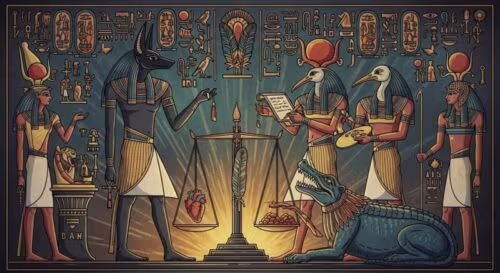
To press forward through the Duat was akin to walking through the most lucid nightmare a human mind could conceive. The Egyptian underworld was no place of rest, but a shifting, violent labyrinth where every second put the sanity and purity of the soul to the test. The pages of these sacred scrolls held an arsenal of precise answers for every contingency. If a serpent of fire crossed the path, a specific incantation existed to force it back by invoking the primordial power of Atum. If a boiling river threatened to scorch the ethereal feet of the deceased, the text provided the exact words to summon the solar barge and glide over the current unscathed. Yet, the climax of this journey did not lie in the combat against the monsters, but in the terrifying stillness of the Hall of the Two Truths. It was there that the renowned Judgment of Osiris reached its consummation. Amidst absolute silence, beneath the impassive gaze of forty-two divine judges, the heart of the deceased—the vessel of their thoughts, their guilt, and their darkest secrets—was symbolically extracted from the chest and placed upon the pan of a colossal scale. On the opposing pan rested the feather of Ma’at, the incorruptible symbol of truth, order, and cosmic justice. Anubis, the jackal-headed god, adjusted the plumb line, while Thot, the ibis-headed divine scribe, waited with reed pen poised to record the verdict. If the heart proved burdened by the weight of selfishness, deception, or cruelty, the scale would tip instantly, sealing a destiny ghastly fate: Ammit, a monstrous beast with the forequarters of a lion, the torso of a leopard, and the jaws of a crocodile, would emerge from the shadows to devour the throbbing organ, condemning the soul to absolute extinction, to the impossibility of ever existing again. But if the heart was light, as pure as the feather against which it was weighed, the deceased was declared 'true of voice' (ma’eru), securing the ultimate safe passage into Aaru, those celestial fields where rivers flow with crystal water and the harvest never knows scarcity.

III. The Silent Legacy of Eternal Magic
Hiding within every formula etched into the papyrus lies the most ancient human defiance: the refusal to accept that death is the final period at the end of our story.
Today, as we gaze upon these fragments of papyrus beneath the cold light of display cases in the world's most prominent museums, we tend to view them solely as archaeological artifacts, as dead documents of an extinct civilization. We commit a profound error. Every one of those lines inscribed in hieratic or demotic script, every stroke of ochre and Egyptian blue pigment, encloses an unyielding psychological truth: the dread visceral and persistent terror of the human being to vanish without a trace within the grand theater of the cosmos. The ancient Egyptians did not build pyramids or write books for the dead out of a macabre morbidity, but rather as a supreme act of faith in the continuity of consciousness. They taught us that memory, the precisely chosen word, and inner rectitude are the sole weapons capable of piercing the gloom of the unknown. In the end, The Book of the Dead it is not merely a guidebook for navigating the underworld of the Nile; it is the mirror in which all of us, sooner or later, must gaze when we ask ourselves what lies beyond the final breath, and whether our own burdened hearts will prove light enough to merit the dawn.
📜Investigation • Frequently Asked Questions
Documentary Archive and Analysis of the Occult • Relatando.com
What origin or documented testimony inspired this story?
This narrative draws direct inspiration from the original funerary papyri of Ancient Egypt, most notably the Papyrus of Ani and the texts preserved in the British Museum, which chronicle the arcane incantations employed by priests to pilot wandering souls through the desolate expanse of the Duat.
Which signs or anomalies herald this phenomenon?
Within the context of archaeological folklore, the signs that a soul was in peril within the underworld included the apparition presence of faceless guardian demons, uncontrollable rivers of fire, and the ultimate trial of the weighing of the heart before the forty-two judges of Osiris.
Is there any documented psychological or scientific explanation?
From the standpoint of depth psychology and cultural anthropology, the Book of the Dead embodies the externalization of our dread of mortality and human guilt, operating as a primordial psychotherapeutic apparatus designed to channel grief and impose order upon the terrifying transition into oblivion.
How do folklore and tradition react to this case?
Western tradition has simultaneously romanticized and demonized these texts, warping them in modern popular culture into synonyms for black magic and ancestral maledictions, whereas their true, foundational purpose was strictly apotropaic, redemptive, and spiritually restorative.
Do not extinguish the light just yet...
If you have had the courage to make it this far, we have other dossiers that will test the limits of your sanity.

Terms and Figures of this Tale
To delve deeper into the legends, creatures, and dark concepts that inspire this account, consult their entries in our dictionary of the uncanny:

Tu correo no se publica ni se comparte con terceros: solo sirve para notificar la respuesta.