Within the impenetrable mists of the Chiloé archipelago, where the boundary between tangible reality and the myth fades away with the tide, lurks one of the most terrifying and singular creatures of Mythology South America: the Chilote Basilisk. Unlike its European counterpart, this spawn is not born from a chicken egg hatched by a toad, but from an even more unsettling process tied to black magic and the decay of southern households. As a seeker of mysteries, venturing into this southernmost corner means discovering that barns and the damp spaces beneath wooden houses harbor more than just winter provisions—they conceal horrors capable of withstanding life itself with a single exhale.
Classified File
- Origin: Chiloé archipelago, southern Chile. Chilote mythology and local witchcraft.
- Nature: Malevolent theriomorphic entity, a hybrid of reptile and malformed bird.
- Hazard Level: Extreme. Lethal capacity through asphyxiation, a petrifying gaze, and a family curse.
- Weaknesses: Mirrors, sacred fire, prayers of protection, and the ritual cutting of the hen that lays its egg.
Origin and Etymology
The term 'Basilisk' derives from the Greek basiliskos, meaning 'little king.' However, the transculturation that took place in southern Chile during the colonial era utterly transformed the classical concept inherited from Pliny the Elder. In Chiloé, the Legend merged with the dark practices attributed to the 'Recta Provincia,' the influential brotherhood of sorcerers that once ruled the islands. According to oral tradition gathered by various ethnographers over the centuries, the Chilote Basilisk does not arise spontaneously; it is manufactured. It is born from a tiny, yolkless egg laid by an aged hen (often the last of the season or a brooding hen under strange conditions), artificially incubated beneath human body heat—typically tucked into the armpit for a designated period—or concealed within the darkest corners of sheds and barns.
Folk etiology maintains that local sorcerers initiate this cursed cycle to exact vengeance upon neighbors or consolidate their power within the community. Upon hatching, creature the creature takes on a diminutive yet intensely lethal form. Its etymological and cultural bond with the southern barns stems from the fact that these dark, damp spaces—stuffed with organic matter and livestock—provide the absolute microclimate for the gestation of such domestic terrors. The stilt-house architecture and Chilote sheds, built from noble woods like larch and cypress, thus become the ideal breeding ground for this rural legend that persists relentlessly within the island's collective unconscious.

Anatomy and Appearance
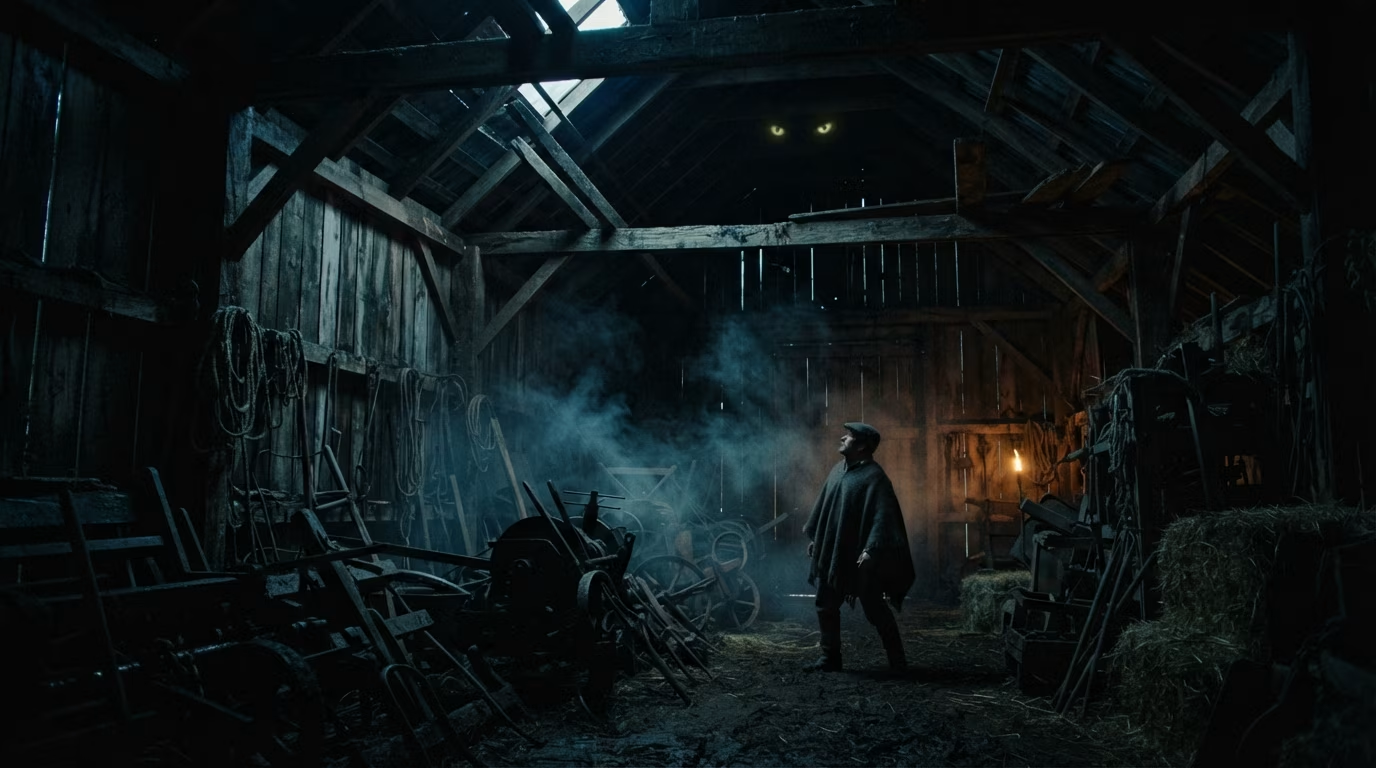
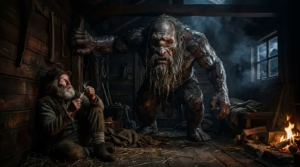
Describing the exact morphology of the Chilote Basilisco is a complex task, since most direct witnesses rarely survive the encounter or are left deeply traumatized. Nevertheless, the chronicles of the ancient inhabitants of Ancud, Castro, and Quellón concur on certain aberrant patterns. It is frequently described as a small creature—similar to a plucked chicken or a deformed lizard—yet endowed with a grotesque and unnatural ugliness. It possesses a bulbous, gelatinous body covered in scaly skin of yellowish and greenish hues, emanating a nauseating stench reminiscent of sulfur and rotting flesh.
Its head is an anatomical nightmare: a hooked, horny beak akin to that of a diseased rooster, yet with jaws teeming with diminutive teeth as sharp as needles. Its eyes are the most dreaded feature; two yellow orbs, bloodshot, that glow in the dark with a phosphorescent and malevolent light. The limbs are short but end in disproportionately long, hooked claws, designed to clutch the wooden beams of barns. The Basilisk's anatomy obeys no laws of conventional biology; it is a physical manifestation of chaos and human wickedness, an accumulation of dark energies condensed into a fragile body lethally venomous at its core.
Modus Operandi and Powers
The Chilote Basilisk operates in a manner as subtle as it is devastating. The creature does not attack its victims directly through brute force, but through its environment and its supernatural faculties. Once the Basilisk takes up residence in the foundations of a house or the upper reaches of a barn, it begins its work of attrition. It feeds on the emanations of life, on the milk of the livestock, and above all, on the vital breath of the household's inhabitants. By night, it descends stealthily from the rafters into the rooms or the stables.
Its primary weapon is the 'lethal breath.' It is said the creature exhales a fetid, invisible vapor that slithers through the cracks of doors and windows. Should a human or beast inhale this cursed air, they are instantly seized by a fulminant asphyxiation—a dry drowning that paralyzes the lungs and distorts the victim's face, leaving them fixed in a grimace of Horror eternal agony. Farm animals, especially cows and horses, are the first to succumb: they are found dead at dawn, rigid and entirely drained of blood or desiccated from within, without a single visible wound. Furthermore, it possesses a paralyzing gaze; any peasant who crosses paths with its yellow eyes in the barn's gloom will suffer instant madness or a progressive physical wasting that drags them to the grave within days.
Weaknesses and Protective Rituals
Despite its fearsome and lethal nature, the Chilote Basilisk is not invulnerable. Over the centuries, the traditions of the archipelago have developed a strict set of defensive methods and purification rituals to neutralize the beast before it claims the lives of an entire family. The most famous and effective weakness against this entity is the use of mirrors. Because the Basilisk possesses a profoundly narcissistic and malignant nature, upon seeing itself reflected in a mirror placed strategically at the barn entrance or beneath the bed, the creature suffers a fulminating psychic collapse when confronted with its own ugliness and evil, dying instantly or fleeing in terror toward the deep forests.
Another traditional method involves burning sacred herbs and fumigants prepared with rue, frankincense, and camphor, whose smoke purifies the air and drives out the foul pestilence of the monster's breath. Likewise, if there is suspicion that the cursed egg has been laid in the hen house, locals turn to a local specialist—often a machi or a healer well-versed in counter-magic—to conduct an exhaustive search, locate the egg, and destroy it with sacred fire before it hatches, thereby severing the dark pact that birthed it.
Documented Cases and Famous Legends
In the annals of Chiloé's oral tradition, accounts abound of entire families who, overnight, lost their livestock and watched their members sicken without any medical explanation. One of the most celebrated cases recorded by local chroniclers in the early twentieth century occurred in the vicinity of Dalcahue, where a prosperous farmer began to notice that his dairy cows were found inert in the barn at dawn, eyes glazed and bodies cold as ice, despite being well fed and sheltered.
Desperate in the face of economic ruin and the sudden illness of his youngest daughter, who had begun to cough up a blackish liquid and waste away in bed, the patriarch consulted an old sage of the community. The diagnosis was clear: a Basilisco had been introduced into his barn through neighborly envy. After placing large pocket mirrors on the main beams and burning branches of maqui and canelo for three consecutive nights, the family heard a harrowing shriek from the roof. At dawn, the lifeless body of a reptilian creature of strange proportions lay charred beside the foundation stones. The daughter, miraculously, began to recover on the third day, consolidating once more the veracity of this myth in the southern imagination.
Comparative Analysis
When subjecting the Chilote Basilisco to a comparative analysis within cryptozoology and comparative mythology, it is fascinating to observe how a medieval European concept mutated radically in the New World. The European basilisk, immortalized in medieval bestiaries and contemporary popular culture, is a gigantic serpent or a rooster with a serpent's tail whose principal weapon is instantaneous visual petrification: whoever looks into its eyes dies or is turned to stone immediately.
By contrast, the Chilote Basilisk is a far more intimate and domestic entity, deeply rooted in rural life and island witchcraft. It does not seek to strut through grand palaces or deserts, but to hide in the dark corners of granaries and beneath wooden dwellings. Its lethal power lies not solely in its gaze, but fundamentally in its pestilent, suffocating breath—an invisible assault that contaminates the air of the home. Whereas the European basilisk is a heraldic monster of antiquity, the Chilote one is a living incarnation of communal tensions, envy, and the deepest fears of the inhabitant of southern Chile.
📜Investigation • Frequently Asked Questions
Documentary Archive and Analysis of the Occult • Relatando.com
How is the Chilote Basilisk born?
It is born from a yolkless egg laid by an old hen, incubated artificially through black magic or in the darkness of granaries under the influence of local sorcerers.
What is this monster's primary weapon?
Its primary weapon is its lethal breath, a fetid vapor that suffocates and instantly kills people and animals who inhale it at night.
How can the Basilisk be warded off or killed?
Its greatest weakness is mirrors. Upon seeing its own reflection, the creature suffers a fulminating collapse brought on by its own evil. Incense burnings and sacred fire are also employed.
How does it differ from the European basilisk?
The European kills with a single glance and is a classic serpent. The chilote dwells in granaries, strikes with its venomous breath, and is bound to island witchcraft.
Do not extinguish the light yet...
If you have had the courage to make it this far, we have other dossiers that will test the limits of your sanity.

Terms and Figures of this Tale
To delve deeper into the legends, creatures, and dark concepts that inspire this account, consult their entries in our dictionary of the uncanny:


Tu correo no se publica ni se comparte con terceros: solo sirve para notificar la respuesta.