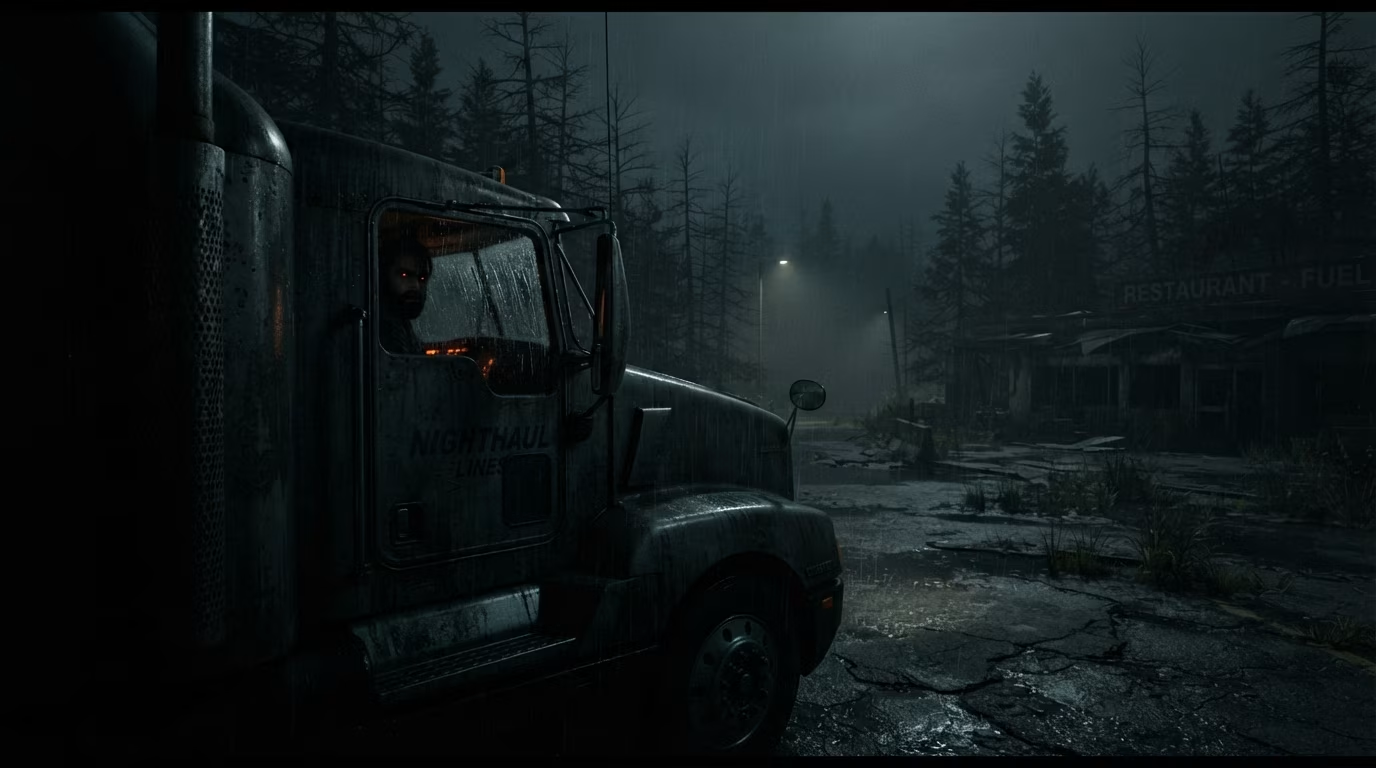
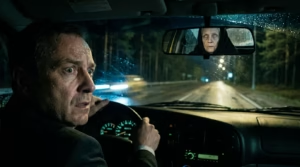
The tachograph showed no mercy. Mateo had spent thirteen hours swallowing asphalt, the stale taste of black tobacco stuck to his palate and his eyelids heavy as lead blocks. When the white lines of the highway began to double under the tired beam of the headlights, he knew his body had said enough. At kilometer 142 of the A-2, a turnoff toward a rest area marked with a cross of police tape and concrete blocks opened on his right. There were no lights. The solar streetlamps lay broken, their bare wires writhing like copper guts in the wind of the meseta. He shut off the Scania's engine. Suddenly, the muffled roar of the diesel vanished, giving way to a dense, sepulchral silence, broken only by the metallic creak of the chassis as it cooled and the rhythmic tap of fine rain against the windshield.
I. The Dead Asphalt
The cab reeked of lukewarm coffee, of dried sweat accumulated over days on the road, and of the cheap plastic of the overheated dashboard. Mateo rubbed his face with rough hands, feeling the stiff beard scraping his palms. Outside, the darkness was a solid block, a blackish paste that swallowed the outlines of the scrawny pines bordering the abandoned area. He pulled out a half-full plastic bottle, drank a swig of warm water that tasted of chlorine, and settled in to recline the seat and scratch out at least three hours of sleep before the sun bleached the horizon.
Then he heard it. It was not a mechanical sound. The damp asphalt creaked under an unnatural weight, a dry, heavy impact that made the cab's step tremble. Something walked slowly around the semi-trailer. Mateo stayed motionless, the water bottle suspended halfway to his mouth. The sound repeated: a dull blow, almost organic, rhythmic. Thud, thud, thud. As if an enormous, splintered hoof struck slabs of broken concrete. The air inside the cab suddenly became unbreathable, charged with a sour stench of wet fur, rotting earth and flaying that penetrated the door seams with the insistence of a gas.

II. The Mirrors
The temptation to switch on the dome light crossed his mind, but he dismissed it at once. Instinct, that old animal dwelling at the base of his skull, ordered him to stay blind. Slowly, millimeter by millimeter, he turned his head toward the left side mirror. The convex glass returned the distorted image of the trailer's gray tarp lashed by the wind and, beyond it, the compact blackness of the pine forest. But there was something else. At the height of the passenger window, floating in the outer gloom without a body to support them, two red points glowed. They were not brake lights or the LEDs of an antenna. They were two damp embers, elongated horizontally, watching him from the impossible height of three meters. They emitted a dull, feverish glow that illuminated nothing around them, but seemed to absorb the scant light of the night.
If I turn the key and start it right now, the concrete block in front will smash the oil pan before the turbo builds pressure.
The thought hung suspended in his throat. The two red points slid backward with an unsettling fluidity, grazing the aluminum panel with a metallic, rasping sound, as though an immense and filthy nail were caressing the container. Mateo clenched his fists against his thighs so hard that his nails bit into the flesh, seeking a physical pain to anchor him to reality. Outside, the weight struck the rear of the truck again, this time with enough force to make the forty-ton bulk sway like a nutshell adrift on water.
III. The White Silence
Dawn took an eternity to seep through the mist of the A-2, a filthy gray that slowly etched the outlines of the dead pines and the traffic signs torn out by the roots. When the first pale rays pierced the windshield, the stench of rot had dissipated, leaving only the metallic reek of rust and burnt oil. Mateo had not slept. His eyes were bloodshot, his jaw numb from gnawing at his lips, and a fine, constant tremor in his hands kept him from holding the wheel steady.
He glanced in the rearview mirror. There were no tracks in the dried mud around the rear wheels. Only the tarp of the trailer bore deep vertical tears, as though four rusted blades had slashed it from top to bottom. He turned the ignition key. The engine coughed out a mouthful of black smoke before settling into a familiar purr. He shifted into first, pressed the accelerator, and the truck lurched onto the highway on-ramp, pulling away from the accursed lay-by. Yet as he merged into the morning traffic and saw his own face reflected in the window glass, Mateo noticed that something was still there, crouched at the bottom of his pupils, looking outward from a darkness that no longer belonged to kilometer 142, but to his own head.
📜Investigation • Frequently Asked Questions
Documentary Archive and Analysis of the Occult • Relatando.com
On what myth or dread reality is this tale based?
It feeds upon the Horror visceral transition to vulnerability on desolate secondary night roads and the urban legends concerning the creatures of depopulated rural Spain.
Are there documented real cases similar to this story?
There are no official records of supernatural entities, yet there are chronicles of atrocities and disappearances at secluded rest stops.
What does the ending of the story mean?
It represents the irreversible invasion of trauma; the monster threat is no longer outside, but firmly entrenched within the protagonist's psyche.
Do not extinguish the light yet...
If you have had the courage to make it this far, we have other dossiers that will test the limits of your sanity.

Terms and Figures of this Tale
To delve deeper into the legends, creatures, and dark concepts that inspire this account, consult their entries in our dictionary of the uncanny:

Tu correo no se publica ni se comparte con terceros: solo sirve para notificar la respuesta.